The Corporate Controller has traditionally been associated with financial reporting, accounting accuracy, the close, and internal controls. Those responsibilities remain central to the profession, but they no longer tell the full story of what many controllers are responsible for today.
The inaugural Controllership 2030: The Future of the Corporate Controller study from Controllers Council surveyed more than 300 corporate finance executives and professionals across North America to examine how the role is changing and what controllership could look like by 2030.
The first question establishes an important baseline: What are the controller’s top responsibilities today?
Financial reporting remains at the top. But the results show a profession that has already expanded considerably beyond historical accounting responsibilities.
Financial Reporting Still Leads the Controller’s Mandate
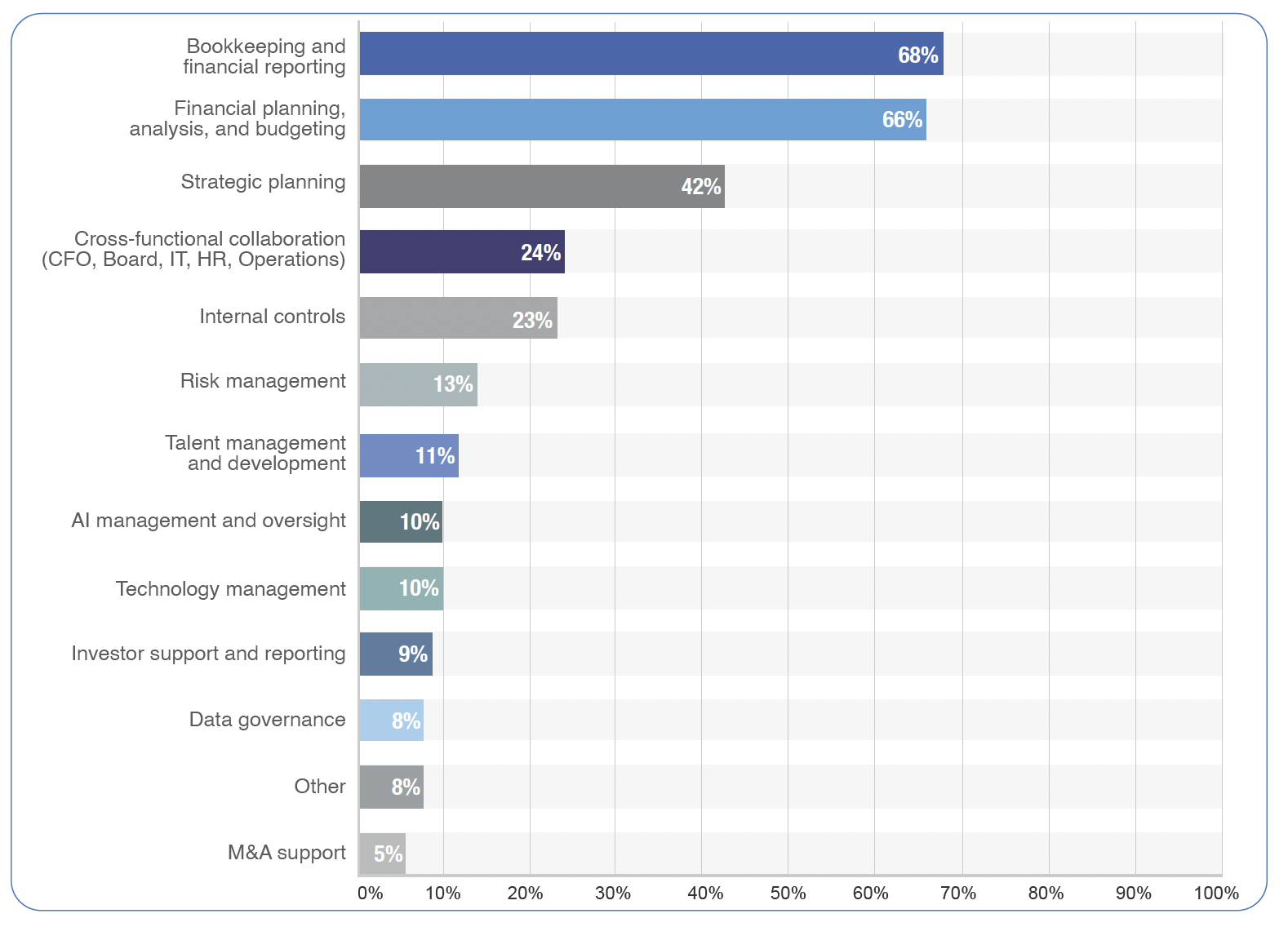
Respondents were asked to select their top three duties or responsibilities today.
Bookkeeping and financial reporting ranks first at 68%, closely followed by financial planning, analysis, and budgeting at 66%. Strategic planning ranks third at 42%.
At first glance, the top result may seem unsurprising. Reliable financial reporting remains one of the fundamental responsibilities of controllership.
The more interesting finding is what sits immediately beside it.
FP&A Is Nearly as Prominent as Financial Reporting
At 66%, financial planning, analysis, and budgeting trails bookkeeping and financial reporting by only two percentage points.
That is a meaningful indication of how much the controller role has already evolved.
Controllership is sometimes described as primarily backward-looking, with the CFO and FP&A organization responsible for forward-looking planning and strategy. The survey suggests that distinction is considerably less clear in practice.
Many controllers appear to operate on both sides of the financial timeline.
They remain responsible for ensuring that historical financial information is accurate and reliable, while also contributing to budgets, forecasts, analysis, and decisions about what happens next.
The report describes this as controllers combining stewardship responsibilities with forward-looking financial management.
That combination is important because it places the controller in a particularly valuable position within the finance organization.
Controllers understand how financial information is created. They understand the accounting policies and controls behind the numbers. They often understand where the data comes from, which assumptions affect it, and where its limitations lie.
When that knowledge is brought into planning and analysis, the controller can provide context that goes beyond reporting the result.
Strategic Planning Is Already a Major Controller Responsibility
The third-ranked responsibility may be even more revealing.
Forty-two percent of respondents identify strategic planning among their top three responsibilities today.
Strategic planning is no longer a peripheral activity for a significant share of controllers.
This can include evaluating investment decisions, modeling business scenarios, supporting resource allocation, assessing the financial implications of operational decisions, and helping management understand the tradeoffs associated with different courses of action.
The controller’s contribution to these discussions is distinct from simply producing the underlying financial information.
It requires interpretation.
A controller participating in strategic planning needs to explain what the numbers mean, identify assumptions that could change the outcome, recognize financial and control implications, and help leadership understand the consequences of different decisions.
That begins to move controllership from financial reporting toward financial decision support.
And according to the study, that transition is already underway.
Controllers Are Becoming More Cross-Functional
Another 24% identify cross-functional collaboration with the CFO, Board, IT, HR, Operations, and other stakeholders among their top responsibilities.
That may appear modest compared with the leading finance responsibilities, but it reflects an important change in how the controller operates.
Many of the issues affecting financial performance originate outside accounting.
Revenue processes may depend on sales systems.
Inventory accuracy depends on operations and supply chain processes.
Payroll and workforce costs intersect with HR.
Technology investments require coordination with IT.
Data used for reporting may originate across multiple applications and business functions.
As finance systems become more integrated with the rest of the enterprise, controllers increasingly need to understand processes that extend beyond the general ledger.
Cross-functional collaboration is therefore becoming less of a soft skill and more of an operating requirement.
A controller cannot effectively govern financial information without understanding the business processes and systems that produce it.
Internal Controls Remain Important, Even as the Control Environment Changes
Internal controls rank fifth at 23%.
That number should not necessarily be interpreted as suggesting controls are becoming less important. Respondents were limited to selecting their top three responsibilities, which naturally concentrates responses among the broadest areas of responsibility.
Control remains fundamental to the controller’s role.
What is changing is the environment in which those controls operate.
Historically, controllers could focus heavily on controls around employees, approvals, reconciliations, journal entries, and accounting systems.
Increasingly, financial information passes through integrated applications, automated workflows, analytics platforms, and AI-enabled systems before reaching financial statements or management reports.
The fundamental responsibility remains familiar: ensure that financial information is reliable.
The mechanisms required to provide that assurance are becoming more complex.
This becomes particularly important as the study moves from today’s responsibilities toward expectations for 2030.
Technology and AI Are Still Relatively Small Parts of Today’s Mandate
One of the most useful aspects of the first survey question is the baseline it establishes for technology-related responsibilities.
Only 10% identify AI management and oversight among their top responsibilities today.
Technology management is also selected by 10%, while data governance stands at just 8%.
Those figures are striking when compared with where respondents expect the profession to go.
They suggest that most controllers have not yet reached a point where AI, technology, or data governance dominates their day-to-day leadership agenda.
That is reasonable.
Many finance organizations are still early in implementing AI within core accounting processes. The study finds that current AI and automation adoption is heavily concentrated in accessible tools such as AI assistants rather than deeply embedded accounting automation.
But the relatively low current percentages create an important benchmark.
The controller of today is already broader than the traditional accounting stereotype, yet some of the largest changes anticipated for the profession have barely begun.
The Controller Is Already Operating Across Three Roles
Taken together, the findings suggest that today’s controller increasingly operates across three overlapping responsibilities.
The first is financial stewardship.
Controllers remain responsible for accurate reporting, accounting processes, controls, and the integrity of financial information.
The second is financial management and analysis.
The near-equal ranking of FP&A and financial reporting shows how deeply many controllers are already involved in budgeting, forecasting, analysis, and forward-looking financial management.
The third is business partnership.
Strategic planning and cross-functional collaboration indicate that many controllers are participating more directly in decisions that affect the broader enterprise.
These responsibilities require different capabilities.
Financial stewardship requires technical accounting knowledge, rigor, and control.
Planning and analysis require analytical capability and an understanding of business drivers.
Business partnership requires communication, judgment, and the ability to translate financial information into decisions.
The controller role has therefore already become more multidimensional, even before considering the additional technology and governance responsibilities expected over the next several years.
Why This Baseline Matters for 2030
Understanding today’s controller responsibilities is essential because the most interesting findings in the study come from comparing the current mandate with expectations for 2030.
The study does not suggest that financial reporting disappears.
Instead, respondents expect the relative allocation of controller attention to change.
As technology assumes more transaction processing, reconciliation, reporting preparation, and routine analysis, controllers may be able to devote more attention to interpretation, planning, governance, and decision support. The report identifies this shift directly, noting that controllers are unlikely to relinquish responsibility for reliable financial information even if less leadership attention is required to produce it.
That distinction is critical.
Automation does not eliminate accountability.
If a reconciliation is automated, finance still needs confidence that it was performed correctly.
If AI generates an analysis, someone still needs to evaluate its accuracy and relevance.
If financial reporting becomes more automated, the organization still needs an executive accountable for the integrity of the result.
The controller’s role may therefore become broader precisely because the mechanics of accounting become more automated.
The Future Controller May Spend Less Time Producing Information and More Time Using It
The first question in the Controllership 2030 study ultimately provides a snapshot of a profession already in transition.
Financial reporting remains the leading responsibility at 68%.
But FP&A is almost equal at 66%, and strategic planning already ranks among the top three responsibilities for 42% of respondents.
Controllers are already moving beyond a narrow reporting mandate.
The next stage may accelerate that transition.
As routine accounting activities become more automated, the value of the controller may increasingly come from understanding the information those systems produce, maintaining confidence in its integrity, and applying it to decisions.
That does not make accounting expertise less important.
It changes where that expertise creates value.
The controller of 2030 may spend less time overseeing the production of financial information and more time interpreting it, governing it, and helping the organization act on it.
And as the remaining findings in the study show, finance leaders expect that shift to be substantial.
What This Means for Controllers and CFOs
The current-state findings provide several questions finance leaders should consider now:
- How much of the controller’s time is still devoted to producing financial information versus interpreting it?
- Is the controller sufficiently involved in budgeting, forecasting, and strategic planning?
- Where could recurring accounting work be automated to create additional leadership capacity?
- Does the controller have enough visibility into the operational processes and systems that produce financial data?
- Are technology, AI, and data responsibilities beginning to enter the controllership function?
- Which capabilities will the controller need if strategic and governance responsibilities continue expanding?
- Is the finance organization developing the controller role around where the function is going, or primarily around where it has historically been?
The answers will differ by organization.
But the study establishes an important starting point: the modern controller is already more than the organization’s senior accounting and reporting executive.
The role increasingly combines stewardship, financial management, analysis, and business partnership.
By 2030, respondents expect that combination to expand considerably further.
Explore the Full Controllership 2030 Study
The controller’s responsibilities today provide the baseline for a much larger transformation explored throughout Controllership 2030: The Future of the Corporate Controller.
The full study examines how controller responsibilities may change by 2030, where AI and automation are expected to have the greatest impact, how finance organizations could be restructured, which governance responsibilities will grow, what skills future controllers will need, and how the relationship between the Controller and CFO may evolve.
Download Controllership 2030: The Future of the Corporate Controller
About the Study Sponsor

Built on insightsoftware’s decades of finance software expertise, Lineos brings finance into focus. It gives teams a single line of sight across the full financial workflow, from budgeting, planning, and reporting through close, consolidation, reconciliation, tax, disclosure, and lease. At every stage, Lineos pulls diverse data from across the business into one place, with powerful AI surfacing the insights that drive action. By freeing finance from spreadsheet forensics and chasing numbers, Lineos enables them to move from reporting the past to shaping what’s next, equipped with the tools they need to drive better decisions and unlock breakthrough insight.