As AI becomes more deeply embedded in finance, the controller’s responsibility for financial governance is expanding with it.
The Controllership 2030: The Future of the Corporate Controller study asked finance leaders which emerging governance responsibilities they expect to become more important for controllers by 2030.
The results were decisive.
Eighty percent identified AI governance, making it the leading emerging governance responsibility by a wide margin. Data governance followed at 64%, while 59% selected cybersecurity oversight.
These findings point to an important evolution in controllership. Financial information increasingly moves through interconnected applications, data platforms, automated workflows, and AI-enabled systems. Controllers remain responsible for the reliability of that information, which means their oversight increasingly extends to the technology and data involved in producing it.
In that environment, technology governance is becoming financial governance.
AI Governance Tops the Controller’s Emerging Responsibilities
Respondents identified the governance responsibilities they expect to become more important for controllers by 2030:
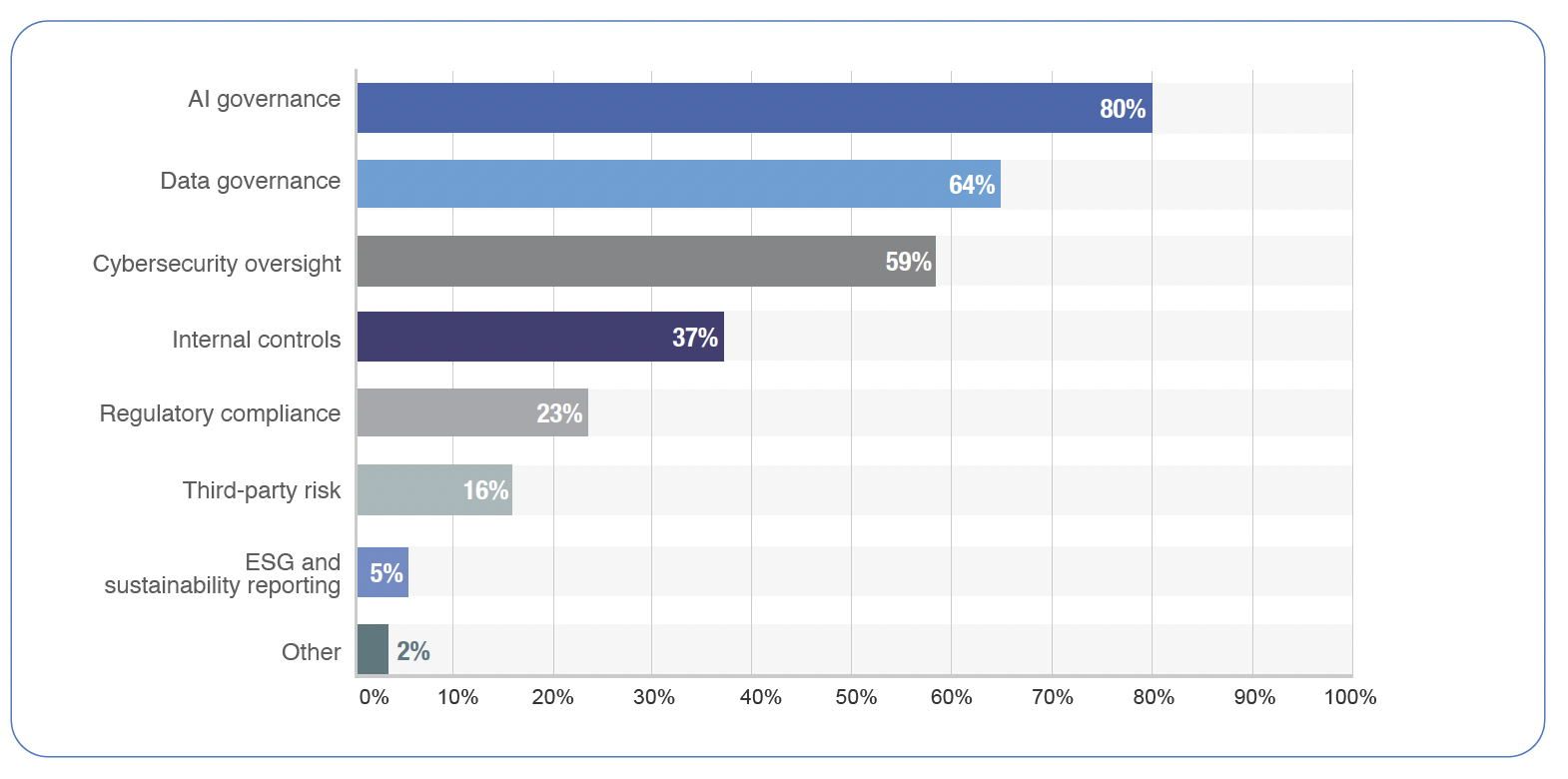
AI governance stands out immediately.
Four out of five respondents expect it to become more important for controllers.
That is particularly significant because AI management and oversight is still a relatively small part of the controller’s current mandate. Only 10% identify it among their top responsibilities today.
By 2030, that figure rises to 34%.
The governance results reinforce the same direction of travel. As AI moves from employee productivity tools into forecasting, reconciliations, reporting, accounting workflows, and autonomous agents, controllers will increasingly need to understand how those systems affect financial processes.
AI Governance in Finance Is Ultimately About Trust
AI governance can sound like a technical discipline, but many of its core questions are familiar to controllers.
- Can the organization rely on the output?
- What data was used?
- Who has access?
- Who reviewed the result?
- What happens when the system is wrong?
- Can the organization explain how a decision or conclusion was reached?
- Is there sufficient documentation?
- Who is ultimately accountable?
These questions closely resemble the principles that already underpin financial controls.
The difference is that the work may increasingly be performed or influenced by AI.
If an employee prepares an analysis, organizations have established ways to assign responsibility, review the work, maintain supporting documentation, and escalate unusual issues.
When AI generates part of the analysis, performs part of a reconciliation, or recommends an accounting action, those same expectations do not disappear.
The organization still needs confidence in the result.
The More AI Executes, the More Governance Matters
The need for AI governance becomes clearer when considered alongside the study’s expectations for future adoption.
By 2030, 50% of respondents expect their teams to use autonomous accounting agents. Forty-nine percent expect automated reconciliations. Forty percent anticipate automated reporting, while predictive forecasting reaches 59%.
These technologies move AI closer to the execution of finance work.
That changes the risk profile.
An AI assistant used to summarize a document presents a different level of financial risk than an automated system participating in a reconciliation or producing information used in a forecast.
Controllers will therefore need governance that reflects the consequence of the use case.
Low-risk applications may require relatively simple guidelines and review.
Processes that affect financial reporting, accounting records, liquidity decisions, compliance, or other significant financial matters may require more rigorous controls.
The question is no longer simply whether AI is permitted.
Controllers increasingly need to determine where AI can be trusted, under what conditions, and with what level of human oversight.
Data Governance Is Closely Connected to AI Governance
Nearly two-thirds of respondents, 64%, expect data governance to become more important for controllers.
That finding is inseparable from the rise of AI.
AI systems depend on data.
If the underlying information is incomplete, inconsistent, outdated, incorrectly classified, or inaccessible, the quality of the output will suffer regardless of how sophisticated the technology may be.
For finance, this is particularly important because financial data often comes from multiple systems and business processes.
ERP platforms, CRM systems, payroll applications, planning tools, banking systems, expense platforms, operational applications, and spreadsheets may all contribute information used by finance.
As AI begins to analyze or act on that information, questions of data ownership and quality become more consequential.
Controllers may need greater visibility into where financial data originates, how it changes, who can modify it, how systems define it, and which data sources automated processes are permitted to use.
In a manual environment, an experienced finance professional may recognize that a particular data set is incomplete or requires adjustment.
An automated process may not make that distinction unless the system has been designed to do so.
That makes reliable data a prerequisite for reliable automation.
Cybersecurity Is Becoming a Finance Issue
Another 59% of respondents expect cybersecurity oversight to become a more important controller responsibility.
Controllers are unlikely to replace chief information security officers or technical cybersecurity teams.
But the financial consequences of cybersecurity make it increasingly difficult for finance leadership to treat security as exclusively an IT concern.
Financial systems contain sensitive information.
Automated workflows rely on system access.
AI tools may connect to financial data.
Payment processes can be targeted by fraud.
Compromised credentials can affect accounting systems, reporting, banking, payroll, and other critical functions.
As financial processes become more connected, controllers need to understand whether appropriate protections surround the systems and data on which finance depends.
Their role may center on financial risk, access controls, segregation of duties, business continuity, and the integrity of financial information rather than technical cybersecurity operations.
That still represents a meaningful expansion of the traditional control environment.
Internal Controls Will Need to Extend Beyond Human Work
Internal controls remain a core component of controllership, and 37% identify them as an emerging governance responsibility that will become more important.
The nature of those controls, however, may change.
Traditional controls were often designed around human activity.
One employee prepares an entry. Another approves it.
An accountant completes a reconciliation. A manager reviews it.
A report is generated. Someone verifies the information before distribution.
When portions of those workflows become automated, organizations need to reconsider where control activities should occur.
An automated system does not need the same supervision as an employee, but it does require governance.
- Who can change its configuration?
- What permissions does it have?
- What happens when a transaction falls outside established parameters?
- Are changes tested?
- Are automated decisions logged?
- How are exceptions reviewed?
- How frequently is performance validated?
The control environment must increasingly cover both people and technology.
Automated Work Still Requires Accountability
One of the most important principles for controllers is that automation does not transfer accountability to the technology.
An AI system cannot assume executive responsibility for the financial statements.
An automated reconciliation cannot be accountable for an incorrect balance.
A forecasting model cannot explain a missed business assumption to the board.
Someone within the organization remains responsible.
This becomes particularly important as automated systems become more capable.
The more work technology performs independently, the easier it may become for employees to assume that the system is correct.
That creates the risk of automation bias: people may give too much weight to a technology-generated result simply because it was produced by the system.
Controllers can help establish the opposite expectation.
AI-generated work should be subject to a level of scrutiny appropriate to its risk and materiality.
The objective is not to manually redo everything the technology produces. That would undermine the value of automation.
The objective is to create enough oversight to know when the organization can rely on the result.
Controllers Will Need to Define Human Review
Human review is likely to become one of the central design decisions in automated finance.
Requiring a person to review every automated action can limit efficiency.
Allowing technology to act without appropriate review can create unacceptable risk.
The right balance depends on the process.
Routine, low-risk activities may be able to operate with exception-based monitoring.
Higher-risk or unusual activities may require explicit approval.
Material financial judgments may remain firmly human.
Controllers are well positioned to help establish those boundaries because they already evaluate processes through the lenses of risk, materiality, controls, and accountability.
The future control environment may increasingly depend on determining when a human needs to enter the workflow rather than placing a human at every step.
Governance Should Begin Before AI Is Fully Embedded
Organizations should not wait until AI performs significant financial work before developing governance.
By that point, tools may already be connected to sensitive information, employees may have established their own practices, and automated processes may be difficult to unwind.
Controllers can begin by understanding how AI is being used within finance today.
- Which tools are employees using?
- What information can those tools access?
- Which outputs influence financial decisions?
- Are employees validating AI-generated work?
- Are there approved and prohibited use cases?
- Who owns AI-related risks within finance?
- What documentation is required?
- How are automated processes monitored?
These questions can establish a governance foundation while adoption is still developing.
As use cases become more sophisticated, the framework can mature with them.
AI Governance Cannot Belong to Finance Alone
Although controllers are expected to play a larger role, AI governance is inherently cross-functional.
Finance brings expertise in accounting, controls, financial risk, materiality, and reporting.
IT understands architecture, integration, access, and system administration.
Cybersecurity brings expertise in security threats and protections.
Legal and compliance teams may address regulatory, contractual, privacy, and liability issues.
Business leaders understand how the technology is being used operationally.
Internal audit may provide independent assessment of controls and governance.
Effective AI governance requires these perspectives to work together.
The controller’s role is therefore unlikely to involve owning every aspect of enterprise AI governance.
Instead, controllers may become responsible for ensuring that AI used within financial processes meets the standards required for reliable financial management.
What This Means for Controllers and CFOs
The finding that 80% of finance leaders expect AI governance to become more important for controllers should prompt organizations to consider whether their current governance models are keeping pace with adoption.
Controllers and CFOs should be asking:
- Which AI systems currently interact with financial information or finance processes?
- Who owns the accuracy of AI-generated financial work?
- What data can AI systems access?
- How are AI-generated outputs validated?
- Which activities require human review?
- How are exceptions identified and escalated?
- Are automated decisions sufficiently documented and traceable?
- Who can change automated rules, models, or configurations?
- How do cybersecurity controls protect AI-enabled financial processes?
- Are responsibilities across finance, IT, security, legal, and internal audit clearly defined?
These questions will become increasingly important as AI moves deeper into finance.
Technology Governance Is Becoming Financial Governance
The controller has always been responsible for trust.
Management, boards, investors, auditors, regulators, lenders, and other stakeholders rely on finance to produce information they can use with confidence.
The systems producing that information are changing.
By 2030, finance leaders expect AI to play a substantially larger role in forecasting, accounting processes, reconciliations, reporting, risk monitoring, compliance, and other activities.
That means controllers will increasingly need to govern an environment in which financial work is performed by both people and technology.
The fundamental objective remains the same: reliable information, effective controls, appropriate oversight, and clear accountability.
What changes is the scope of what must be governed.
As technology becomes part of the financial process, governing the technology becomes part of financial stewardship.
Explore the Full Controllership 2030 Study
Controllership 2030: The Future of the Corporate Controller examines how AI, automation, governance, talent, and organizational change could reshape controllership through 2030, including the emerging responsibilities and skills finance leaders believe will become most important.
Download the full Controllership 2030: The Future of the Corporate Controller study
About the Study Sponsor

Built on insightsoftware’s decades of finance software expertise, Lineos brings finance into focus. It gives teams a single line of sight across the full financial workflow, from budgeting, planning, and reporting through close, consolidation, reconciliation, tax, disclosure, and lease. At every stage, Lineos pulls diverse data from across the business into one place, with powerful AI surfacing the insights that drive action. By freeing finance from spreadsheet forensics and chasing numbers, Lineos enables them to move from reporting the past to shaping what’s next, equipped with the tools they need to drive better decisions and unlock breakthrough insight.