As the controller’s responsibilities expand, the relationship between the Controller and CFO is likely to change with them.
The Controllership 2030: The Future of the Corporate Controller study finds that finance leaders expect controllers to assume a broader leadership role over the next several years.
Sixty-one percent expect controllers to absorb more responsibilities traditionally held by CFOs. Fifty-nine percent expect Controllers and CFOs to divide their duties more distinctly between operational and strategic responsibilities. Another 40% believe the Controller role will become the default path to CFO.
At first glance, some of these expectations may appear contradictory. How can controllers take on more CFO responsibilities while the two roles become more distinct?
Together, the findings suggest a potential rebalancing of finance leadership.
As controllers assume greater responsibility for the finance operating model, technology, data, governance, planning, and business support, CFOs may be able to devote more attention to enterprise strategy, capital, investors, boards, transactions, and external stakeholders.
The result could be a more expansive controller role and a closer partnership between the two positions.
61% Expect Controllers to Absorb More CFO Responsibilities
When respondents were asked how they expect the Controller-CFO relationship to change by 2030, they said:
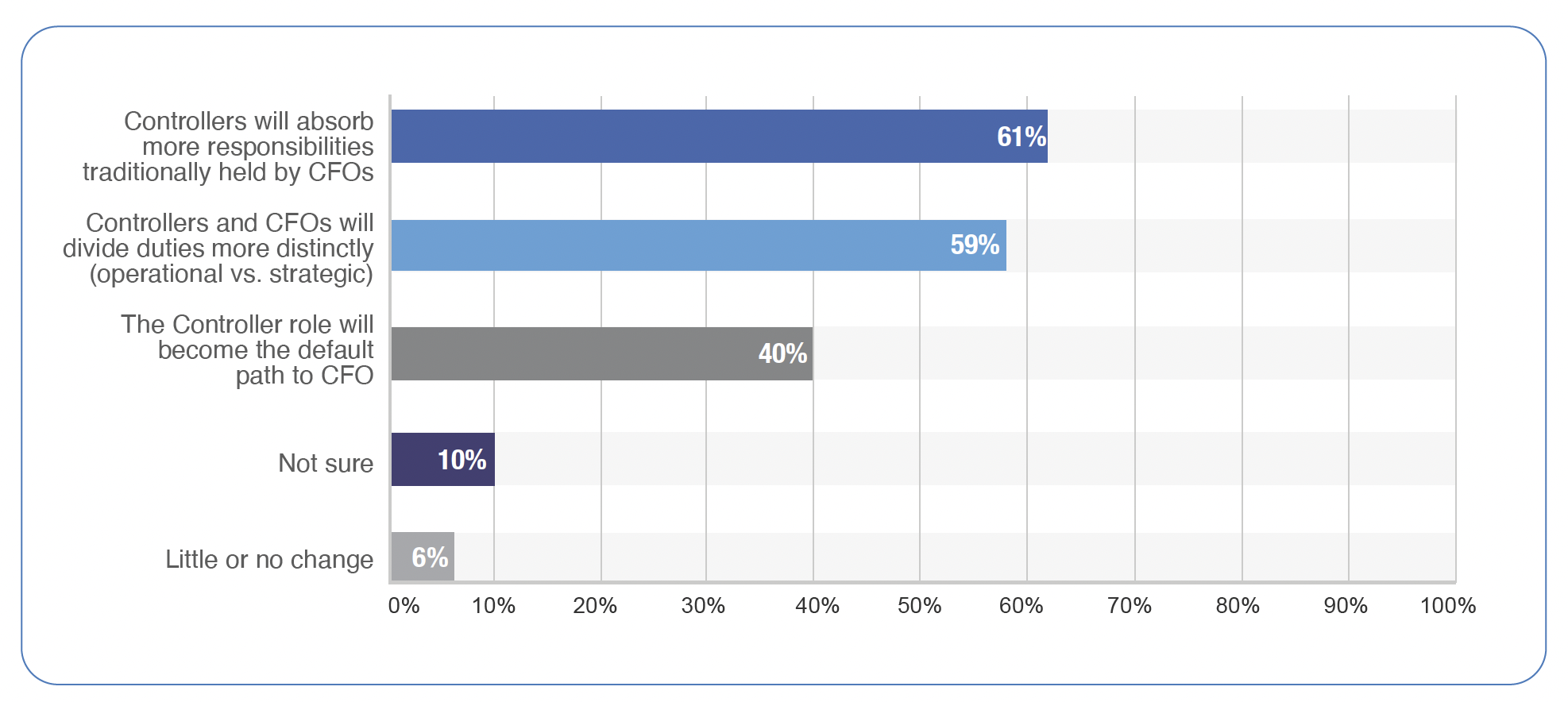
Only 6% expect little or no change.
That is significant because the Controller-CFO relationship has historically varied considerably by organization.
In some companies, the controller is primarily responsible for accounting, reporting, controls, and the close. In others, the controller already plays a broader role across FP&A, systems, operations, strategy, and executive decision support.
The survey suggests the broader model could become increasingly common.
A Broader Controller Does Not Necessarily Mean a Smaller CFO Role
The finding that 61% expect controllers to absorb more CFO responsibilities should not necessarily be interpreted as the two positions converging into one.
The CFO’s mandate has also expanded.
Modern CFOs may be responsible for capital allocation, financing, investor relations, board communication, M&A, enterprise strategy, risk, transformation, technology investments, and other priorities extending well beyond traditional finance operations.
As the CFO role expands outward, there is a practical need for another senior finance leader to assume greater responsibility for the internal finance organization.
That role may increasingly be the controller.
The controller can become responsible for a larger portion of the finance operating model while the CFO concentrates more heavily on enterprise-level priorities.
In this structure, the controller becomes a more important extension of the CFO rather than a substitute for one.
The Operational and Strategic Divide May Become Clearer
The 59% expecting a more distinct division between operational and strategic duties provides additional context.
A possible future model is one in which the controller assumes broader ownership of how finance operates.
That could include accounting, reporting, controls, financial systems, data quality, automation, AI oversight, process management, and potentially portions of planning and analysis.
The CFO, meanwhile, may concentrate more heavily on capital strategy, investors, the board, major transactions, enterprise performance, and the company’s long-term direction.
The line will not be identical at every organization, and both executives will continue to participate in strategy.
But the controller could become the senior executive responsible for ensuring that the finance organization itself operates effectively.
That is a considerably broader mandate than managing the accounting function.
Automation Could Accelerate the Shift
Automation is one reason this relationship may change.
The study finds that 43% of respondents expect more than 40% of today’s controller responsibilities to become automated by 2030.
Much of that automation is expected to occur in areas such as account reconciliations, manual journal entries, the month-end close, AP processing, and reporting.
As recurring accounting work requires less manual intervention, controllers may have more capacity to take on responsibilities that previously sat with the CFO or other senior finance leaders.
At the same time, someone must oversee the increasingly complex environment through which financial work is performed.
Automation does not remove responsibility for financial information. It changes what needs to be managed.
Controllers may spend less time supervising transaction processing and more time overseeing systems, controls, data, exceptions, analytics, and the broader finance operating model.
That creates room for the role to expand upward.
The Controller’s Strategic Role Is Already Growing
The expected evolution of the Controller-CFO relationship also aligns with how respondents believe the controller’s own responsibilities will change.
Today, 42% identify strategic planning among their top controller responsibilities. By 2030, that rises to 55%.
Financial planning, analysis, and budgeting is expected to become the controller’s leading responsibility at 61%.
Meanwhile, financial reporting declines in relative prominence from 68% today to 45% by 2030.
The controller is therefore expected to spend a greater share of leadership attention looking forward rather than exclusively reporting backward.
That creates more overlap with areas traditionally associated with the CFO.
Controllers who are deeply involved in planning, forecasting, business performance, technology, and strategy are naturally positioned to become more significant participants in executive decision-making.
The Controller May Become the CFO’s Primary Operating Partner
The open-ended responses in the Controllership 2030 study reinforce this direction.
Respondents described the future controller as the CFO’s “right hand” and “primary support arm,” along with descriptions such as strategic business partner, assistant CFO, C-suite resource, and strategic advisor.
These descriptions point toward a controller who operates much closer to the center of finance leadership.
In that model, the CFO does not need to personally manage every aspect of the finance organization.
The controller can provide leadership across core finance operations while also translating financial information into insights that support executive decisions.
That relationship becomes particularly valuable as the CFO’s own responsibilities continue to broaden.
A strong controller gives the CFO greater confidence that the financial infrastructure of the organization is functioning effectively while also providing a senior partner capable of participating in larger business discussions.
40% See the Controller as the Default Path to CFO
The career implications are equally important.
Forty percent of respondents believe the Controller role will become the default path to CFO by 2030.
The Controller-to-CFO progression is already well established, but the survey suggests it could become even more natural as the controller’s mandate broadens.
Historically, a controller aspiring to become CFO may have needed to deliberately gain experience outside accounting, particularly in FP&A, strategy, capital markets, operations, or investor relations.
That will still matter.
But if future controllers are already responsible for planning, technology, AI oversight, governance, data, cross-functional collaboration, and strategic support, the experience gap between Controller and CFO may narrow.
The Controller role itself could become a more comprehensive preparation ground for the CFO position.
Future CFO Candidates Will Need More Than Accounting Expertise
A broader path to CFO also changes what controller development should look like.
Strong technical accounting remains essential.
A future CFO needs to understand financial statements, controls, accounting policy, reporting, and the economics of the business.
But accounting expertise alone will not prepare a controller for the broader responsibilities the study anticipates.
Future finance leaders will need to understand how the business makes money, how capital is allocated, how performance is measured, how technology affects the operating model, and how financial insights influence enterprise decisions.
They will also need stronger communication and leadership capabilities.
The transition from Controller to CFO involves moving from ownership of financial accuracy toward responsibility for financial leadership across the enterprise.
If more controllers are expected to make that transition, development needs to begin before the CFO position becomes available.
CFOs Should Think Differently About Controller Succession
The findings also have implications for current CFOs.
Controller succession planning should not focus exclusively on who can run accounting.
The more useful question may be who can eventually help lead finance.
That can change the experiences high-potential controllers and assistant controllers should receive.
Exposure to budgeting and forecasting matters.
Participation in strategic planning matters.
Cross-functional work with operations, technology, sales, HR, and other business functions matters.
Experience presenting to executive leadership and boards can matter.
Leading technology and transformation initiatives can matter.
Understanding how the organization allocates capital and evaluates investments can matter.
A controller who develops these capabilities becomes more valuable in the current role while also becoming better prepared for future finance leadership.
A Stronger Controller Can Expand the CFO’s Capacity
There is an important organizational benefit to this evolution.
Just as automation can create capacity within the accounting organization, a broader controller can create capacity for the CFO.
When the controller can independently lead more of the finance function, the CFO has greater ability to focus on issues that require executive attention.
That might include a major acquisition, financing strategy, board engagement, investor relationships, enterprise transformation, expansion into new markets, or long-range planning.
The value of the controller role therefore extends beyond the responsibilities it directly owns.
A capable controller can increase the effectiveness of the CFO.
This may be one reason respondents simultaneously expect controllers to absorb CFO responsibilities and expect a clearer division between the two positions.
Delegating greater responsibility downward can allow the CFO role to become more focused at the enterprise level.
The Relationship Still Depends on Organizational Context
There will not be one universal Controller-CFO model by 2030.
A controller at a private middle-market company may have a very different mandate from a controller at a large public corporation.
Ownership structure, company size, industry, regulatory requirements, international operations, finance team size, and the individual strengths of the CFO and controller will all influence how responsibilities are divided.
Some organizations will maintain a relatively traditional structure.
Others may develop controllers whose scope resembles that of a deputy CFO.
The survey does not prescribe one model.
What it does show is that finance leaders overwhelmingly expect the relationship to change.
With only 6% anticipating little or no change, organizations should be prepared to reconsider where responsibilities belong as both positions evolve.
What This Means for Controllers and CFOs
For controllers, the findings represent an opportunity to think more broadly about career development.
Becoming a stronger accounting leader remains important, but the future role may require much more.
Controllers should seek exposure to planning, strategy, technology, data, operations, and executive decision-making. They should understand the business beyond the accounting organization and develop the ability to translate financial information into implications for management.
For CFOs, the findings create an opportunity to intentionally expand the controller role.
Which responsibilities are currently sitting with the CFO because the controller’s mandate has historically been narrower? Which could be delegated as technology reduces transactional workload? Which experiences would prepare the controller to become a stronger enterprise finance leader? Is the organization developing a credible internal successor for the CFO role?
These questions connect organizational design with succession planning.
The Controller Could Become the Second Executive Leader of Finance
The future Controller-CFO relationship appears likely to be defined by greater responsibility, clearer division of duties, and closer partnership.
Controllers are expected to absorb responsibilities previously held by CFOs.
At the same time, the two positions may develop a more deliberate division between managing the finance operating model and leading broader enterprise financial strategy.
For controllers with CFO ambitions, that creates a significant opportunity.
For CFOs, it creates the possibility of building a stronger second-in-command.
And for the finance organization, it could result in a leadership model better suited to an environment in which technology performs more of the routine work while finance assumes a greater role in strategy, governance, and enterprise decision-making.
By 2030, the controller may increasingly become the executive who enables the CFO to operate as a more strategic enterprise leader.
Explore the Full Controllership 2030 Study
Controllership 2030: The Future of the Corporate Controller™ examines how the Controller role could evolve through 2030, including changes to responsibilities, automation, finance organization structures, governance, future skills, talent, and the relationship between Controllers and CFOs.
Download the full Controllership 2030: The Future of the Corporate Controller study
About the Study Sponsor

Built on insightsoftware’s decades of finance software expertise, Lineos brings finance into focus. It gives teams a single line of sight across the full financial workflow, from budgeting, planning, and reporting through close, consolidation, reconciliation, tax, disclosure, and lease. At every stage, Lineos pulls diverse data from across the business into one place, with powerful AI surfacing the insights that drive action. By freeing finance from spreadsheet forensics and chasing numbers, Lineos enables them to move from reporting the past to shaping what’s next, equipped with the tools they need to drive better decisions and unlock breakthrough insight.