
The skills that built successful controllership careers will remain important through 2030. But they may no longer be sufficient on their own.
The Controllership 2030: The Future of the Corporate Controller study asked finance leaders which skills they believe will become most valuable for Controllers by 2030.
One capability ranked well above the rest.
Eighty-one percent selected practical AI skills and tool proficiency, nearly twice the 41% who selected technical accounting. Data analysis and analytics ranked second at 64%.
The findings do not suggest that accounting expertise is becoming obsolete. Controllers will still be responsible for reliable financial information, sound controls, and professional judgment.
Instead, the results point toward a broader definition of finance expertise. The Controller of 2030 may need to combine accounting knowledge with the ability to use, evaluate, and govern increasingly sophisticated technology.
Practical AI Proficiency Ranks First
Finance leaders identified the following skills as most valuable for Controllers by 2030:
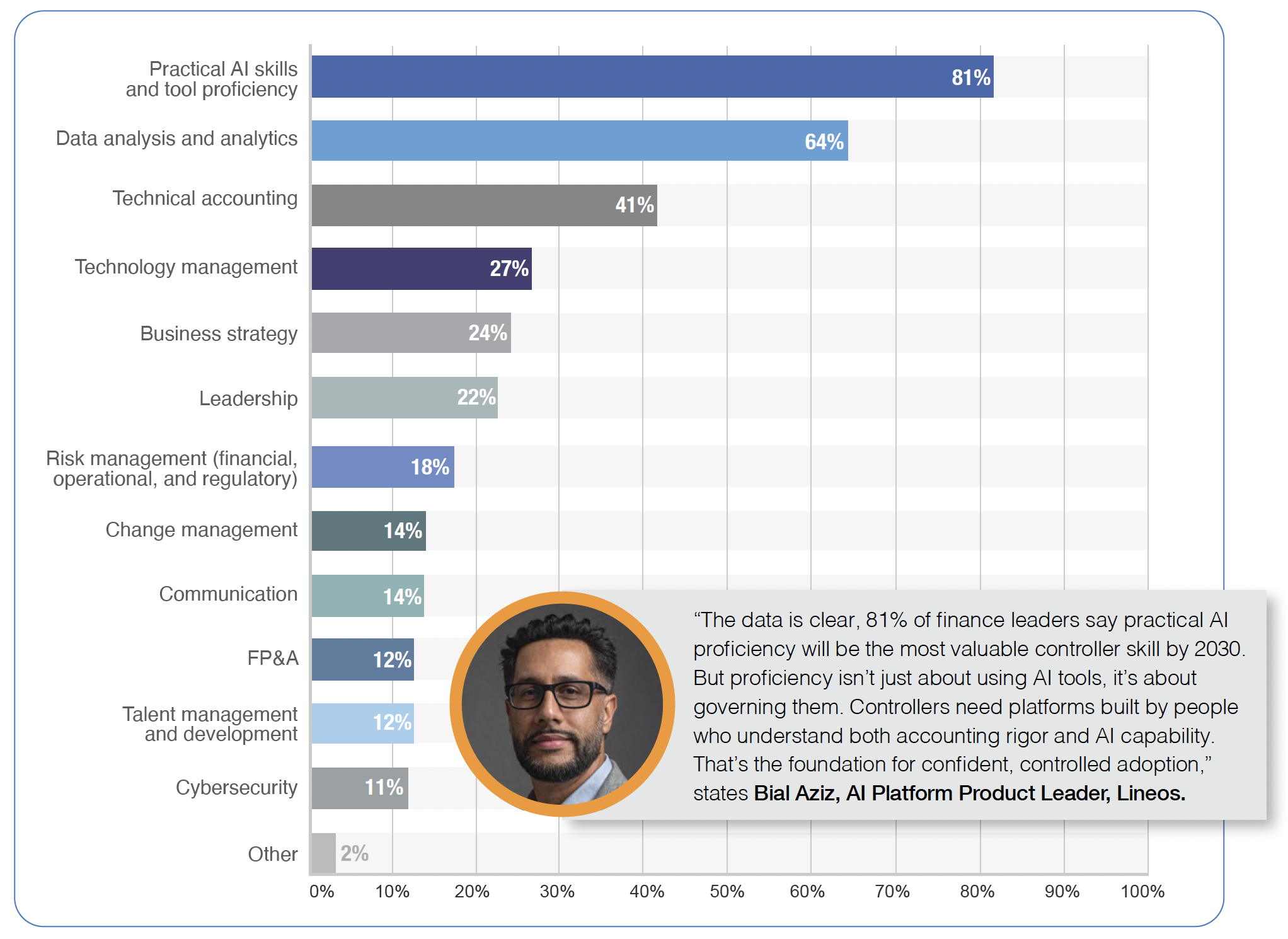
The prominence of AI is striking.
Practical AI proficiency was selected by approximately twice as many respondents as technical accounting and three times as many as technology management.
That distinction is important.
Finance leaders are not necessarily saying tomorrow’s Controller needs to become a technologist. They appear to be placing greater value on the ability to work effectively with AI in practice.
That means understanding how to apply AI to finance work, evaluate its outputs, recognize its limitations, and determine where human judgment remains necessary.
Practical AI Skills Are Different From Technology Management
The gap between practical AI proficiency at 81% and technology management at 27% provides an important clue about what finance leaders expect.
Controllers do not necessarily need to manage the organization’s technical infrastructure.
They do need to understand the technology that increasingly affects their own function.
A Controller may never configure an AI model or design an enterprise architecture. But that same Controller may need to decide whether AI should be used in a reconciliation process, whether an AI-generated variance explanation is credible, or what level of review an autonomous accounting agent requires.
That is practical proficiency.
It is the difference between knowing that AI exists and being capable of using it responsibly within a financial environment.
As AI becomes more integrated into finance, this may become similar to spreadsheet or ERP proficiency today. Controllers will not necessarily need to understand every technical detail behind the tool, but they will need enough fluency to use it effectively and supervise the work it supports.
AI Proficiency Will Increasingly Include Governance
For Controllers, practical AI knowledge cannot stop at productivity.
The study finds that 80% of respondents expect AI governance to become a more important Controller responsibility by 2030.
That means proficiency also requires understanding risk.
Controllers may need to know what data an AI application can access, how outputs are validated, when human review is required, and what happens when the technology produces an incorrect result.
They may also need to evaluate whether automated financial work is sufficiently documented and traceable.
This makes AI proficiency particularly different for Controllers than for many other business professionals.
The Controller is responsible for trust in financial information.
Using AI faster is valuable only if the organization can continue relying on the work being produced.
The future skill is therefore likely to be a combination of application and oversight: knowing how to use AI while understanding how to control it.
Data Analysis Is Becoming a Foundational Finance Capability
Data analysis and analytics ranks second at 64%.
That finding aligns closely with the expected evolution of the Controller role.
As technology assumes more responsibility for processing transactions and producing financial information, Controllers are expected to spend more time interpreting that information.
That requires analytical ability.
A future Controller may have access to more financial and operational data than any previous generation of finance leaders. AI may also make it possible to analyze that information faster and identify patterns that would previously have required substantial manual effort.
But more data does not automatically produce better decisions.
Controllers still need to determine which measures matter, recognize anomalies, challenge assumptions, distinguish correlation from meaningful business drivers, and translate financial results into implications for management.
The analytical skill is not simply the ability to produce another dashboard.
It is the ability to determine what the information means.
Technical Accounting Remains a Core Differentiator
Technical accounting ranks third at 41%.
That percentage should not be interpreted as evidence that accounting knowledge is declining in importance.
Instead, it reflects the fact that respondents were asked which skills will become most valuable as the Controller role changes.
Technical accounting remains foundational to the position.
AI may prepare an analysis, recommend an accounting treatment, identify a discrepancy, or perform part of a financial process. Someone still needs to know whether the result is correct.
That responsibility becomes particularly important when unusual or material issues arise.
Technology is generally most effective when processes are standardized and rules are clear. Controllers often become most valuable when circumstances fall outside those conditions.
A complex transaction, unusual contract, acquisition, impairment, accounting judgment, or regulatory change may require expertise that cannot simply be delegated to a system.
In an increasingly automated finance environment, technical accounting knowledge may become less visible in everyday processing while becoming even more important when judgment is required.
The Most Valuable Controllers May Combine Accounting, AI, and Analytics
Taken together, the top three skills provide a useful profile of the future Controller:
- Practical AI proficiency: 81%
- Data analysis and analytics: 64%
- Technical accounting: 41%
These capabilities complement one another.
Accounting knowledge helps the Controller understand what is financially correct.
Analytics helps the Controller understand what the information means.
AI proficiency helps the Controller use technology to perform and scale the work.
A professional strong in only one area may face limitations.
An accounting expert without technology fluency may struggle to lead an increasingly automated finance organization.
A strong technologist without accounting expertise may not understand the financial consequences of a system’s output.
An analyst without either may be able to identify trends without understanding the accounting foundation or technology producing the data.
The future Controller may increasingly need to operate at the intersection of all three.
Business Strategy and Leadership Still Matter
The study also identifies business strategy at 24% and leadership at 22% among the most valuable future skills.
These capabilities become particularly relevant as the Controller’s role moves closer to the CFO.
Sixty-one percent of respondents expect Controllers to absorb more responsibilities traditionally held by CFOs by 2030. Fifty-five percent expect strategic planning to become one of the Controller’s top responsibilities.
A Controller with broader responsibility needs more than technical expertise.
The role increasingly requires understanding how the company operates, where it makes money, which investments create value, how financial decisions affect the broader organization, and how to communicate those implications to executives outside finance.
Leadership is similarly important as the finance workforce changes.
Controllers may oversee teams containing accountants, analysts, technology specialists, data professionals, outsourced resources, and automated systems.
Managing that environment requires a different leadership model than supervising a traditional accounting department.
Change Management Could Become an Underrated Skill
Only 14% selected change management, but its importance may extend beyond the ranking suggests.
Nearly every major shift identified in the study requires organizational change.
Finance teams are expected to automate significant portions of their current work.
Organizational structures may become more centralized and flatter.
New AI, data, and technology roles may emerge.
Existing employees will need different skills.
Controllers may absorb broader responsibilities.
Governance models will need to evolve.
Implementing those changes successfully requires more than selecting technology.
Employees need to understand new processes. Responsibilities need to be reassigned. Controls need to be redesigned. New expectations need to be communicated. Teams need to learn different ways of working.
Controllers who can lead through those transitions may become particularly valuable, even if “change management” never appears prominently in their job description.
The Findings Have Major Implications for Controller Development
The traditional development path for Controllers has often emphasized accounting depth.
Professionals build experience in financial reporting, the general ledger, close management, controls, audit, and technical accounting before progressing into leadership.
Those experiences remain valuable.
But the study suggests development programs should broaden.
Aspiring Controllers may need meaningful exposure to AI tools, analytics, finance systems, process automation, data governance, and strategic planning much earlier in their careers.
Current Controllers may need to assess their own skill gaps as well.
A Controller does not need to become the organization’s leading AI expert. But waiting for IT, consultants, or software vendors to explain every technological development may become increasingly difficult as technology becomes more central to financial processes.
Finance leadership will require enough fluency to participate directly in those decisions.
Recruiting the Future Controller May Become More Difficult
The changing skill profile also creates a recruiting challenge.
Organizations will continue to need professionals with strong accounting foundations.
At the same time, they will increasingly value AI proficiency, analytics, technology understanding, strategic thinking, and leadership.
The supply of professionals who combine all of those capabilities may be limited.
That makes internal development particularly important.
Organizations may find it easier to teach experienced finance professionals how to use AI and analytics than to recruit a candidate who already possesses deep accounting expertise, technology fluency, business knowledge, and leadership experience.
It may also require finance leaders to rethink job descriptions.
A Controller position written primarily around close management, reporting, audit, and controls may fail to attract or identify the type of leader the organization will need several years from now.
Accounting Education May Need to Evolve Too
The implications extend beyond corporate training.
If practical AI skills and data analytics become central to controllership, accounting education and professional development may need to adapt.
Future accountants will still need to understand debits and credits, financial statements, accounting standards, controls, audit principles, and taxation.
But they may enter organizations where technology performs more of the mechanical work associated with those concepts.
Their value will increasingly come from knowing how to apply accounting knowledge within technology-enabled processes.
That suggests finance education may need to place greater emphasis on data, systems, AI, process design, and critical evaluation of technology-generated outputs.
The goal should not be to produce accountants who are less technically capable.
It should be to produce accountants capable of applying that expertise in a different operating environment.
What This Means for Controllers and CFOs
The 81% result provides a clear signal for finance leadership.
Practical AI proficiency is becoming part of the Controller skill set.
Controllers should consider where they currently sit across the capabilities identified in the study. Are they comfortable using AI tools directly? Can they evaluate AI-generated financial work? Do they understand the data feeding automated processes? Can they interpret increasingly sophisticated analytics? Are they prepared to oversee technology without relying entirely on technical teams?
CFOs should ask similar questions about their leadership pipelines.
Does the next generation of finance leaders have opportunities to develop these skills? Are training programs keeping pace with the changing role? Are high-potential accounting professionals receiving exposure to technology, analytics, and strategy? Do Controller job descriptions reflect where the position is going rather than where it has been?
The organizations that answer these questions early may have a significant advantage in developing future finance leadership.
The Future Controller Will Need a Broader Professional Toolkit
The Controller of 2030 will still need to understand accounting.
But accounting expertise will increasingly sit alongside a much broader set of capabilities.
Finance leaders overwhelmingly expect practical AI proficiency to become valuable. They also place significant emphasis on data analysis, while technology, strategy, leadership, risk, and change management all contribute to a more multidimensional role.
The emerging profile is not an accountant being replaced by a technologist.
It is an accounting leader becoming more technologically and analytically capable.
The strongest Controllers of 2030 may be those who can combine accounting rigor, analytical judgment, and practical AI proficiency into a single leadership skill set.
Explore the Full Controllership 2030 Study
Controllership 2030: The Future of the Corporate Controller™ examines the skills finance leaders believe Controllers will need by 2030, along with changes to AI and automation, governance, staffing, organizational structure, talent, and the Controller-CFO relationship.
Download the full Controllership 2030: The Future of the Corporate Controller study
About the Study Sponsor

Built on insightsoftware’s decades of finance software expertise, Lineos brings finance into focus. It gives teams a single line of sight across the full financial workflow, from budgeting, planning, and reporting through close, consolidation, reconciliation, tax, disclosure, and lease. At every stage, Lineos pulls diverse data from across the business into one place, with powerful AI surfacing the insights that drive action. By freeing finance from spreadsheet forensics and chasing numbers, Lineos enables them to move from reporting the past to shaping what’s next, equipped with the tools they need to drive better decisions and unlock breakthrough insight.