
Artificial intelligence is no longer a future initiative within finance organizations.
For several years, discussions surrounding AI focused primarily on potential. Finance leaders debated where the technology might fit, which processes could benefit, and whether adoption justified the investment. Those conversations are beginning to give way to something far more practical. The question is no longer whether finance organizations will use AI. Increasingly, the discussion centers on how AI can be implemented responsibly while maintaining the governance, controls, and accuracy that finance requires.
The Corporate Finance & Accounting Talent Study 2026 illustrates just how quickly that transition has occurred. A majority of respondents, 53 percent, report that artificial intelligence is currently being evaluated, piloted, or implemented using internal staff. Another 12 percent are working with consultants or outsourced specialists to support implementation, while 16 percent have AI training planned or already underway. Only 19 percent indicate that their finance organizations are not currently using AI.
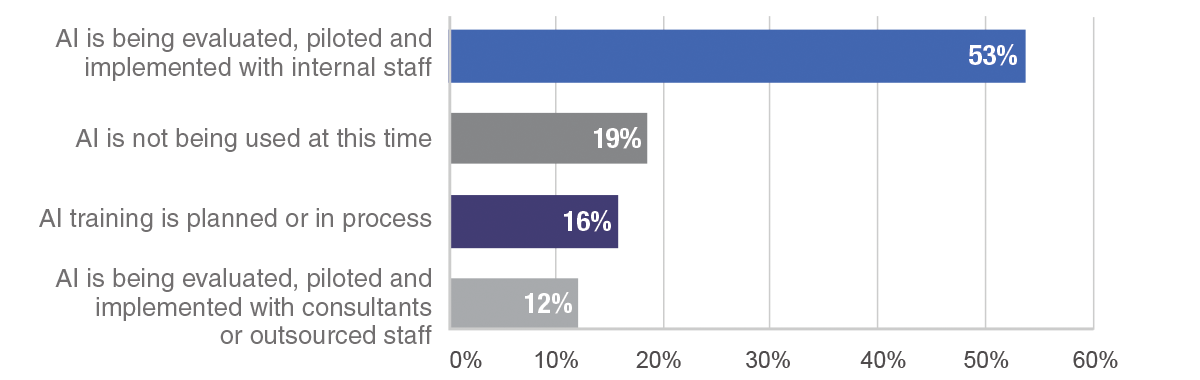
Taken together, these findings show that more than four out of five finance organizations have already begun some form of AI journey. Although organizations remain at different stages of maturity, artificial intelligence has clearly progressed beyond isolated experimentation and is becoming part of mainstream finance operations.
Finance Leaders Are Taking a Deliberate Approach
One aspect of the survey stands out immediately.
Most organizations are not relying primarily on outside consultants to introduce AI into finance. Instead, the majority are evaluating and implementing the technology with their own employees.
That distinction is important because it suggests finance leaders view artificial intelligence as an operational capability rather than a temporary technology project. Organizations are building internal knowledge, testing use cases, and gradually developing governance practices that can support long-term adoption.
The relatively small percentage relying exclusively on consultants reinforces this observation. External advisors remain valuable for strategy, implementation, and specialized expertise, but finance organizations increasingly recognize that successful AI adoption ultimately depends upon internal ownership.
Finance departments cannot outsource institutional knowledge.
The AI Conversation Has Shifted From Curiosity to Practical Use
Only a few years ago, most finance discussions surrounding AI centered on broad questions about automation and disruption.
Today’s conversations are far more specific.
Finance organizations are evaluating how AI can accelerate account reconciliations, summarize financial information, improve reporting, assist with variance analysis, support forecasting, identify anomalies, prepare documentation, and streamline recurring administrative work. These applications focus less on replacing finance professionals and more on reducing repetitive tasks that consume valuable time.
That evolution reflects the practical nature of finance itself.
Controllers and CFOs rarely adopt technology because it is innovative. They adopt technology because it improves accuracy, efficiency, consistency, or decision-making. Artificial intelligence is increasingly being evaluated according to those same standards.
The emphasis has shifted from technological curiosity to measurable business value.
AI Governance Remains the Defining Issue
While adoption is accelerating, finance organizations continue approaching AI with considerably more caution than many other business functions.
That caution is appropriate.
Unlike marketing, customer service, or content creation, finance operates within an environment governed by internal controls, regulatory requirements, audit standards, and executive accountability. Financial reporting depends upon accuracy, consistency, documentation, and traceability. Errors can affect earnings, compliance, investor confidence, and regulatory obligations.
Consequently, finance leaders are asking different questions than other departments.
Can AI-generated results be verified?
How will outputs be documented?
What controls should govern its use?
Who remains accountable for financial decisions?
How should confidential financial information be protected?
The organizations making the greatest progress with AI tend to answer these governance questions before expanding deployment across the finance function.
AI Is Changing the Nature of Finance Work
One misconception surrounding artificial intelligence is that its primary purpose is workforce reduction.
The survey findings point toward a different outcome.
Finance organizations continue hiring, compensation continues increasing, and talent shortages remain widespread throughout the profession. Rather than replacing employees, AI appears to be changing how finance professionals spend their time.
Routine administrative work continues becoming more automated.
Preparing reports, organizing supporting documentation, researching accounting guidance, summarizing information, identifying exceptions, and performing repetitive analysis increasingly lend themselves to AI-assisted workflows.
That allows experienced finance professionals to devote greater attention to responsibilities requiring professional judgment, including financial planning, technical accounting, internal controls, business partnering, executive communication, and strategic analysis.
Artificial intelligence is expanding the value of human expertise rather than diminishing it.
Training Will Determine Long-Term Success
One finding deserves particular attention.
Sixteen percent of organizations report that AI training is either planned or currently underway. While this group has not yet implemented AI broadly, it recognizes that workforce readiness must accompany technology adoption.
This may ultimately prove more significant than the implementation numbers themselves.
Artificial intelligence introduces new skills that extend well beyond learning how to use software. Finance professionals must understand prompt development, data quality, model limitations, governance expectations, privacy requirements, validation procedures, and the appropriate role of human review.
Organizations investing in employee education today are likely positioning themselves to adopt AI more effectively over the coming several years.
Technology evolves quickly.
Organizational capability develops more gradually.
AI Will Reward Strong Finance Processes
Artificial intelligence does not eliminate operational weaknesses.
In many cases, it exposes them.
Organizations with inconsistent chart of accounts, fragmented data sources, poorly documented processes, or weak governance structures frequently discover that AI magnifies those underlying issues rather than correcting them. High-quality outputs still depend upon high-quality financial data and disciplined operational processes.
Conversely, organizations with mature ERP systems, standardized workflows, reliable financial data, and well-defined internal controls are generally better positioned to realize meaningful benefits from AI initiatives.
Finance leaders should therefore view AI as an extension of finance transformation rather than a substitute for it.
The strongest results will likely come from organizations that modernize both technology and business processes together.
Competitive Advantage Will Come From Responsible Adoption
Perhaps the most important conclusion emerging from this year’s survey is that competitive advantage will not belong simply to organizations using artificial intelligence.
It will belong to organizations using it well.
Successful finance departments will combine AI with experienced professionals, disciplined governance, modern finance systems, and thoughtful oversight. Human judgment will continue guiding material accounting decisions, while AI increasingly supports the speed, consistency, and efficiency of routine finance operations.
The organizations that strike this balance will likely improve productivity without compromising the accuracy and accountability that define effective finance leadership.
What This Means for Finance Leaders
The Corporate Finance & Accounting Talent Study 2026 demonstrates that artificial intelligence has entered a new stage of maturity within corporate finance. Most organizations are no longer asking whether AI belongs in the finance function. They are determining where it creates the greatest value and how it can be implemented responsibly.
For CFOs and Controllers, the priority should not be adopting AI as quickly as possible. It should be building the governance, employee capabilities, technology foundation, and operational discipline necessary to ensure AI strengthens financial performance rather than introducing unnecessary risk.
Finance has always balanced innovation with control. Artificial intelligence will require exactly the same discipline.
Download the complete Corporate Finance & Accounting Talent Study 2026 to explore all survey findings, benchmarking data, and analysis covering AI adoption, hiring, talent shortages, compensation, recruiting, workplace trends, workforce development, and the future of finance leadership.