
For many years, organizations assumed compensation was the primary reason finance professionals accepted new positions. Salary negotiations often dominated retention discussions, and employers frequently responded to turnover by increasing pay or expanding benefits.
The latest research suggests that assumption tells only part of the story.
While competitive compensation remains important, today’s finance professionals are increasingly making career decisions based on long-term growth rather than short-term financial gain. Employees want opportunities to build new skills, assume greater responsibility, work with modern technology, and advance into leadership roles. When those opportunities appear limited, even well-compensated professionals may begin exploring alternatives.
The Corporate Finance & Accounting Talent Study 2026 reinforces this trend. Lack of career advancement opportunities ranks as the leading reason finance and accounting professionals leave their organizations, cited by 54 percent of respondents. Inadequate compensation and benefits follow at 29 percent, while limited flexibility or work-life balance accounts for 26 percent. Lack of training and development opportunities and burnout or overwork each received 25 percent of responses, followed by poor management or leadership at 15 percent.
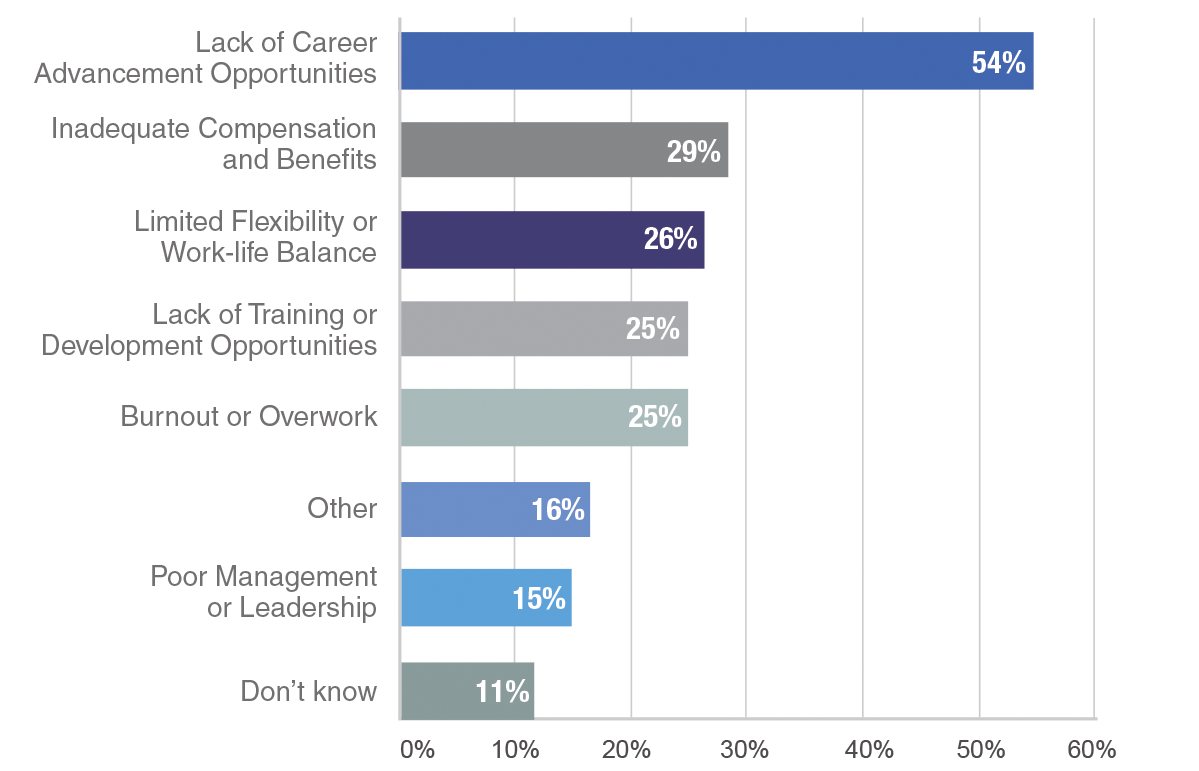
Perhaps the most significant finding is not simply that career advancement ranks first. It is that opportunities for professional growth outpace compensation by nearly two-to-one, suggesting that retention has become fundamentally tied to employee development.
Employees Want Careers Rather Than Positions
Finance professionals have always sought opportunities to advance, but expectations have evolved considerably over the past decade.
Today’s employees increasingly evaluate whether an organization offers a visible path toward greater responsibility. They want exposure to new technologies, participation in strategic projects, leadership experience, and opportunities to expand beyond routine accounting responsibilities.
That expectation reflects the changing nature of the profession itself.
Controllers, accounting managers, FP&A professionals, and finance executives now oversee technology initiatives, automation projects, business analytics, governance, acquisitions, and organizational transformation alongside traditional accounting responsibilities. Professionals recognize that remaining competitive requires continuous growth, making career development an essential part of long-term success.
Organizations that fail to provide those opportunities may find it increasingly difficult to retain ambitious employees, even when compensation remains competitive.
Compensation Opens the Door but Rarely Keeps It Open
The survey does not suggest that salary has become unimportant.
On the contrary, compensation remains the second most common reason employees leave and continues to influence recruiting throughout the finance labor market. Elsewhere in the study, organizations report significant salary increases during the past year while forecasting continued growth over the coming twelve months. Those findings confirm that employers continue investing heavily in competitive compensation.
The survey does suggest, however, that compensation has become a baseline expectation rather than a lasting competitive advantage.
Employees generally expect to receive market-competitive salaries. Once that expectation has been met, other factors increasingly influence whether they remain with an organization. Professional development, leadership quality, meaningful work, organizational culture, and opportunities for advancement often become the deciding factors.
This represents an important distinction for finance leaders.
Salary may persuade someone to accept an offer.
Career growth often determines whether that individual remains five years later.
Burnout Remains a Persistent Concern
Burnout and excessive workload continue ranking among the leading causes of turnover, cited by one-quarter of respondents.
This finding is hardly surprising.
Finance organizations continue operating under increasing pressure. Regulatory requirements have expanded, reporting expectations have become more demanding, technology implementations require additional effort, and many accounting departments continue managing talent shortages. During financial close, budgeting cycles, audits, and major transactions, workloads can become particularly intense.
When staffing shortages persist over extended periods, remaining employees frequently absorb additional responsibilities.
The result is often a cycle that reinforces itself. Staff shortages increase workload. Higher workload contributes to burnout. Burnout leads to additional turnover, creating even greater staffing pressure.
Breaking that cycle requires more than replacing departing employees. Organizations must also examine workload distribution, process efficiency, staffing models, and the role automation can play in reducing repetitive administrative work.
Professional Development Supports Retention
Another notable finding is the importance employees place on training and development opportunities.
One-quarter of respondents identify limited development opportunities as a reason finance professionals leave their organizations. That result closely aligns with another question in the study, where internal training programs emerge as the leading strategy organizations use to address finance skills gaps.
Together, these findings present a clear message.
Employees expect employers to invest in their continued development. Organizations that provide technical education, leadership training, mentoring, certifications, ERP experience, and exposure to emerging technologies create environments where professionals can envision long-term careers rather than temporary employment.
Professional development therefore serves two purposes simultaneously.
It strengthens organizational capability while reducing voluntary turnover.
Flexibility Continues to Influence Employment Decisions
Although workplace flexibility no longer dominates recruiting conversations as it did several years ago, it remains an important factor in employee retention.
More than one-quarter of respondents identify limited flexibility or work-life balance as a reason finance professionals leave their organizations. This finding follows earlier results in the study showing that hybrid work continues to represent a substantial portion of finance workplace models, even as onsite work becomes more common.
These findings suggest that finance professionals increasingly view flexibility as one component of an overall employment experience rather than an extraordinary benefit.
Organizations need not adopt identical workplace policies, but employees generally expect leadership to evaluate attendance requirements thoughtfully and align them with business needs rather than tradition alone.
Well-designed workplace policies support both operational effectiveness and employee satisfaction.
Retention Is Becoming More Valuable Than Recruitment
Perhaps the most important implication of this year’s findings is financial rather than cultural.
Replacing experienced finance professionals has become increasingly expensive.
Recruiting costs, onboarding, training, productivity losses, delayed projects, institutional knowledge, and leadership disruption all contribute to the true cost of turnover. When experienced Controllers, accounting managers, tax professionals, or FP&A leaders depart, organizations frequently spend months restoring the capability that was lost.
Retention therefore deserves the same strategic attention as recruiting.
Organizations often invest considerable resources attracting new employees while devoting comparatively less attention to retaining the experienced professionals they already employ.
The survey suggests that approach may warrant reconsideration.
Career development, succession planning, leadership quality, employee engagement, technology investments, and competitive compensation all contribute to retaining institutional knowledge that would otherwise be difficult and expensive to replace.
What This Means for Finance Leaders
The Corporate Finance & Accounting Talent Study 2026 demonstrates that retaining finance talent requires a broader perspective than compensation alone.
Career advancement opportunities now represent the leading reason finance professionals leave their organizations, followed by compensation, workplace flexibility, professional development, and burnout. Collectively, these findings indicate that employees increasingly evaluate employers based on their long-term career experience rather than immediate financial rewards.
For CFOs and Controllers, retention strategy should extend beyond annual salary reviews. Organizations that invest consistently in leadership development, meaningful career progression, modern finance technology, manageable workloads, and employee engagement will likely retain more experienced professionals while reducing the substantial costs associated with turnover.
Download the complete Corporate Finance & Accounting Talent Study 2026 to explore all survey findings, benchmarking data, and analysis covering retention, hiring, compensation, recruiting, AI adoption, workforce development, workplace trends, and the future of finance talent.