
The question surrounding automation in finance is increasingly shifting from whether it will happen to where it will have the greatest impact.
The Controllership 2030: The Future of the Corporate Controller study provides a clear answer.
Finance leaders expect automation to have its greatest effect on recurring, rules-driven activities that require significant manual processing today. Account reconciliations and manual journal entries top the list, followed by the month-end close and accounts payable.
More judgment-intensive areas, including tax compliance, treasury, and audit support, rank considerably lower.
The results point toward a future in which automation does not affect every finance activity equally. Instead, it is likely to concentrate first on the work that is repetitive, structured, data-intensive, and easiest to standardize.
For controllers, that could fundamentally change where finance teams spend their time.
Reconciliations and Journal Entries Lead the Automation List
When respondents were asked which accounting and finance functions are most likely to become highly automated by 2030, they identified:
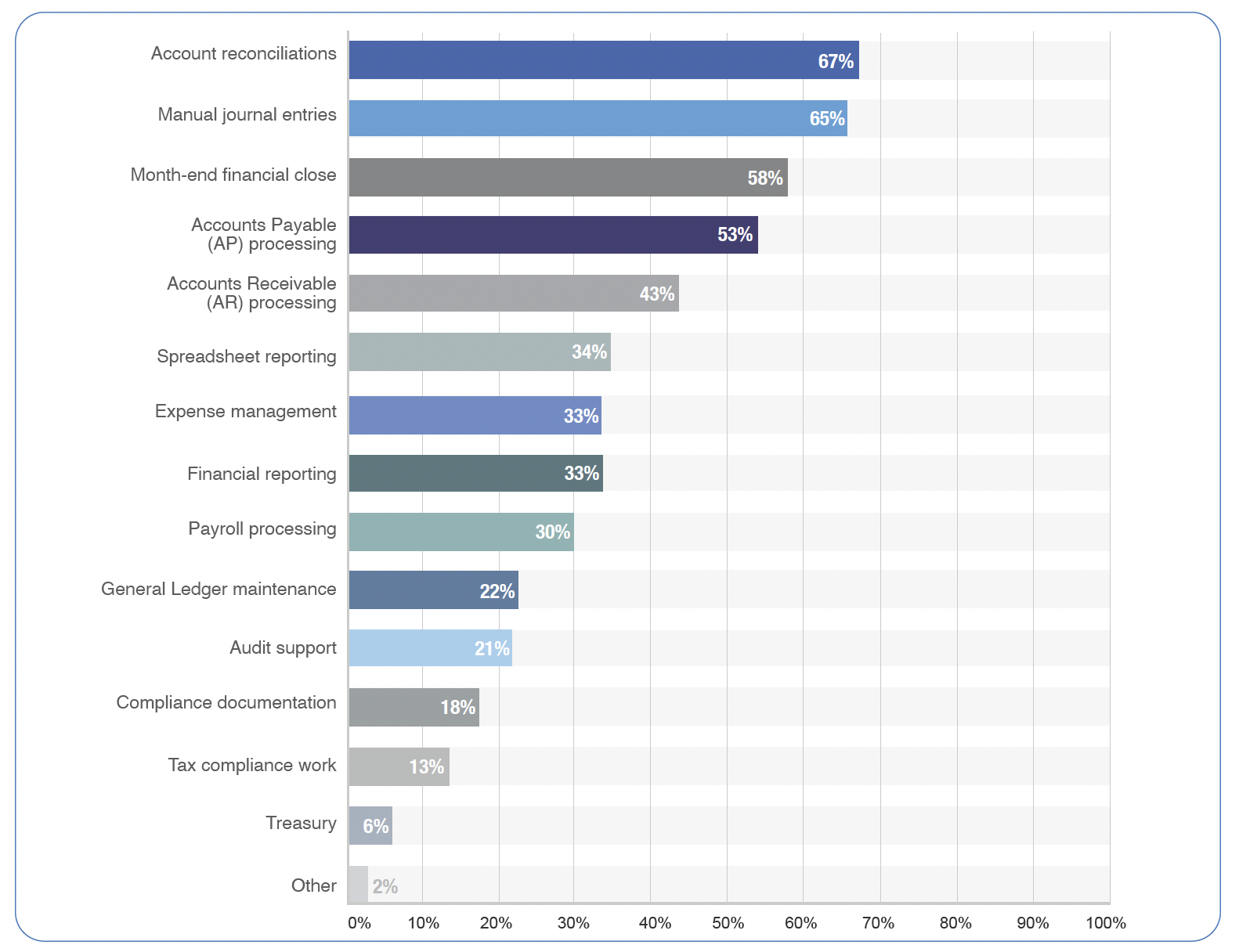
The four functions selected by a majority of respondents are all recurring activities that consume significant finance capacity: reconciliations, journal entries, the financial close, and AP processing.
These processes are also highly structured.
They involve defined inputs, repeatable steps, established approval requirements, and identifiable exceptions. Those characteristics make them particularly suitable for automation.
Account Reconciliations Are the Leading Candidate
At 67%, account reconciliations rank as the finance process most likely to become highly automated by 2030.
It is easy to understand why.
Reconciliations often require finance professionals to gather data from multiple sources, compare balances or transactions, identify differences, investigate exceptions, document explanations, and obtain review.
Much of that work follows repeatable logic.
Technology can increasingly perform matching, identify discrepancies, categorize exceptions, and direct employees toward the items that actually require investigation.
The result does not necessarily eliminate the reconciliation process. It changes where people participate in it.
Instead of manually reviewing every transaction, finance professionals can focus on exceptions, unusual activity, and higher-risk items.
Managers can focus more of their review on the areas where judgment is required.
Controllers can spend more time ensuring that reconciliation rules, thresholds, access, and exception procedures remain appropriate.
Automation can therefore reduce the volume of manual activity while making the remaining human work more targeted.
Manual Journal Entries Could Decline Significantly
Manual journal entries follow closely at 65%.
Journal entries are another natural automation target because many recurring entries are based on predictable events, calculations, allocations, or schedules.
Automation can potentially prepare entries, populate supporting information, route approvals, post transactions, and maintain documentation.
For controllers, the opportunity is significant.
Manual journal entry processes can require considerable effort while also introducing the possibility of data-entry errors, inconsistent documentation, delayed approvals, or incorrect account coding.
Greater automation could reduce those risks while accelerating processing.
But journal entries also illustrate why automation and controls must develop together.
Not every entry should be treated the same way.
Routine recurring entries may be strong candidates for substantial automation. Unusual, material, or judgment-based entries may require much more human involvement.
The challenge is therefore not simply determining whether journal entries can be automated. It is designing rules that distinguish between transactions technology can process reliably and those requiring additional scrutiny.
The Month-End Close Could Look Very Different
More than half of respondents, 58%, believe the month-end financial close is likely to become highly automated by 2030.
That finding could have broad implications for the finance operating model.
The close is not a single task. It is a coordinated sequence involving reconciliations, journal entries, accruals, intercompany activity, consolidation, review, variance analysis, reporting, and other activities.
Many of the individual processes within the close are themselves identified as strong automation candidates.
That creates the potential for a compounding effect.
If reconciliations become more automated, journal entries require less manual preparation, reports update more dynamically, and exceptions are identified earlier, the traditional close calendar could become less dependent on large amounts of concentrated manual effort at month-end.
Finance teams may be able to identify issues throughout the period rather than waiting until the close begins.
That could eventually change the economics of the close itself.
The objective may become less about completing the same month-end process faster and more about redesigning how financial information is processed and reviewed throughout the month.
AP and AR Show the Potential for Transactional Automation
Accounts payable processing ranks fourth at 53%, while accounts receivable processing follows at 43%.
Both functions contain many characteristics that favor automation.
AP can involve invoice capture, coding, matching, approval routing, duplicate detection, payment preparation, and exception management.
AR can involve invoicing, cash application, payment matching, collection prioritization, and account monitoring.
Technology can perform an increasing share of these activities while directing employees toward exceptions or situations requiring customer, vendor, or business interaction.
The implications extend beyond productivity.
More automated transaction processing can create more standardized workflows, faster processing, better visibility, and more consistent application of policies.
It can also support broader organizational changes.
If routine transactional work requires fewer manual touchpoints, finance organizations may have greater flexibility to centralize activities, expand shared services, or redesign roles around process ownership rather than transaction execution.
Spreadsheet Reporting Remains an Automation Opportunity
Despite decades of investment in ERP, reporting, analytics, and planning technology, 34% of respondents still identify spreadsheet reporting as likely to become highly automated.
That figure reflects an enduring reality of finance.
Spreadsheets remain deeply embedded in many reporting processes because they are flexible, familiar, and easy to adapt. But that flexibility can also create manual work.
Employees may repeatedly export data, update formulas, refresh tables, reconcile versions, format reports, and distribute files.
Automation can reduce many of those steps by connecting reporting more directly to source systems and allowing information to update with less manual intervention.
The opportunity is not necessarily to eliminate spreadsheets entirely.
It is to reduce the amount of repetitive human work required to move information from financial systems into a form that management can use.
As reporting becomes more automated, the finance team’s contribution can shift toward explaining results, identifying implications, and supporting decisions.
The Least Automatable Activities Share a Different Characteristic
At the other end of the results, respondents are considerably less likely to expect high automation in:
- Audit support at 21%
- Compliance documentation at 18%
- Tax compliance work at 13%
- Treasury at 6%
These areas can certainly benefit from automation. But they often require more interpretation, specialized expertise, regulatory knowledge, business context, or professional judgment.
Tax rules may change and require interpretation.
Treasury decisions can depend on liquidity needs, capital structure, market conditions, banking relationships, and risk tolerance.
Audit and compliance work often require evidence, explanation, professional skepticism, and interaction with internal and external stakeholders.
Technology can assist with many of these activities without assuming responsibility for the entire process.
This reinforces an important distinction in how finance leaders should think about automation.
The more standardized and rules-oriented the activity, the greater the opportunity for technology to execute it. The more the activity depends on judgment and context, the more likely technology is to augment the professional performing it.
Automation Could Change the Economics of Finance
The findings have important implications for finance productivity.
Reconciliations, journal entries, close activities, AP, AR, reporting, and expense management collectively consume substantial amounts of employee time.
If technology assumes a larger portion of that workload, finance organizations may be able to process greater transaction volumes without equivalent increases in headcount.
That could be particularly important as companies grow.
Historically, more entities, transactions, customers, vendors, accounts, and reporting requirements often meant adding finance resources.
Automation can weaken that relationship.
A finance function may be able to support a larger and more complex organization without expanding transactional staffing at the same rate.
For CFOs and controllers, this changes the business case for automation.
The value may come not only from reducing current costs, but also from avoiding future costs as the organization scales.
The Bigger Opportunity Is What Finance Does With the Capacity
There is another side to the automation equation.
Saving time has limited strategic value if the organization simply fills that time with different administrative work.
The larger opportunity is to redirect finance capacity.
The Controllership 2030 study finds that controllers expect financial planning, analysis, budgeting, and strategic planning to become increasingly central to their responsibilities.
Those activities require time.
So do business partnership, data governance, AI oversight, risk management, and increasingly complex decision support.
Automation could create some of that capacity.
A controller who spends less organizational effort managing reconciliations, journal entries, transaction processing, and report preparation can potentially devote more attention to forecasting, analysis, controls, technology oversight, and business performance.
The strategic value of automation therefore depends partly on what finance chooses to do with the time it creates.
Automation Does Not Remove Accountability
Highly automated finance processes still need owners.
A reconciliation completed by technology must still be reliable.
An automatically generated journal entry must still be appropriate.
An automated AP process must still pay the correct vendor the correct amount.
An automated report must still present accurate financial information.
Technology changes how work is performed. It does not eliminate the controller’s responsibility for the integrity of financial processes.
In some cases, automation may actually require controllers to become more deliberate about governance.
Manual processes often contain controls that developed around specific employee activities. When those activities are automated, organizations need to determine whether the existing controls remain relevant.
Some may disappear.
Others may need to change.
New controls may be necessary around system configuration, data access, permissions, automated rules, model outputs, exceptions, and changes to the technology itself.
The control environment has to evolve with the process.
Controllers Should Prioritize Processes, Not Automation in General
The study results suggest that finance leaders may benefit from approaching automation process by process rather than as one broad transformation initiative.
The starting point should be identifying activities with the strongest combination of high manual effort, repeatability, reliable data, standardized rules, and measurable business value.
For many organizations, the survey indicates where those opportunities are likely to be found first: reconciliations, journal entries, the close, AP, and AR.
From there, controllers can determine which portions of the workflow can be automated safely and where human judgment remains necessary.
That creates a more practical automation roadmap than pursuing technology simply because a capability exists.
What This Means for Controllers and CFOs
The finance functions most likely to be automated by 2030 are not peripheral activities.
They sit at the center of day-to-day accounting operations.
That means controllers should begin thinking about automation as an operating-model issue, not simply a technology initiative.
Which recurring processes consume the most finance capacity today? Which could be standardized further? Where are employees performing work that technology could reliably execute? Which exceptions require professional judgment? What controls would need to change? And, critically, how would finance redeploy the capacity created?
The answers will differ by organization.
But the direction identified by finance leaders is clear.
By 2030, much of the repetitive work surrounding reconciliations, journal entries, close activities, AP, AR, and reporting could require substantially less manual intervention.
The controller’s challenge will be to ensure that finance becomes more efficient without becoming less controlled.
The controller’s opportunity will be to turn that efficiency into greater capacity for the work technology cannot easily replace: judgment, analysis, interpretation, governance, and strategic decision support.
Explore the Full Controllership 2030 Study
Controllership 2030: The Future of the Corporate Controller examines how automation could reshape accounting and finance through 2030, including the responsibilities most likely to change, expected AI adoption, finance staffing and organizational structures, emerging governance requirements, future controller skills, and the evolving relationship between Controllers and CFOs.
Download the full Controllership 2030: The Future of the Corporate Controller study
About the Study Sponsor

Built on insightsoftware’s decades of finance software expertise, Lineos brings finance into focus. It gives teams a single line of sight across the full financial workflow, from budgeting, planning, and reporting through close, consolidation, reconciliation, tax, disclosure, and lease. At every stage, Lineos pulls diverse data from across the business into one place, with powerful AI surfacing the insights that drive action. By freeing finance from spreadsheet forensics and chasing numbers, Lineos enables them to move from reporting the past to shaping what’s next, equipped with the tools they need to drive better decisions and unlock breakthrough insight.