AI has already entered the finance function, but where it goes next may be considerably more consequential than where it started.
Today, AI adoption is dominated by assistants. Sixty-four percent of respondents to the Controllership 2030: The Future of the Corporate Controller study say their teams actively use AI assistants for accounting-related tasks.
By 2030, finance leaders expect something different.
AI assistants remain the most widely used capability, but the largest anticipated gains occur deeper inside financial processes. Predictive forecasting, autonomous accounting agents, automated reconciliations, automated reporting, cash forecasting, risk monitoring, and compliance support are all expected to become significantly more common.
Most notably, only 2% expect to use none of the AI or automation capabilities measured by 2030, compared with 14% today.
That implies a shift from 86% usage today to 98% by 2030.
The more important story, however, is not simply that more finance organizations will use AI. It is what they expect AI to do.
AI and Automation Could Become Nearly Universal in Finance
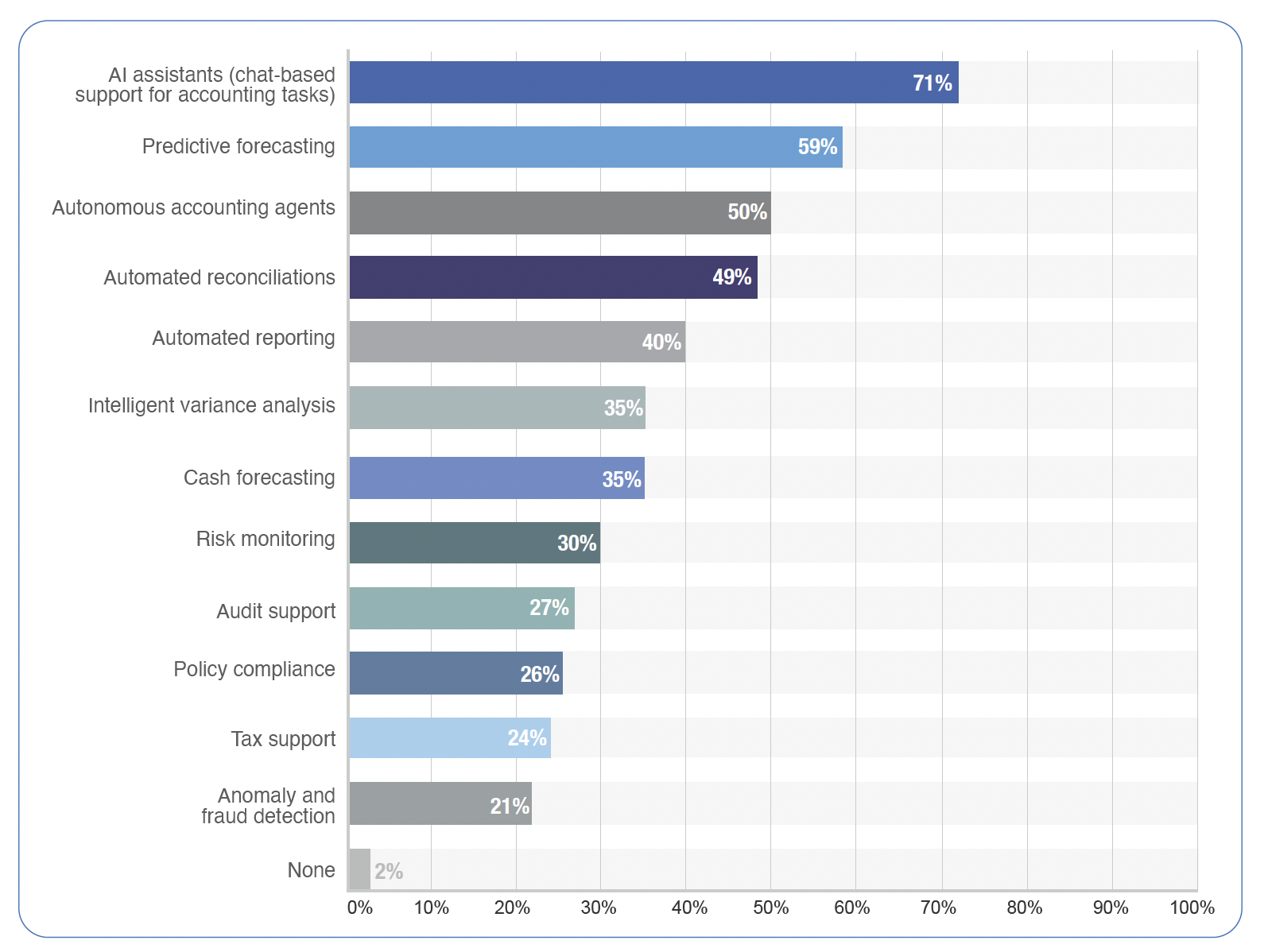
Respondents were asked which AI or automation capabilities they expect their teams to use by 2030:
The breadth of expected adoption is notable.
Today, usage falls off sharply after AI assistants. By 2030, respondents expect several capabilities to reach adoption rates of 40% or higher.
This suggests finance organizations are not simply expecting employees to become more comfortable with AI tools. They anticipate AI and automation becoming embedded in a much broader range of finance activities.
That is a different stage of adoption.
Automated Reconciliations Show How Dramatic the Shift Could Be
One of the clearest examples is account reconciliation.
Only 10% of respondents say their teams actively use automated reconciliations today. By 2030, 49% expect to use them.
That represents a 39-percentage-point increase, one of the largest changes among the capabilities measured.
The significance goes beyond eliminating manual matching.
Reconciliations are a fundamental component of the accounting control environment. Automating them means technology may increasingly identify matches, detect discrepancies, flag exceptions, and determine which items require human attention.
That can reduce a substantial amount of recurring manual work.
It also changes the controller’s responsibility.
Instead of primarily supervising whether employees completed reconciliations correctly and on time, controllers may increasingly need to determine whether the automated reconciliation process itself is operating effectively.
- Are the matching rules appropriate?
- Are exceptions being identified correctly?
- What thresholds require human review?
- Can automated decisions be traced?
- Who can change the rules?
- How are unresolved exceptions escalated?
The process becomes more automated, but the need for oversight remains.
Autonomous Accounting Agents Could Become Mainstream
Autonomous accounting agents provide another indication of where finance may be heading.
Current usage stands at 27%. By 2030, respondents expect adoption to reach 50%.
An AI assistant generally responds when an employee asks it to perform a task. An autonomous agent can potentially perform a series of actions toward an objective with less direct intervention.
That distinction could have substantial implications for finance.
An accounting agent might gather information, monitor transactions, identify exceptions, prepare analyses, initiate workflow steps, or perform other defined activities within a financial process.
As these capabilities advance, the finance operating model begins to change.
Work that previously moved from employee to employee may increasingly move between systems, agents, and people.
The controller then needs to understand where human responsibility begins and ends.
This creates questions around authorization, access, segregation of duties, exception management, documentation, and accountability.
Finance leaders have spent decades designing controls around human workflows. Increasingly, they may need to design controls around a combination of human and automated work.
Predictive Forecasting Could Change How Finance Looks Forward
Predictive forecasting is already the second-most-used AI or automation capability in the study at 31%.
By 2030, respondents expect adoption to reach 59%.
This matters because it connects directly with the changing controller mandate.
Financial planning, analysis, and budgeting is expected to become the controller’s leading responsibility by 2030, while strategic planning ranks second.
As controllers become more forward-looking, forecasting technology is expected to become more sophisticated at the same time.
Predictive systems can potentially incorporate larger data sets, identify relationships that are difficult to detect manually, update forecasts more frequently, and model alternative scenarios.
But greater analytical capability does not remove the need for financial judgment.
Forecasts depend on assumptions. Historical patterns can change. External events can invalidate models. Data can be incomplete or misleading.
The controller’s value may increasingly come from understanding how technology arrived at an output and determining whether that output makes sense in the context of the business.
In that environment, finance professionals may spend less time constructing every element of the forecast and more time evaluating, challenging, and interpreting it.
Automated Reporting Could Change the Reporting Cycle
Automated reporting is expected to increase from 15% today to 40% by 2030.
Reporting has traditionally consumed significant finance capacity through data extraction, consolidation, formatting, checking, updating, and distribution.
Greater automation could reduce many of those activities.
Reports could potentially update as underlying data changes. Narrative explanations could be generated automatically. Variances could be identified and summarized. Management reporting packages could require less manual preparation.
That could shorten the distance between a financial event occurring and management understanding its implications.
But faster reporting creates a new challenge.
If information can be produced continuously, finance leaders need to determine which information requires review before it reaches decision-makers.
Speed does not reduce the importance of accuracy.
The value of automated reporting will therefore depend partly on the controls surrounding the information, not simply the speed at which technology can generate it.
AI Adoption Is Expanding Into Higher-Consequence Finance Activities
Another important pattern appears further down the results.
By 2030:
- 35% expect to use automated cash forecasting.
- 30% expect risk monitoring.
- 27% expect AI or automation for audit support.
- 26% expect policy compliance.
- 24% expect tax support.
These areas generally involve more judgment, regulation, financial exposure, or governance than many basic productivity use cases.
Their expected growth suggests organizations may become increasingly comfortable applying AI to higher-consequence finance activities.
That raises the standard for implementation.
An incorrect draft email generated by an AI assistant may be inconvenient.
An incorrect cash forecast used to make a liquidity decision can have much larger consequences.
An unreliable compliance process can create regulatory exposure.
An inaccurate tax analysis can create financial risk.
As AI moves deeper into finance, the required level of governance should increase with the consequence of the activity.
The Biggest Change Is From Human Execution to Human Oversight
Across the results, a common pattern emerges.
AI assistants primarily help people perform work.
The capabilities expected to grow fastest increasingly allow technology to perform portions of the work itself.
That changes what finance professionals do.
Consider reconciliation again.
In a largely manual process, an employee may gather information, compare balances, investigate differences, document explanations, and submit the completed reconciliation for review.
In a more automated environment, technology may handle much of the matching and identification process.
The employee’s work shifts toward exceptions.
The manager’s work shifts toward reviewing higher-risk items.
The controller’s work shifts toward ensuring that the overall process, rules, data, controls, and escalation procedures remain reliable.
The amount of human activity can decline even as the importance of human judgment increases.
This may become one of the defining characteristics of finance work over the next several years.
Technology Selection Is Only One Part of the Challenge
If finance organizations expect AI usage to become nearly universal by 2030, selecting the right tools will obviously matter.
But the study suggests the larger challenge will be operational.
Automated financial processes require:
- Defined ownership
- Dependable source data
- Appropriate system permissions
- Clear validation procedures
- Exception management
- Human review requirements
- Audit trails
- Controls appropriate to the financial risk involved
Without those foundations, adding automation can create new problems rather than eliminate old ones.
A poorly designed manual process does not necessarily become a good process because AI is added to it.
In some cases, automation may simply allow the organization to execute a flawed process faster.
Controllers should therefore view AI implementation as an opportunity to reconsider the underlying workflow.
- What is the objective of the process?
- Which steps are necessary?
- Which controls still make sense?
- Where is human judgment actually required?
- Which exceptions matter?
- What evidence needs to be retained?
- Who remains accountable for the result?
Those questions should precede decisions about how much of the process can be automated.
The Controller Will Need Visibility Into How Automated Finance Works
The expected adoption rates also reinforce a broader finding from the Controllership 2030 study.
AI management and oversight rises from only 10% of controllers’ top responsibilities today to 34% by 2030.
That increase makes sense in the context of the technologies finance leaders expect to deploy.
If AI is primarily an employee productivity tool, controllers may have relatively limited involvement in its technical operation.
If AI performs reconciliations, generates reports, supports forecasts, monitors risk, assists with compliance, and operates through autonomous accounting agents, the situation changes.
Controllers do not need to build these systems themselves.
But they may increasingly need to understand how the systems affect financial processes.
That includes knowing what data they rely on, what they are authorized to do, where human intervention occurs, how outputs are validated, and what happens when the technology produces an unexpected result.
For the controller, AI proficiency may therefore become less about understanding the technology in isolation and more about understanding how technology changes the financial control environment.
98% Usage Does Not Mean 98% Automation
The projected increase from 86% to 98% usage is a powerful headline, but it is important to interpret it correctly.
It does not mean finance organizations expect virtually all work to be automated by 2030.
It means virtually all respondents expect to use at least one of the AI or automation capabilities measured.
The study separately asks how much of today’s controller responsibilities respondents expect to become automated. Most anticipate substantial change, but not wholesale replacement.
This distinction matters.
The future finance function is unlikely to consist of either humans or AI.
It will increasingly consist of humans working within processes where technology performs a greater share of execution.
The organizational challenge is determining the appropriate division of responsibility.
What This Means for Controllers and CFOs
Finance leaders do not need to wait until 2030 to prepare for this transition.
They can begin by examining where current AI use sits on the spectrum from assistance to execution.
Questions worth considering include:
- Which finance processes are currently using AI only as an employee assistant?
- Which processes could realistically move toward partial automation?
- Where would automation create the greatest capacity?
- Is financial data sufficiently reliable and accessible to support deeper automation?
- Which activities require mandatory human review?
- Who owns exceptions generated by automated processes?
- Can automated financial decisions be reconstructed and explained?
- Do current controls address work performed by AI and automated systems?
- How should roles change as employees spend less time executing recurring tasks?
These questions move the conversation beyond whether finance should adopt AI.
That decision appears increasingly settled.
The more consequential question is how much financial work should technology perform, and how should controllers govern it when it does?
The Next Stage of Finance AI Will Be Operational
The Controllership 2030 findings suggest that finance is approaching a significant transition.
Today, AI assistants dominate adoption.
By 2030, respondents expect predictive forecasting to reach 59%, autonomous accounting agents 50%, automated reconciliations 49%, and automated reporting 40%.
Only 2% expect no AI or automation usage at all.
The future of AI in finance therefore appears to be moving beyond individual productivity.
Technology is expected to enter the processes that produce, analyze, monitor, and govern financial information.
That transition could create substantial efficiency and additional capacity for finance teams.
It will also place greater responsibility on controllers to ensure that increasingly automated processes remain accurate, controlled, traceable, and aligned with the needs of the business.
The next phase of finance AI will not simply be about using technology. It will be about determining which work technology can be trusted to perform.
Explore the Full Controllership 2030 Study
Controllership 2030: The Future of the Corporate Controllerexamines how AI and automation are expected to reshape finance through 2030, including the activities most likely to become automated, changes to finance staffing and organizational structures, emerging governance responsibilities, future controller skills, and the evolving relationship between the Controller and CFO.
Download the full Controllership 2030: The Future of the Corporate Controller study
About the Study Sponsor

Built on insightsoftware’s decades of finance software expertise, Lineos brings finance into focus. It gives teams a single line of sight across the full financial workflow, from budgeting, planning, and reporting through close, consolidation, reconciliation, tax, disclosure, and lease. At every stage, Lineos pulls diverse data from across the business into one place, with powerful AI surfacing the insights that drive action. By freeing finance from spreadsheet forensics and chasing numbers, Lineos enables them to move from reporting the past to shaping what’s next, equipped with the tools they need to drive better decisions and unlock breakthrough insight.