
AI adoption in finance is no longer theoretical.
The Controllership 2030: The Future of the Corporate Controller study finds that 86% of finance organizations are already using at least one of the AI or automation capabilities measured in the survey. Only 14% report no current use.
That headline alone suggests widespread adoption. But a closer look at what finance teams are actually using tells a more nuanced story.
AI assistants are used by 64% of respondents, making them by far the most common AI or automation capability today. Adoption drops considerably when technology moves deeper into accounting processes.
Predictive forecasting is used by 31%. Autonomous accounting agents are at 27%. Automated reconciliations, despite their obvious relevance to accounting, are used by only 10%.
The distinction matters because using AI to assist a finance professional is very different from allowing technology to execute part of a financial process.
For many finance organizations, AI adoption has begun. Operational transformation is still developing.
AI Assistants Dominate Current Finance Adoption
Respondents were asked which AI or automation capabilities their teams actively use today:
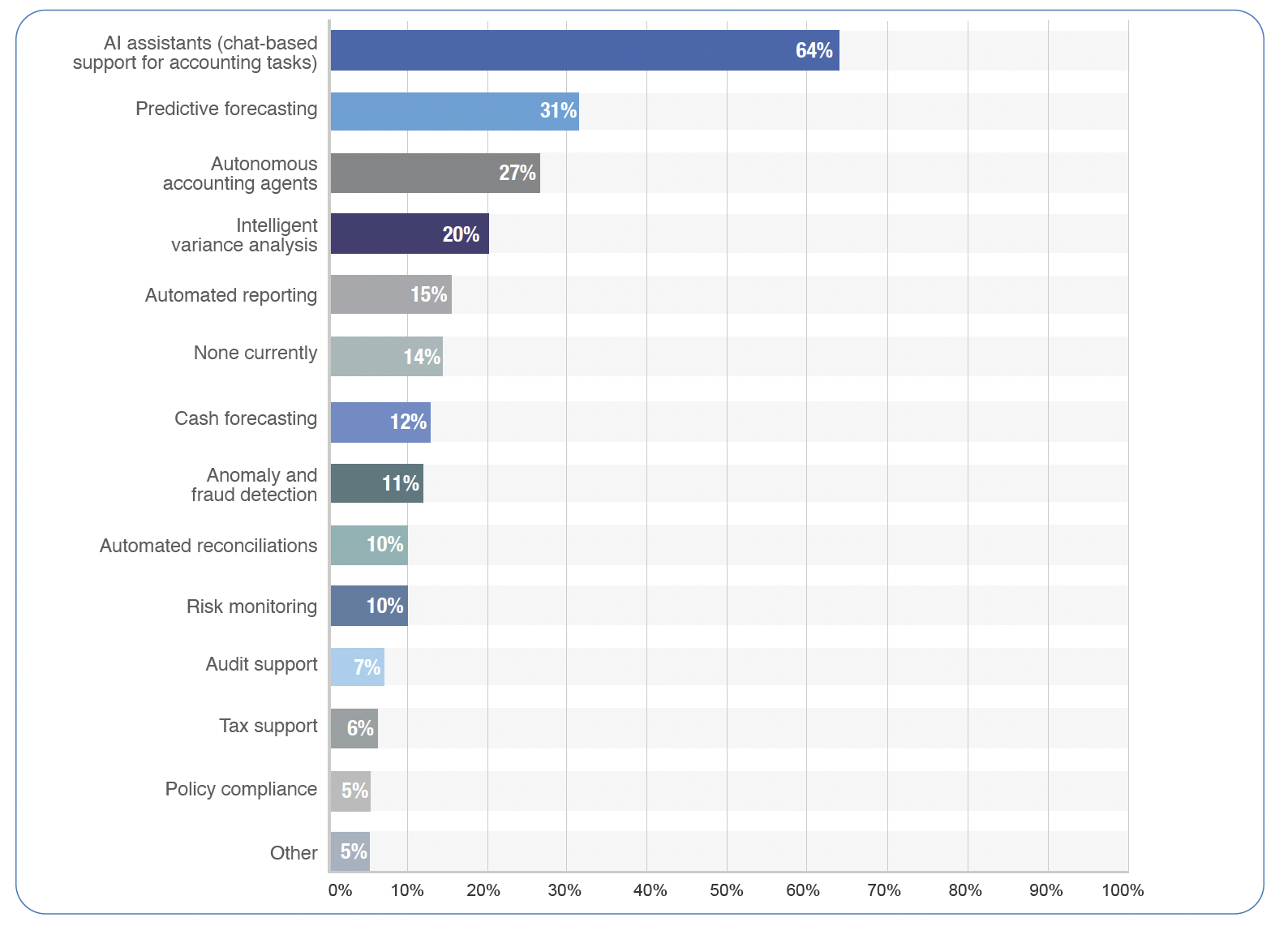
The gap between AI assistants at 64% and nearly every other capability is significant.
It suggests that the most common entry point for AI in finance is also one of the easiest to introduce.
AI assistants can help summarize information, draft communications, analyze data, answer questions, support research, and assist with accounting tasks without necessarily changing the underlying financial architecture.
A finance professional can begin using an AI assistant while the ERP, close process, chart of accounts, approval workflows, and internal controls remain largely unchanged.
That makes assistant-based AI relatively accessible. The next stage is more difficult.
There Is a Major Difference Between AI Assistance and AI Execution
Consider the difference between asking an AI assistant to help analyze an account and allowing an automated system to perform the reconciliation itself.
The first augments an employee. The second changes the process.
That distinction appears throughout the survey results.
Only 15% currently use automated reporting. Automated reconciliations stand at 10%. Risk monitoring is also 10%, while policy compliance is just 5%.
These capabilities require more than employee access to an AI tool.
They may require integration with financial systems, access to reliable source data, defined business rules, appropriate permissions, exception handling, documentation, and controls over how the process operates.
They also raise a more consequential question for controllers:
How much responsibility should technology be allowed to assume inside a financial process?
The answer will differ depending on the process and organization. But it is a substantially different governance question from whether employees should be permitted to use an AI assistant.
Finance Appears to Be in an Intermediate Stage of AI Adoption
The findings suggest that many finance organizations are somewhere between experimentation and deeper operationalization.
AI is already being used.
But much of that usage still occurs alongside established processes rather than within them.
That is an important distinction when organizations evaluate their own AI maturity.
Counting the number of employees with access to an AI assistant may provide one measure of adoption. It says relatively little about whether AI has materially changed how the finance function operates.
A more useful assessment may be to ask where AI sits within the workflow.
- Is it helping an employee draft an explanation of a variance?
- Is it identifying the variance automatically?
- Is it investigating potential causes?
- Can it access the underlying financial information?
- Does it recommend an action?
- Can it execute any portion of that action?
- Where is human review required?
Each step represents a different level of operational reliance on the technology.
Predictive Forecasting Is Already Gaining Ground
The second-most-common capability, predictive forecasting at 31%, is particularly interesting because it points toward a more analytical use of AI.
Forecasting has traditionally depended on historical results, business assumptions, spreadsheets, financial models, and significant manual input.
Predictive capabilities can expand the amount of data considered, identify patterns more quickly, and support scenario analysis.
For controllers, this fits closely with another major finding from the study: financial planning, analysis, and budgeting is already cited among the top responsibilities of 66% of respondents.
As the controller role becomes more forward-looking, the technologies being adopted by finance may follow the same trajectory.
AI’s value to controllership may therefore extend well beyond automating accounting transactions. It can also affect how finance analyzes performance, anticipates outcomes, and supports management decisions.
But predictive capabilities still require judgment.
A more sophisticated forecast does not automatically become a better forecast. Finance leaders still need to understand the inputs, assumptions, limitations, and business context behind the result.
Autonomous Accounting Agents Deserve Attention
Perhaps the most surprising current-adoption figure is 27% for autonomous accounting agents.
That puts agents ahead of intelligent variance analysis, automated reporting, reconciliations, and several other process-specific capabilities.
Autonomous agents represent a potentially important shift because they move AI closer to performing work rather than simply providing information.
Depending on the application, an agent may be able to monitor activity, gather information, complete steps in a workflow, identify exceptions, or initiate actions with varying degrees of human involvement.
For controllers, the significance goes beyond productivity.
The introduction of autonomous systems creates questions that look very familiar from a controllership perspective:
- Who is authorized to perform the work?
- What data can the system access?
- What actions can it take?
- What happens when an exception occurs?
- Who reviews the output?
- How is the activity documented?
- Can the organization reconstruct what happened later?
Those are ultimately questions of accountability and control.
The technology may be new, but many of the underlying principles are not.
Why Core Accounting Automation Is Harder
The relatively low adoption of automated reconciliations, risk monitoring, policy compliance, audit support, and tax support should not necessarily be interpreted as a lack of interest.
These are areas where errors can have meaningful financial, regulatory, or control consequences.
Automating them successfully often requires a foundation that extends beyond the AI itself.
Data needs to be reliable and accessible.
Processes need to be sufficiently standardized.
Systems need to communicate with one another.
Exceptions need to be defined.
Access needs to be controlled.
Outputs need to be traceable.
Human review needs to occur at the appropriate point.
This helps explain why broadly accessible AI tools can spread quickly while automation inside core financial processes moves more deliberately.
The technical capability may exist before the organization is operationally prepared to use it.
The Controller’s AI Role May Grow as Adoption Moves Deeper
This distinction also helps explain why the study finds such a large expected increase in AI management and oversight as a controller responsibility.
Today, only 10% identify AI management and oversight among their top responsibilities. By 2030, that rises to 34%.
The more AI remains an individual productivity tool, the easier it is to treat adoption primarily as a technology or employee-use issue.
As AI becomes embedded in reconciliations, reporting, forecasting, compliance, and other financial processes, it moves directly into the controller’s domain.
The controller becomes concerned not simply with whether the technology works, but whether the financial process remains reliable.
That can require determining appropriate levels of human review, establishing validation procedures, managing exceptions, monitoring access, documenting automated activity, and ensuring that the control environment evolves alongside the technology.
AI adoption in finance therefore has a governance dimension that may become more important as adoption matures.
Finance Leaders Should Measure Depth, Not Just Adoption
The finding that 86% of respondents currently use AI or automation is an important indicator of how quickly these technologies have entered finance.
But it should not become the only measure organizations use to benchmark themselves.
Two finance organizations can both report using AI while operating at very different levels of maturity.
One may have employees using AI assistants to draft emails and summarize documents.
Another may have AI integrated with forecasting, reporting, reconciliation, and accounting workflows.
Both have adopted AI. Their operating models are very different.
Finance leaders may benefit from measuring adoption across several dimensions:
- How many finance employees actively use AI?
- Which workflows include AI or automation?
- Is AI assisting employees or executing work?
- Which financial systems and data sources are connected?
- What level of human review is required?
- How are automated outputs validated?
- Which controls have been redesigned because of automation?
- How much manual work has actually been removed?
These questions provide a better indication of whether AI has changed the finance function itself.
The Next Stage of Finance AI Will Be More Difficult
The first wave of finance AI adoption has benefited from tools that can be deployed relatively quickly.
The next wave may require more organizational work.
Moving from assistants toward automated accounting processes requires integration, data readiness, process redesign, governance, controls, and confidence in the outputs.
It also requires finance teams to decide which work should remain human, which work can be automated, and where the two should operate together.
That makes the next stage less about simply introducing another AI tool and more about redesigning how finance work gets done.
The study’s expectations for 2030 indicate that finance leaders believe this transition will happen.
Predictive forecasting is expected to rise from 31% today to 59%. Autonomous accounting agents increase from 27% to 50%. Automated reconciliations jump from 10% to 49%, while automated reporting rises from 15% to 40%.
Only 2% expect to use none of the AI or automation capabilities measured by 2030.
If those expectations are realized, finance will move from widespread AI access toward much deeper AI execution.
What This Means for Controllers and CFOs
For finance leaders, the current adoption data provides an opportunity to assess where their organizations actually stand.
Useful questions include:
- Is AI primarily being used as an employee assistant, or is it embedded in finance workflows?
- Which accounting processes are sufficiently standardized to support greater automation?
- Is the underlying financial data reliable enough for automated decision-making?
- Where should human review remain mandatory?
- Who is accountable for validating AI-generated financial work?
- Do existing internal controls account for processes performed partially or fully by technology?
- Which current use cases could progress from assistance to execution over the next several years?
The objective should not be to automate every finance process simply because the technology makes it possible.
The more important goal is to identify where AI and automation can improve finance while preserving the reliability, control, and accountability the function requires.
Today, AI assistants dominate finance adoption.
By 2030, respondents expect a much more automated environment.
The transition between those two states may prove to be one of the defining challenges for the next generation of controllership.
Explore the Full Controllership 2030 Study
Controllership 2030: The Future of the Corporate Controller™ examines how AI and automation are changing finance, which accounting activities are most likely to become automated, how controller responsibilities could evolve, what skills will become more valuable, and how finance organizations may need to change over the next several years.
Download the full Controllership 2030: The Future of the Corporate Controller study
About the Study Sponsor

Built on insightsoftware’s decades of finance software expertise, Lineos brings finance into focus. It gives teams a single line of sight across the full financial workflow, from budgeting, planning, and reporting through close, consolidation, reconciliation, tax, disclosure, and lease. At every stage, Lineos pulls diverse data from across the business into one place, with powerful AI surfacing the insights that drive action. By freeing finance from spreadsheet forensics and chasing numbers, Lineos enables them to move from reporting the past to shaping what’s next, equipped with the tools they need to drive better decisions and unlock breakthrough insight.