For decades, the Corporate Controller’s role has been anchored in a familiar set of responsibilities: financial reporting, accounting accuracy, controls, and stewardship.
Those responsibilities are not going away. But finance leaders expect the amount of attention controllers devote to them to change considerably over the next several years.
The Controllership 2030: The Future of the Corporate Controller study asked more than 300 corporate finance executives and professionals what they expect their top three duties or responsibilities to be by 2030.
The results point toward a controller who remains responsible for financial integrity but spends considerably more time on planning, strategy, technology, and oversight.
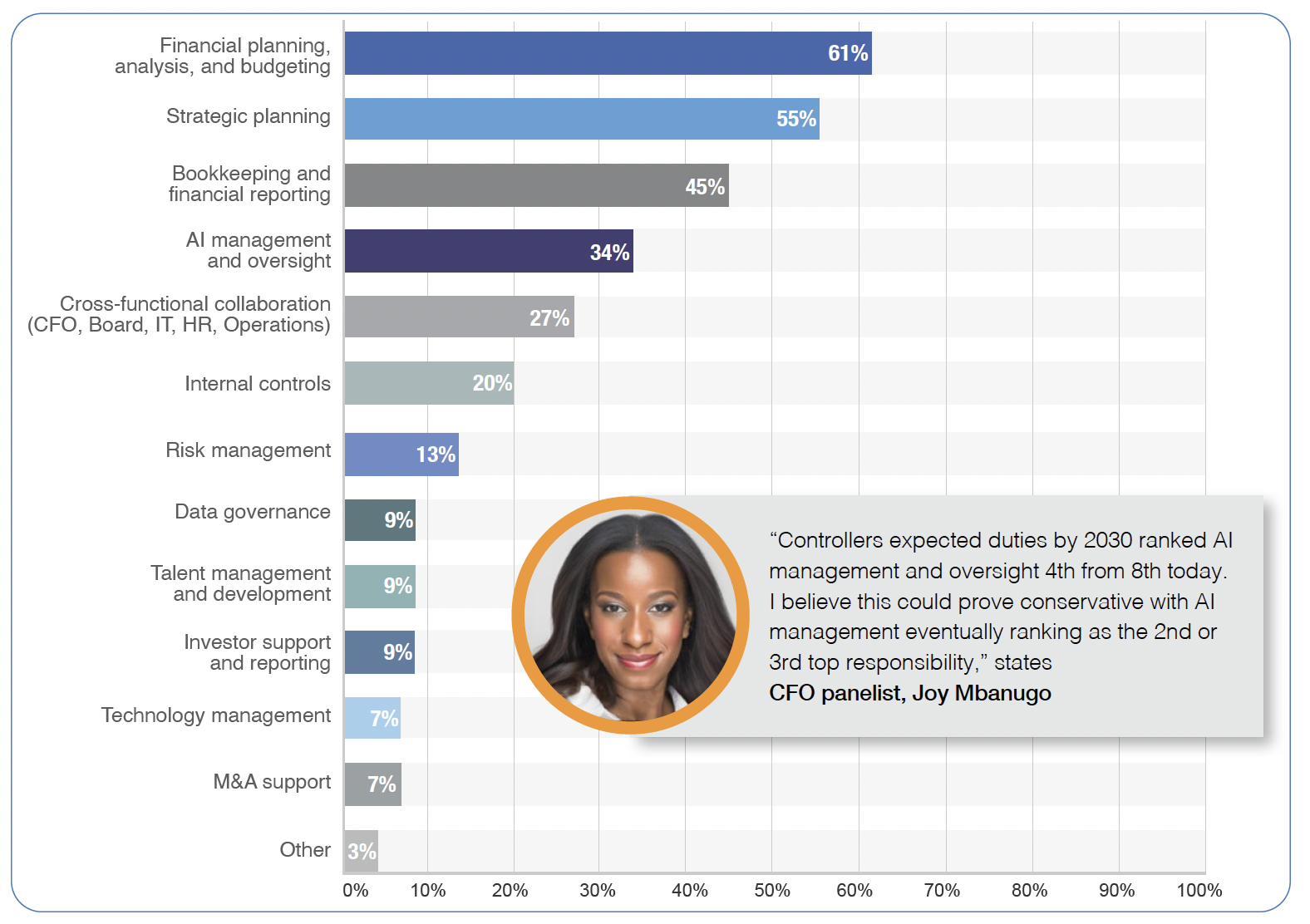
Financial planning, analysis, and budgeting becomes the leading responsibility at 61%, followed by strategic planning at 55%. Bookkeeping and financial reporting falls to third at 45%. Most notably, AI management and oversight rises from just 10% today to 34% by 2030.
The shift suggests that the future of controllership may be defined less by abandoning traditional responsibilities than by expanding what financial stewardship requires.
FP&A Becomes the Controller’s Leading Responsibility
FP&A already ranks second among controllers’ responsibilities today at 66%. By 2030, respondents expect it to occupy the top position.
The change in ranking matters more than the movement in percentage.
It suggests that forward-looking financial management may become the center of gravity for the controller role.
Controllers have historically been responsible for explaining what happened financially. Increasingly, they may also be expected to help determine what happens next.
That requires a different allocation of leadership attention toward forecasting, scenario analysis, budgeting, resource allocation, performance management, and the financial implications of business decisions.
Strategic Planning Moves Closer to the Center of Controllership
Strategic planning shows an even clearer increase, rising from 42% today to 55% by 2030.
That moves strategy firmly into the controller’s expected core responsibilities.
Controllers occupy a distinctive position inside an organization because they see the business through both an operational and financial lens. They understand how revenue, costs, working capital, investments, controls, and accounting decisions ultimately flow through financial performance.
As controllers become more involved in strategy, that knowledge can be applied earlier in the decision-making process.
Instead of primarily explaining the financial consequences after decisions are made, controllers can contribute to evaluating those decisions beforehand.
That may include assessing investments, evaluating growth initiatives, modeling alternative scenarios, challenging assumptions, identifying risks, and determining whether strategic plans are supported by the organization’s financial capacity.
The controller consequently becomes more closely connected to the decisions that create financial results, rather than primarily the processes that report them.
Financial Reporting Declines in Prominence, Not Importance
One of the most important findings requires careful interpretation.
Bookkeeping and financial reporting falls from 68% among today’s top responsibilities to 45% in 2030.
That does not mean accurate financial reporting becomes less important.
Controllers will still be accountable for the integrity of financial information. Accounting standards will still need to be applied. The close will still need to occur. Financial statements will still need to be reliable.
What may change is the amount of controller attention required to produce that information.
The study anticipates substantial automation across many of the processes that currently support reporting. Respondents expect reconciliations, journal entries, month-end close, accounts payable, and other recurring finance activities to become increasingly automated.
If systems perform more transaction processing, reconciliation, reporting preparation, and routine analysis, controllers may spend less time supervising the mechanics of producing financial information.
The report describes the resulting shift as greater responsibility for interpreting results and supervising the processes that produce them.
That is an important distinction.
Financial reporting can become a smaller share of the controller’s workload while remaining one of the function’s most important accountabilities.
AI Oversight Makes the Largest Leap
The most dramatic change is AI.
Today, only 10% of respondents identify AI management and oversight among their top three controller responsibilities.
By 2030, that figure rises to 34%, a 24-percentage-point increase.
That moves AI management and oversight from a relatively minor responsibility today to the fourth-ranked controller responsibility in 2030.
This deserves attention because it suggests finance leaders do not expect responsibility for AI to remain exclusively within IT, data science, or a centralized technology function.
As AI enters accounting and finance processes, controllers may increasingly become responsible for how it is used within their domain.
That could include determining which processes are appropriate for AI, establishing review requirements, overseeing automated financial workflows, validating outputs, monitoring exceptions, and ensuring that AI-enabled processes remain consistent with financial controls.
In other words, controllers do not necessarily need to become AI engineers.
They do need to understand enough about AI to remain accountable for financial work increasingly performed with it.
Financial Stewardship Is Expanding to Include Technology
This may be one of the most important ways to think about the controller of 2030.
Traditionally, financial stewardship has centered on the reliability of financial records, accounting processes, controls, and reporting.
But what happens when an increasing portion of those processes is automated?
Responsibility does not disappear simply because the work is performed by technology.
If an automated reconciliation produces an exception, someone must determine how that exception is handled.
If an AI system generates an analysis used in a forecast, someone must understand whether the underlying data and assumptions are reliable.
If an autonomous accounting agent performs work that previously required direct employee intervention, someone must establish the boundaries within which it can operate.
The study connects this future responsibility with understanding how automated systems reach conclusions, which data they use, where human review is required, and how automated outputs affect reporting and decision-making.
For controllers, that effectively extends financial stewardship into technology-enabled work.
The Controller May Become the Bridge Between Finance and Technology
There is an interesting distinction in the findings.
AI management and oversight reaches 34% among expected responsibilities, while broader technology management is selected by only 7%.
That suggests respondents are not necessarily envisioning the controller becoming responsible for enterprise technology.
Instead, the controller may assume greater responsibility for the financial application and governance of technology.
IT can manage infrastructure, security architecture, integrations, and enterprise systems. Technology teams can develop or configure AI capabilities.
The controller’s responsibility is different.
Finance leaders need to determine whether those capabilities are appropriate for accounting and financial processes, whether the underlying information can be trusted, whether adequate controls exist, and whether outputs are suitable for financial decision-making.
That makes the controller an increasingly important bridge between accounting requirements and technology capabilities.
Automation Could Create the Capacity for a More Strategic Controller
There is also a practical question behind this expanded mandate: where will controllers find the time?
The answer may be automation itself.
The study finds that 43% of respondents expect more than 40% of today’s controller responsibilities to be automated by 2030.
That does not imply that 43% of controller positions disappear.
Instead, automation could change the composition of the job.
Time currently spent supervising reconciliations, reviewing routine journal activity, preparing reports, gathering data, or managing other recurring processes could shift toward analysis, planning, exceptions, governance, and business support.
This creates an important management challenge.
Automation alone does not automatically create a more strategic finance organization. It creates capacity.
Finance leaders still need to decide how that capacity will be used.
If a controller saves ten hours through automation but continues performing the same responsibilities in essentially the same way, the organization may capture an efficiency gain without fundamentally changing the role.
The larger opportunity is to deliberately redirect capacity toward the responsibilities that respondents expect to become more important.
The Controller-CFO Boundary May Begin to Move
The rise of FP&A and strategic planning also has implications for finance leadership.
Many responsibilities traditionally associated with the CFO are becoming more prominent within controllership.
That does not necessarily mean the two positions converge. It may mean the controller assumes a larger portion of the finance operating model while the CFO concentrates more heavily on enterprise strategy, capital, investors, boards, transactions, and external stakeholders.
Later findings in the study reinforce this possibility: 61% expect controllers to absorb more responsibilities traditionally held by CFOs, while 59% expect a more distinct division between operational and strategic duties.
The changing controller mandate therefore needs to be considered alongside the changing CFO mandate.
As the controller moves further into planning, technology, governance, and decision support, finance organizations may need to become more explicit about where responsibility sits between the two roles.
The Future Role Requires a Broader Definition of Controller Readiness
The implications extend beyond today’s controllers.
Organizations developing the next generation of finance leaders need to consider whether traditional controller career paths provide sufficient preparation for the role respondents describe.
Technical accounting expertise remains essential.
But a controller whose leading responsibilities include FP&A, strategic planning, AI oversight, and cross-functional collaboration will also need capabilities in analytics, technology, communication, business strategy, and leadership.
The study later makes that skills shift particularly clear. Eighty-one percent identify practical AI skills and tool proficiency as among the most valuable controller skills for 2030, while 64% select data analysis and analytics. Technical accounting remains important at 41%.
The implication is not that accounting expertise is being replaced.
It is that accounting expertise alone may no longer be sufficient preparation for the controller role.
Controllers Should Begin Reallocating Their Own Attention
2030 is close enough that this cannot remain a long-range workforce discussion. Organizations can begin by examining how controllers spend their time today:
- How much leadership attention goes toward recurring accounting processes?
- How much goes toward interpreting financial information?
- How involved is the controller in planning and major business decisions?
- Who owns AI oversight within finance?
- Who is responsible for understanding the controls around automated processes?
- Where could technology reduce manual supervision and create additional capacity?
These questions can help finance leaders determine whether the role is already evolving in the direction respondents expect.
They can also identify where organizational structures, technology investments, and professional development need to change.
What This Means for Controllers and CFOs
The comparison between today’s responsibilities and those expected in 2030 provides one of the clearest indications of where controllership is heading.
Financial reporting remains important, but its relative prominence declines.
FP&A moves into the leading position.
Strategic planning expands.
AI management and oversight makes the largest jump of any responsibility measured.
For finance leaders, several questions deserve consideration now:
- Is the controller sufficiently involved in planning and strategic decisions?
- Which current responsibilities could become substantially automated before 2030?
- How should capacity created by automation be redeployed?
- Who will own AI oversight within accounting and finance?
- Does the controller understand how automated financial processes are governed and validated?
- Which responsibilities should remain with the CFO, and which could increasingly move to the controller?
- Are succession and development plans preparing future controllers for this broader mandate?
The controller of 2030 is unlikely to stop being the organization’s financial steward.
Instead, financial stewardship itself is becoming broader.
Reliable reporting will remain fundamental, but controllers may increasingly create value by interpreting financial information, guiding planning, governing technology-enabled processes, and helping leadership make better decisions.
That is a considerably larger mandate than controllership has traditionally carried.
Explore the Full Controllership 2030 Study
The changing controller mandate is one of several major themes explored in Controllership 2030: The Future of the Corporate Controller.
The full research examines how AI and automation are being used today and where adoption is heading, which finance activities are most likely to become automated, how finance teams may be restructured, what governance responsibilities will emerge, which skills future controllers will need, and how the Controller-CFO relationship may evolve.
Download the full Controllership 2030: The Future of the Corporate Controller study.
About the Study Sponsor

Built on insightsoftware’s decades of finance software expertise, Lineos brings finance into focus. It gives teams a single line of sight across the full financial workflow, from budgeting, planning, and reporting through close, consolidation, reconciliation, tax, disclosure, and lease. At every stage, Lineos pulls diverse data from across the business into one place, with powerful AI surfacing the insights that drive action. By freeing finance from spreadsheet forensics and chasing numbers, Lineos enables them to move from reporting the past to shaping what’s next, equipped with the tools they need to drive better decisions and unlock breakthrough insight.