The rapid increase in finance and accounting compensation over the past year appears unlikely to be a short-lived event.
While many organizations expected salary pressures to ease as inflation moderated and hiring activity stabilized, finance leaders are forecasting another year of above-average compensation growth. The outlook suggests that employers continue to anticipate a highly competitive labor market, particularly for experienced professionals whose expertise has become increasingly difficult to replace.
The Corporate Finance & Accounting Talent Study 2026 found that organizations expect average salary increases of 6.0 percent for clerical and administrative staff, 5.9 percent for managers, 4.5 percent for executives, and 4.4 percent for directors during the next twelve months. Although these projections are modestly lower than the actual increases reported during the previous year, they remain substantially higher than historical norms and nearly double the salary growth reported in the 2025 study.
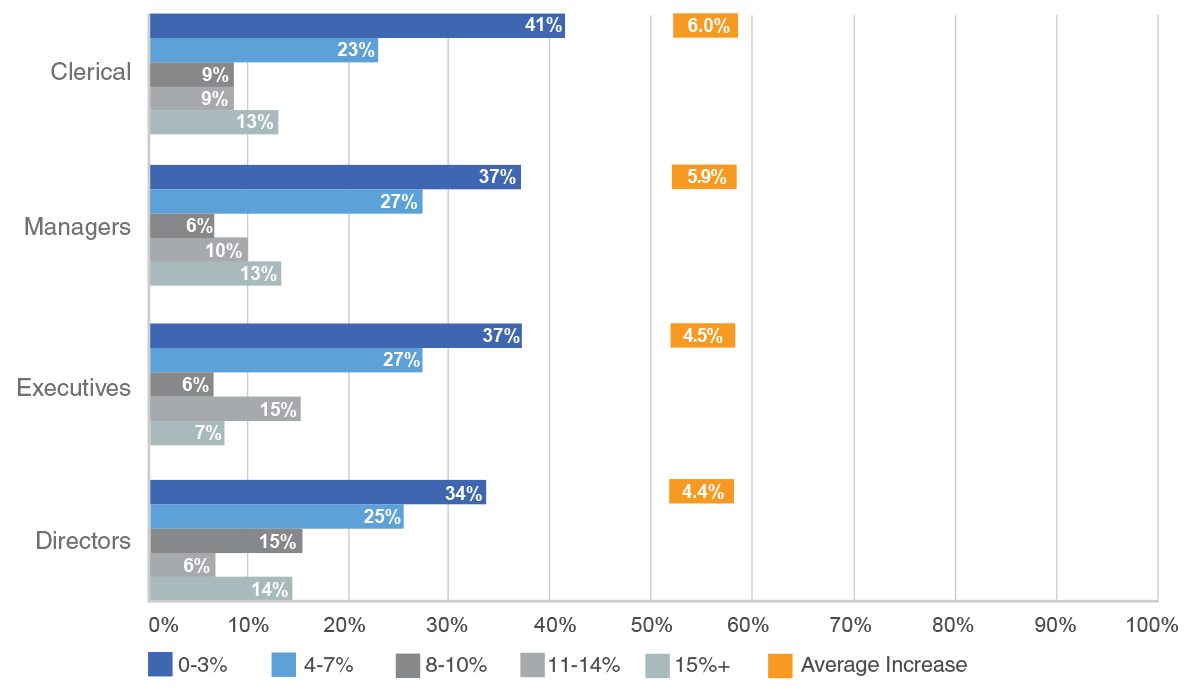
These projections reveal an important shift in employer expectations. Finance leaders are no longer budgeting for a temporary spike in compensation. Instead, they appear to be planning for a labor market in which higher salaries remain necessary to attract and retain qualified talent.
Employers Expect Competition to Continue
Compensation forecasts provide a useful measure of executive confidence because they reflect decisions made before hiring occurs. Organizations build salary assumptions into annual budgets based on what they believe the labor market will require rather than what has already happened.
The projected increases in this year’s study indicate that finance leaders expect recruiting conditions to remain challenging throughout the coming year.
That expectation aligns closely with the broader findings in the research. Organizations continue reporting significant shortages of finance and accounting talent, while hiring plans have strengthened considerably compared with the previous year. When employers anticipate filling more positions while simultaneously expecting qualified candidates to remain scarce, higher compensation becomes a logical budgeting assumption rather than a reactive measure.
Rather than forecasting a return to pre-pandemic salary growth, finance organizations appear to be preparing for continued competition across nearly every level of the accounting function.
The Distribution of Salary Growth Is Changing
One of the more interesting findings from the compensation forecast is that projected increases are relatively balanced across organizational levels.
Clerical and administrative employees lead expected increases at 6.0 percent, followed closely by managers at 5.9 percent. Executives and directors are projected to receive somewhat smaller increases, though both remain well above historical averages.
This distribution differs from compensation cycles in which executive leadership receives disproportionately larger increases than the broader workforce.
Instead, employers appear focused on maintaining stability throughout the finance organization. That approach reflects the operational reality that accounting departments depend on experienced professionals across multiple functions. Financial reporting, payroll, accounts payable, treasury, tax, budgeting, compliance, and financial planning all require institutional knowledge that can be difficult and expensive to replace.
Organizations therefore appear willing to invest across the entire finance function rather than concentrating resources exclusively on senior leadership.
Budgeting for Uncertainty
Forecasting compensation has become more challenging than it was only a few years ago.
Finance leaders must balance several competing forces simultaneously. Hiring demand remains strong, talent shortages persist, and employees continue expecting competitive pay. At the same time, organizations face uncertainty surrounding economic growth, interest rates, geopolitical developments, and future business investment.
The projected salary increases reflect that balance.
They remain aggressive enough to acknowledge continued labor market pressure while stopping short of assuming that compensation will continue accelerating indefinitely. Employers appear to expect stability rather than another dramatic escalation.
For CFOs, this represents a practical budgeting exercise. Compensation is often the single largest expense within a finance organization, making salary assumptions one of the most consequential decisions during the annual planning process.
Retention Budgets May Become More Important Than Recruiting Budgets
Organizations often focus their compensation discussions on attracting new employees.
The survey suggests retention deserves equal attention.
Replacing experienced finance professionals has become increasingly expensive. Beyond recruiting fees and salary negotiations, turnover introduces productivity losses, onboarding costs, training requirements, delayed projects, and the loss of institutional knowledge accumulated over many years.
Those indirect costs frequently exceed the cost of providing competitive salary adjustments to existing employees.
Forward-looking organizations increasingly recognize that compensation planning should prioritize retention alongside recruiting. Well-timed salary reviews, market benchmarking, performance incentives, and career progression discussions often produce stronger long-term financial outcomes than repeatedly replacing experienced employees.
As competition for finance talent continues, organizations that proactively address compensation concerns may reduce turnover while strengthening organizational continuity.
Salary Growth Alone Will Not Solve Workforce Challenges
Although compensation remains essential, the study reinforces that salary is only one component of an effective workforce strategy.
Elsewhere in the research, respondents identify career advancement opportunities as the leading reason finance professionals leave their organizations, surpassing compensation and benefits. Professional development, workplace flexibility, organizational culture, leadership quality, and opportunities to work with modern finance technology all influence retention decisions.
This finding carries an important lesson for employers.
Increasing salaries without improving career pathways or employee development may slow turnover temporarily, but it rarely creates lasting loyalty. Experienced professionals continue evaluating employers based on long-term career prospects rather than annual compensation adjustments alone.
The organizations most likely to retain top talent will therefore combine competitive pay with visible advancement opportunities, leadership development, meaningful work, and investments in technology that improve the employee experience.
Finance Technology May Offset Cost Pressures
As compensation expenses continue rising, many finance leaders will look for ways to improve productivity without proportionally increasing headcount.
Automation, artificial intelligence, and modern ERP platforms are becoming increasingly important components of that strategy.
Technology enables finance organizations to automate reconciliations, reporting workflows, document processing, approvals, and routine accounting activities. Those efficiency gains allow experienced professionals to spend more time supporting forecasting, business analysis, compliance, internal controls, and executive decision-making.
Rather than reducing the value of finance professionals, technology increases the return organizations receive from highly skilled employees.
Employers that successfully combine competitive compensation with productivity-enhancing technology may be better positioned to absorb rising labor costs while continuing to improve finance performance.
What This Means for Finance Leaders
The projected compensation increases in the Corporate Finance & Accounting Talent Study 2026 suggest that finance organizations are planning for another year of elevated salary growth rather than expecting labor market conditions to normalize.
Although projected increases are slightly below the exceptional gains reported during the previous year, they remain historically strong and reflect continued confidence that competition for experienced finance professionals will persist. Combined with the study’s findings on hiring plans and talent shortages, the projections indicate that workforce planning will remain one of the most important priorities for CFOs and Controllers during the coming year.
Organizations that approach compensation as part of a broader talent strategy, balancing competitive pay with leadership development, technology investment, career progression, and employee engagement, will likely be in the strongest position to attract and retain the finance professionals needed for long-term success.
Download the complete Corporate Finance & Accounting Talent Study 2026 to explore all survey findings, benchmarking data, and analysis covering compensation trends, hiring plans, talent shortages, AI adoption, recruiting, retention, and the future of corporate finance and accounting.