

Selecting an enterprise resource planning (ERP) system is among the most significant technology decisions a finance organization will undertake. The platform a company chooses will influence financial reporting, operational efficiency, internal controls, scalability, and decision-making for years to come. During the recent Controllers Council and Citrin Cooperman webinar, Selecting Your Next ERP: What Every CFO and Controller Needs to Know, Citrin Cooperman Partners Shahrooz Shams and Jory Weissman shared a practical framework for evaluating ERP solutions, reducing implementation risk, and preparing organizations for long-term success.
Rather than focusing on software features alone, the discussion centered on the planning, governance, and organizational readiness that separate successful ERP initiatives from disappointing ones.
ERP Leadership Has Shifted to Finance
One of the opening themes was that ERP strategy has increasingly become a finance-led initiative rather than an IT-driven project.
As Weissman explained: “ERP has moved from IT to finance.”
He noted that finance leaders have evolved beyond simply reporting historical results.
“I think the finance community has transcended from doing forensic autopsies of what has happened in the past to being proactive contributors to the future state.”
Because finance teams ultimately own the financial data flowing through the organization, CFOs and Controllers are increasingly responsible for guiding ERP strategy, evaluating technology investments, and aligning implementation with business objectives.
Preparation Determines the Outcome
Organizations often devote substantial attention to software demonstrations. According to Shams, the real work begins long before any vendor presentation.
He observed: “Every successful ERP project, it goes back to decisions that made before even they even saw the demo.”
He continued: “The demo is where things become visible, but the outcomes usually already determined by that point.”
Instead of beginning with product comparisons, organizations should first understand their own operations, future growth plans, reporting requirements, and organizational priorities. Only after establishing those fundamentals should they evaluate vendors.
The presenters organized this planning process into four stages:
- Diagnose current business requirements.
- Prioritize organizational objectives.
- Reduce implementation risk.
- Build a defensible business case before making a final decision.
Understand Your Business Before Selecting Software
A recurring message throughout the session was that organizations sometimes purchase software based on reputation instead of business fit.
Shams cautioned: “People buying on brand, because that’s I’ve heard from others, you know, it’s a great ERP, it’s a great financial system.”
Instead, finance leaders should evaluate whether a platform supports their own operational requirements.
Questions to answer before beginning product evaluations include:
- Is the organization managing multiple entities or currencies?
- Does revenue recognition require additional sophistication?
- Are supply chain or manufacturing operations involved?
- What level of growth is expected over the next five to ten years?
- Will acquisitions or expansion create additional complexity?
The answers to those questions should shape the evaluation process far more than product popularity.
Look Beyond Software Licensing Costs
ERP investments extend well beyond implementation fees and subscription pricing.
The presenters encouraged attendees to evaluate total cost of ownership over a five-year period, including:
- Ongoing application support
- Internal staffing requirements
- User training
- Change management
- Integration costs
- Continuous optimization after go-live
While cloud-based ERP platforms eliminate many traditional infrastructure responsibilities, organizations still need internal ownership.
Shams emphasized: “You need continuous optimization to make it do new functionality in your business.”
An ERP implementation should therefore be viewed as an ongoing business capability rather than a one-time technology project.
Change Management Often Determines Success
Perhaps the strongest message of the webinar concerned organizational readiness.
Shams explained: “Selection determines the ceiling. Implementation determines whether you actually reach it.”
The presenters identified several factors that consistently influence project outcomes:
- Executive sponsorship from finance leadership
- Clean and reliable master data
- Sufficient internal project capacity
- Structured change management
- Early user involvement
- Formal training before go-live
Shams also stressed the importance of assigning ownership inside the organization.
“The single best predictor of success is adoption.”
Organizations that prepare employees for new processes and establish internal champions are generally better positioned to realize the full value of their ERP investment.
Replacement Is Not Always the Right Answer
An important discussion focused on whether companies need a new ERP.
The presenters described three possible approaches:
- Replace an outdated or unsupported ERP.
- Extend an existing platform with specialized applications.
- Delay major investment until the organization is better prepared.
For companies running modern ERP systems, extending existing capabilities through reporting tools, industry-specific applications, or AI-powered analytics may deliver substantial value without requiring a complete replacement.
The appropriate decision depends on current capabilities, business strategy, and organizational readiness rather than software age alone.
How We Think About the ERP Landscape
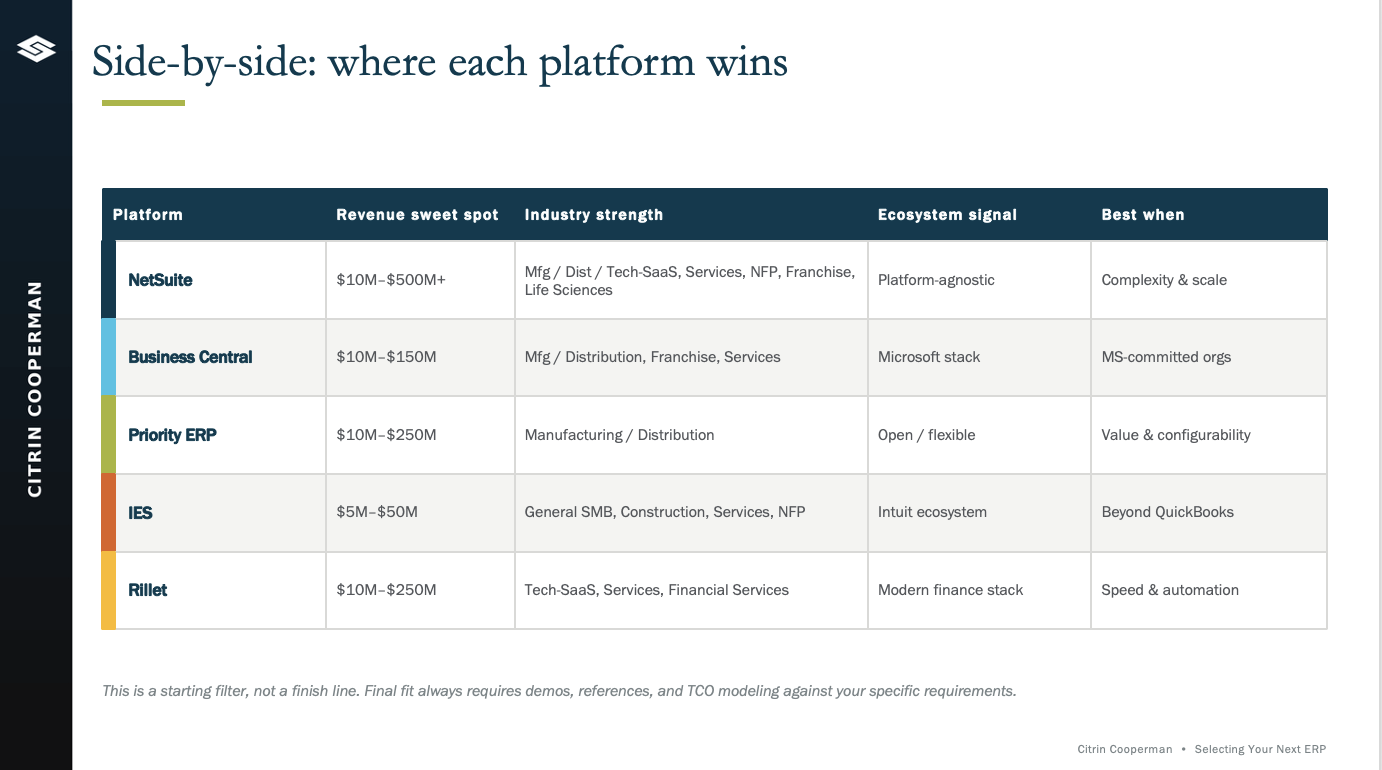
The presenters encouraged attendees to think beyond product names and instead evaluate ERP platforms based on their organization’s size, operational complexity, industry, technology environment, and growth plans. While no single solution fits every business, each platform offers advantages for specific use cases.
The webinar highlighted several leading mid-market ERP platforms:
- NetSuite: Best suited for organizations with multiple entities, global operations, and significant growth plans.
- Microsoft Business Central: A strong option for companies already invested in the Microsoft ecosystem.
- Priority ERP: Well suited for manufacturers and distributors seeking flexibility and operational depth.
- Intuit Enterprise Suite (IES): Designed for businesses that have outgrown QuickBooks but are not yet ready for a full ERP.
- Rillet: An AI-native finance platform built for modern finance teams, particularly SaaS and service-based organizations.
The speakers emphasized that this comparison is intended as a starting point. A successful ERP selection still requires thorough requirements gathering, demonstrations, and a complete evaluation of implementation readiness and total cost of ownership.
Building a Strong Business Case
When presenting an ERP initiative to executive leadership or the board, finance leaders should balance measurable savings with broader operational benefits.
The discussion highlighted several areas to evaluate:
- Infrastructure and maintenance savings
- Process automation
- Reduced manual effort
- Improved audit readiness
- Faster financial close
- Better reporting visibility
- Improved employee experience
- Reduced technology risk
Some benefits are straightforward to quantify, while others strengthen long-term operational performance even if they are less easily measured.
AI Is Becoming Part of the ERP Conversation
Artificial intelligence also received considerable attention.
Rather than viewing AI as a separate initiative, the presenters described three approaches emerging across ERP platforms:
- AI-native platforms built around automation
- Established ERP systems with embedded AI capabilities
- External AI tools connected through integrations
Shams explained that embedded AI will continue expanding inside ERP systems, but organizations should not expect ERP functionality to replace every AI initiative across the business.
Instead, finance leaders should evaluate how AI fits within their broader data and technology strategy.
A Disciplined Selection Process Produces Better Results
The webinar concluded with a reminder that software demonstrations should come after careful planning rather than before it.
Weissman summarized the recommended sequence:
- Discovery
- Detailed requirements gathering
- Thoughtful evaluation
- Product demonstrations
- Total cost of ownership analysis
- Business case development
- Final recommendation
He encouraged organizations to follow this structured approach regardless of whether they conduct the selection internally or work with an outside advisor.
Final Thoughts
ERP decisions shape financial operations for many years. Although every organization has unique requirements, the principles discussed during this session remained consistent throughout the presentation. Understand the business before evaluating products. Invest in planning before implementation begins. Treat change management as a core component of the project rather than an afterthought. Most importantly, evaluate ERP platforms according to organizational needs rather than marketplace recognition.
Organizations that follow a disciplined evaluation process place themselves in a much stronger position to improve reporting, strengthen operational visibility, and support future growth with confidence.
To hear the complete discussion from Shahrooz Shams and Jory Weissman, including their ERP evaluation framework, implementation guidance, platform comparisons, and audience Q&A, watch the on-demand webinar here.
About Our Sponsor
Citrin Cooperman is one of the nation’s largest professional services firms, the 19th largest CPA/accounting firms in the U.S. and ranked the 28th largest technology consulting firm in the U.S. by Accounting Today. Citrin Cooperman Digital Services include Microsoft, NetSuite, VENA, Salesforce, Cybersecurity and more. Citrin Cooperman is headquartered in NYC with offices nationally. Learn more at www.CitrinCooperman.com.