For much of the past decade, workforce planning in finance centered on recruiting. When a position became vacant, organizations searched for qualified candidates, extended an offer, and hoped the new employee would remain long enough to justify the investment.
That approach is becoming increasingly difficult to sustain.
As experienced finance professionals become harder to recruit and retain, many organizations are recognizing that hiring alone cannot solve the growing talent gap. Instead, employers are shifting their attention toward developing existing employees, expanding technical capabilities, and preparing finance teams for responsibilities that continue to evolve through automation, artificial intelligence, and changing business expectations.
The Corporate Finance & Accounting Talent Study 2026 reflects that change in strategy. Internal training programs are the most common approach to addressing finance and accounting skills gaps, cited by 74 percent of respondents. External training and professional certification programs follow at 53 percent, while 36 percent supplement internal capabilities through consultants or outsourcing. Only 8 percent report hiring internationally to address talent shortages.
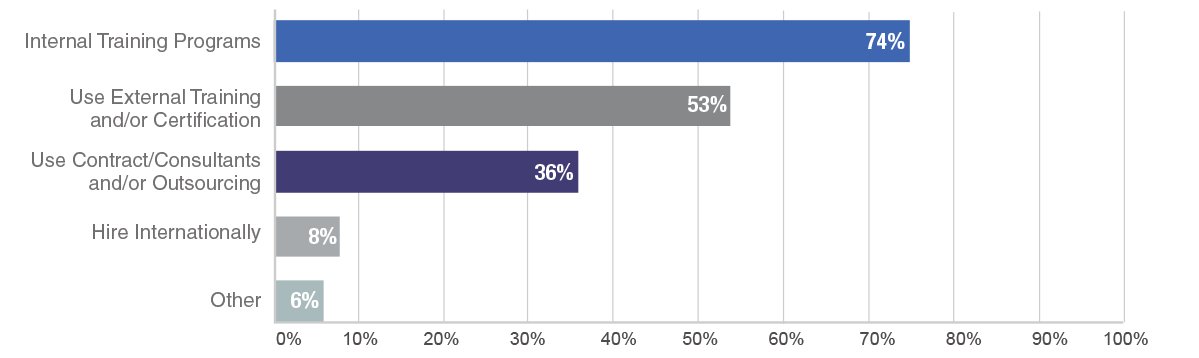
These findings suggest that finance leaders increasingly view workforce development as a long-term business investment rather than simply an employee benefit. Organizations appear to recognize that cultivating talent internally often provides a more reliable solution than competing for an increasingly limited supply of experienced professionals.
Internal Development Has Become a Strategic Priority
The prominence of internal training programs reflects a significant change in workforce philosophy.
Rather than assuming the labor market will provide professionals with every required skill, finance leaders are increasingly accepting responsibility for developing those capabilities themselves. This shift acknowledges the reality that many of today’s most valuable finance competencies cannot be acquired through formal education alone.
Accounting standards evolve continuously. ERP platforms are regularly upgraded. Artificial intelligence is changing reporting processes. Data analytics, automation, internal controls, and regulatory requirements continue expanding the scope of finance responsibilities.
No university curriculum or professional certification can fully prepare employees for every change they will encounter during their careers.
Organizations that build structured learning programs are therefore creating an environment in which employees continue developing long after they join the company. Technical accounting education, leadership development, technology training, cross-functional assignments, and mentoring all contribute to building a stronger and more adaptable finance organization.
Professional Education Remains Essential
More than half of respondents continue investing in external training and certification programs, reinforcing the importance of formal professional development.
The accounting profession has long depended upon continuing education to maintain technical competency. CPA continuing professional education requirements remain one example, but finance professionals increasingly pursue certifications and specialized education covering financial planning, treasury management, internal audit, data analytics, ERP platforms, project management, and artificial intelligence.
External education also introduces employees to new perspectives that may not emerge within a single organization.
Industry conferences, certification programs, executive education, and technical seminars expose finance professionals to emerging practices, regulatory developments, technology innovations, and benchmarking information from peers facing similar challenges.
Organizations that encourage continuous learning often strengthen both employee capability and employee engagement, particularly among professionals who value long-term career development.
Consultants Are Filling Capability Gaps While Organizations Build Expertise
The survey found that more than one-third of organizations use consultants, contractors, or outsourcing arrangements to supplement internal capabilities.
This finding should not be interpreted as a replacement for employee development.
Instead, many organizations appear to use external expertise strategically while internal teams build experience in specialized areas. ERP implementations, technical accounting projects, finance transformation initiatives, tax matters, cybersecurity, artificial intelligence, and complex regulatory issues often require expertise that organizations may need only periodically.
Rather than hiring permanent employees for every specialized discipline, finance leaders increasingly combine internal staff with outside specialists who can accelerate projects while transferring knowledge to internal teams.
When managed effectively, this approach provides both immediate expertise and long-term capability development.
Artificial Intelligence Is Expanding the Skills Finance Teams Need
One of the most important factors influencing workforce development is the rapid adoption of new technology.
Artificial intelligence, automation, advanced analytics, and cloud-based finance platforms are changing how accounting work is performed. Routine transaction processing continues becoming more efficient, while demand grows for employees capable of interpreting data, evaluating results, strengthening governance, and supporting strategic decision-making.
This evolution changes the nature of finance training.
Organizations are no longer focused exclusively on accounting standards and compliance. Increasingly, finance professionals also require familiarity with AI tools, data management, ERP systems, automation platforms, visualization software, cybersecurity awareness, and process improvement methodologies.
Technical accounting remains essential.
Technical adaptability is becoming equally important.
The finance departments best positioned for future success will likely be those that develop both capabilities simultaneously.
Developing Employees Is Also a Retention Strategy
Training programs produce benefits that extend beyond technical competency.
Employees who believe their organizations invest in their professional growth are generally more likely to remain with those employers over the long term. Career development communicates that leadership views employees as long-term contributors rather than short-term resources.
This relationship appears throughout the broader findings of the study.
Lack of career advancement opportunities ranks as the leading reason finance professionals leave their organizations, while training and development opportunities rank among the most common strategies employers use to attract and retain talent. Those findings reinforce one another. Organizations that invest consistently in employee development address both recruiting and retention at the same time.
For finance leaders, workforce development should therefore be viewed as a strategic investment rather than an administrative expense.
Leadership Development May Become the Greatest Need
Although technical training receives considerable attention, leadership development may prove equally important over the next several years.
Elsewhere in the study, Controllers remain the most difficult finance professionals to recruit, highlighting the growing shortage of experienced leaders. Organizations cannot realistically expect the external labor market to produce enough qualified Controllers, Chief Accounting Officers, FP&A leaders, and finance executives to satisfy future demand.
The logical response is to begin developing future leaders much earlier.
Rotational assignments, mentoring, succession planning, project leadership opportunities, executive exposure, and cross-functional collaboration all help prepare employees for broader responsibilities. Technical expertise remains the foundation of finance leadership, but communication, judgment, strategic thinking, and people management increasingly determine success at senior levels.
Organizations that intentionally cultivate those capabilities today will likely experience fewer leadership shortages tomorrow.
What This Means for Finance Leaders
The Corporate Finance & Accounting Talent Study 2026 demonstrates that workforce development has become one of the defining responsibilities of modern finance leadership.
Organizations continue facing talent shortages, stronger hiring demand, and increasing competition for experienced professionals. In response, finance leaders are investing more heavily in internal training, professional education, technology skills, and leadership development while selectively supplementing internal capabilities through outside expertise.
The organizations most likely to thrive over the coming decade will not necessarily be those that hire the most talent. They will be the organizations that consistently develop it.
Download the complete Corporate Finance & Accounting Talent Study 2026 to explore all survey findings, benchmarking data, and analysis covering workforce development, hiring, compensation, recruiting, retention, workplace trends, artificial intelligence, and the future of finance talent.