
After two years of cautious hiring, corporate finance appears to be entering a different phase.
The latest findings from the Corporate Finance & Accounting Talent Study 2026 indicate that finance leaders are preparing for renewed workforce expansion, but the data suggests something more meaningful than a routine hiring cycle. Organizations are not simply replacing vacancies. They are rebuilding finance teams to meet changing operational demands, expanding technology adoption, and increasing expectations placed on finance organizations.
According to the study, 38 percent of respondents expect to increase finance and accounting headcount during the next twelve months, while 57 percent anticipate maintaining current staffing levels. Only 4 percent expect reductions. Those responses produce a Hiring Index of 134 percent, compared with 119 percent in last year’s study. The increase is notable because it returns hiring activity to levels last observed during the stronger post-pandemic labor market.
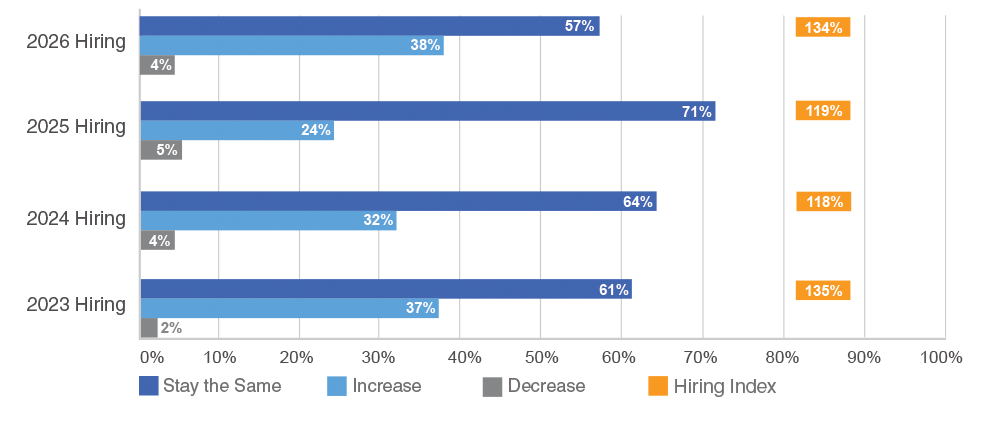
At first glance, those numbers suggest confidence. A closer examination points toward something different. Finance leaders appear to recognize that maintaining organizational capability will require greater investment in talent than it did only one year ago.
The Return of Growth Hiring
During periods of economic uncertainty, many organizations rely on attrition, delayed hiring decisions, and tighter workforce planning. Those strategies appear to be giving way to more proactive hiring.
The fourteen-point increase in organizations planning to expand finance headcount represents a substantial change in sentiment. Equally significant is the decline in organizations planning to simply maintain staffing levels. Rather than waiting for conditions to improve further, many finance organizations appear ready to invest.
That shift reflects several market forces developing simultaneously.
Finance organizations continue to face increasing reporting requirements, expanding regulatory expectations, more sophisticated forecasting demands, and greater executive reliance on financial analysis. Those responsibilities have grown even as many accounting departments have struggled with experienced talent shortages.
Hiring therefore becomes less about organizational growth alone and more about maintaining operational capacity.
The Labor Market Is Driving Behavior
Hiring demand cannot be viewed independently from labor supply.
Elsewhere in the study, 61 percent of respondents report experiencing either minor or significant shortages of accounting, finance, or CPA talent. That represents a sharp deterioration from the prior year’s findings and reinforces that the accounting talent shortage has become an enduring business issue rather than a temporary recruiting challenge.
This relationship matters.
Organizations frequently respond to talent shortages in one of two ways.
The first approach is defensive. Existing employees absorb additional responsibilities while open positions remain vacant. Productivity gradually declines, burnout increases, and voluntary turnover often follows.
The second approach is proactive. Organizations hire earlier, invest in succession planning, strengthen recruiting pipelines, and attempt to secure experienced professionals before competition intensifies further.
The 2026 hiring data suggests many finance organizations are moving toward the second approach.
Hiring Is Becoming More Selective
Increasing hiring plans should not be interpreted as broad expansion across every finance function.
Modern finance organizations increasingly seek professionals who combine accounting expertise with analytical capability, technology fluency, communication skills, and business judgment.
Routine accounting activities continue to become more automated through ERP systems, workflow platforms, and emerging AI capabilities. Meanwhile, responsibilities involving financial planning, governance, internal controls, business partnership, technical accounting, and executive decision support continue to expand.
That changes the profile of the ideal candidate.
Organizations are placing greater value on professionals capable of interpreting financial information, improving business processes, collaborating across departments, and adapting to new technologies rather than simply processing transactions efficiently.
Technology Changes Headcount Decisions
Some observers assume greater automation should reduce hiring.
The survey results suggest a more nuanced reality.
Technology does eliminate portions of repetitive work, but finance leaders increasingly use those productivity gains to redirect talent toward higher-value activities rather than reducing staff outright.
As automation assumes responsibility for routine reconciliations, report preparation, workflow management, and data collection, finance professionals spend more time supporting forecasting, performance management, internal controls, regulatory compliance, and strategic planning.
In many organizations, automation changes the composition of finance teams rather than their overall size.
That distinction helps explain why hiring can increase even as automation adoption accelerates.
Recruiting Alone Will Not Solve the Problem
One of the more important implications of this year’s findings is that recruiting remains only one component of workforce strategy.
Organizations competing for experienced Controllers, accountants, FP&A professionals, and tax specialists are increasingly pursuing the same limited talent pool.
Successful finance organizations therefore invest beyond recruiting.
Career development, internal promotion, technical education, mentoring, leadership development, and workplace flexibility all influence whether organizations can retain experienced professionals after they have been hired.
Retention has become a competitive advantage.
Replacing experienced finance professionals is becoming progressively more expensive, both in direct recruiting costs and in lost institutional knowledge.
What CFOs and Controllers Should Watch During the Next Year
The Hiring Index represents more than an encouraging statistic.
It serves as an early indicator of broader changes occurring throughout corporate finance.
If hiring demand continues rising while talent shortages remain elevated, organizations should expect continued pressure on compensation, increased competition for experienced professionals, and growing emphasis on internal development programs.
Finance leaders should also expect hiring priorities to continue shifting toward professionals capable of working alongside automation and AI rather than performing exclusively transactional responsibilities.
The organizations most likely to succeed will not necessarily be those offering the highest salaries. They will be those providing meaningful career progression, modern finance technology, effective leadership, and opportunities to develop new capabilities as the profession continues to evolve.
What This Means for Finance Leaders
The hiring outlook reflected in the Corporate Finance & Accounting Talent Study 2026 represents renewed confidence, but it also signals increasing competition.
Finance organizations are rebuilding teams while confronting one of the most constrained accounting labor markets in years. Those realities will shape recruiting, compensation, workforce planning, and technology investment throughout the coming year.
The question facing CFOs and Controllers is no longer whether they will need additional talent.
The more pressing question is whether they can attract, develop, and retain the professionals capable of leading tomorrow’s finance organization.
Download the complete Corporate Finance & Accounting Talent Study 2026 to explore all survey findings, benchmarking data, and analysis covering finance hiring, talent shortages, compensation, AI adoption, workforce models, retention, and recruiting trends.