Finance leaders are preparing for a workforce problem that extends beyond recruiting.
The Controllership 2030: The Future of the Corporate Controller study finds that Controllers expect to face two talent pressures simultaneously: a continuing shortage of accounting professionals and a growing need for capabilities that many traditional finance teams do not yet possess.
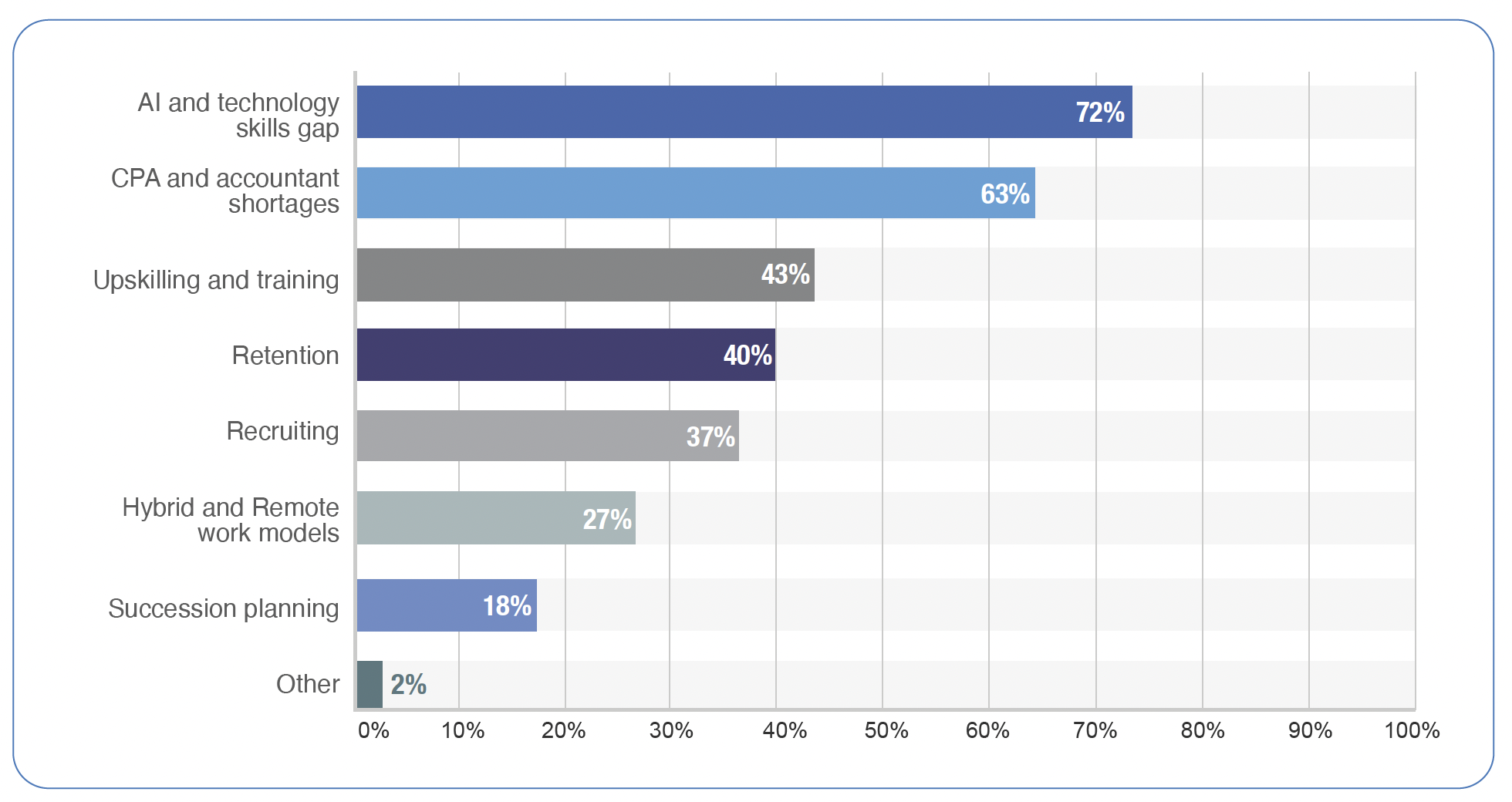
Seventy-two percent of respondents identify the AI and technology skills gap as a talent challenge that will increase by 2030. Sixty-three percent point to CPA and accountant shortages.
Those two findings are closely connected.
Finance organizations need enough qualified accounting professionals to perform and oversee the work. At the same time, those professionals increasingly need practical AI proficiency, data skills, technology fluency, and the ability to operate in more automated environments.
The future finance talent challenge is therefore about both capacity and capability.
AI and Technology Skills Lead the Talent Concerns
When respondents were asked which talent challenges they expect to increase by 2030, they identified:
The ranking is significant.
Recruiting and retention remain substantial concerns, but the leading challenge is whether finance professionals possess the skills required for the work ahead.
This aligns directly with another finding from the study: 81% believe practical AI skills and tool proficiency will become one of the most valuable Controller skills by 2030, while 64% identify data analysis and analytics.
Finance organizations are therefore confronting a moving target.
They are competing for a limited supply of accounting professionals while simultaneously redefining what they need those professionals to know.
The Accounting Shortage Is Only Part of the Problem
The shortage of accounting talent is already familiar to many finance leaders.
Fewer available candidates can make positions harder to fill, increase compensation pressure, extend recruiting timelines, and place additional demands on existing employees.
The Controllership 2030 results suggest finance leaders do not expect those pressures to disappear.
Sixty-three percent anticipate CPA and accountant shortages becoming a greater talent challenge by 2030.
But simply increasing the number of accountants may not solve the problem.
The work itself is changing.
A finance organization that becomes more automated may need fewer employees dedicated exclusively to transaction processing while requiring more professionals capable of analyzing information, supervising automated workflows, managing exceptions, governing data, and evaluating AI-generated work.
The talent shortage therefore has a qualitative dimension as well as a quantitative one.
Finance needs accountants.
Increasingly, it needs accountants with a broader combination of capabilities.
The Skills Gap May Become More Difficult Than the Headcount Gap
The fact that the AI and technology skills gap ranks above accountant shortages deserves attention.
Organizations can recruit for an open accounting position.
Closing a capability gap across an entire finance team is more complicated.
It requires finance leaders to understand what employees know today, what their roles will require several years from now, and which capabilities can realistically be developed internally.
This becomes especially important as technology changes quickly.
An organization may implement a new AI or automation capability within months. Developing the accounting judgment, technology fluency, data literacy, and governance expertise needed to use it effectively can take considerably longer.
The result is a potential mismatch between the speed of technology adoption and the speed of workforce development.
Finance leaders that focus primarily on implementing tools may discover that their largest constraint is not the technology itself.
It is whether the organization has people capable of using and governing it.
Upskilling Is Becoming Workforce Capacity Planning
Forty-three percent of respondents expect upskilling and training to become a greater talent challenge by 2030.
That percentage should be considered alongside the expected changes to finance staffing.
The study finds that 41% expect finance teams to remain approximately the same size but require different skills.
If that expectation proves accurate, retraining existing employees becomes one of the primary ways finance organizations build the workforce they need.
Upskilling can no longer be treated solely as professional development offered when schedules permit.
It becomes part of workforce capacity planning.
Finance leaders need to determine which skills should be developed, who needs them, how quickly they are required, and whether employees have enough time to learn while continuing to meet current responsibilities.
That may require structured training in AI tools, analytics, finance technology, data governance, process automation, and other emerging areas.
It may also require employees to learn through practical application rather than classroom instruction alone.
AI proficiency, in particular, is difficult to develop theoretically. Finance professionals need opportunities to use the technology on actual business problems while learning where it performs well and where human judgment remains necessary.
Automation Could Help With the Talent Shortage
There is an important relationship between the talent shortage and automation.
The same technology creating new skill requirements may also help finance organizations operate with fewer traditional accounting resources.
The study finds that 43% of respondents expect more than 40% of today’s Controller responsibilities to become automated by 2030.
Finance leaders also expect high levels of automation across reconciliations, manual journal entries, the financial close, AP processing, and other recurring activities.
That creates an opportunity to reduce the amount of human capacity required for work that is already difficult to staff.
Rather than viewing automation solely as a cost-reduction tool, finance organizations can also use it as a response to labor scarcity.
If accountants become more difficult to recruit, technology can absorb portions of the workload that would otherwise require additional employees.
This could allow organizations to reserve scarce finance talent for the activities where professional judgment and business knowledge provide the greatest value.
Automation Does Not Eliminate the Need for Accounting Expertise
There is a risk, however, in assuming technology solves the accounting talent problem entirely.
Automated work still needs knowledgeable oversight.
Someone needs to recognize when a reconciliation exception matters.
Someone needs to determine whether an unusual journal entry is appropriate.
Someone needs to evaluate whether an AI-generated analysis makes sense.
Someone needs to understand the accounting implications of a transaction that falls outside standard rules.
As technology assumes more routine work, the finance professionals who remain may spend a larger portion of their time handling the difficult cases.
That can actually increase the importance of accounting judgment.
The workforce challenge becomes finding and developing professionals who understand accounting deeply enough to supervise technology while also possessing the skills to work effectively with that technology.
That combination may be considerably harder to find than either capability independently.
Retention Becomes More Important When Skills Are Scarce
Forty percent of respondents expect retention to become a greater challenge.
In a market where experienced accounting professionals are already difficult to recruit, losing employees with both institutional knowledge and emerging technology skills can be particularly costly.
As organizations invest in upskilling, retention also becomes a way to protect that investment.
A finance professional who understands the company’s systems, data, processes, controls, and business model while also developing AI and analytics capabilities may become increasingly difficult to replace.
This suggests finance leaders should think about talent development and retention together.
Employees need opportunities to build skills, but they also need reasons to remain with the organization after acquiring them.
Career paths, meaningful responsibilities, exposure to new technology, leadership opportunities, compensation, flexibility, and the quality of the work itself can all become part of the retention equation.
Recruiting Strategies May Need to Change
Thirty-seven percent identify recruiting as an increasing challenge.
Part of that challenge may be the changing profile of the candidate finance organizations are seeking.
Traditional Controller and accounting job descriptions often emphasize years of experience, CPA credentials, ERP knowledge, close management, financial reporting, controls, and audit.
Those qualifications remain relevant.
But future roles may increasingly require analytics, automation, AI proficiency, technology understanding, and cross-functional business skills.
Organizations may need to broaden how they evaluate candidates.
A candidate may not arrive with experience in every specific AI platform the company ultimately adopts. The more valuable attribute may be an ability to learn new technologies while applying strong accounting judgment.
Similarly, finance leaders may need to consider candidates whose backgrounds cross traditional functional boundaries, including professionals with experience spanning accounting, FP&A, finance systems, analytics, or transformation.
The objective is not to lower accounting standards.
It is to recognize that the definition of a strong finance professional is becoming broader.
Entry-Level Automation Creates a Long-Term Talent Question
One of the more complicated talent implications of automation involves the development of junior accountants.
Many of the activities expected to become highly automated by 2030 have traditionally been where early-career professionals learn the fundamentals of accounting.
- They prepare reconciliations.
- They investigate discrepancies.
- They post entries.
- They participate in the close.
- They assemble reports.
Through repetition, they learn how transactions flow through the organization and eventually develop the judgment required for more senior responsibilities.
If technology performs much of that work, finance leaders need to determine how junior employees will gain equivalent experience.
This is more than a training question.
It is a succession question.
Today’s entry-level accountants are part of the pipeline for tomorrow’s managers, Controllers, and CFOs.
Organizations that remove foundational work without creating alternative development opportunities could eventually find themselves with fewer professionals prepared to exercise senior-level judgment.
Automation should therefore be accompanied by deliberate redesign of early-career development.
The Talent Strategy Should Follow the Future Operating Model
Finance organizations cannot build an effective talent strategy without first understanding what the function is becoming.
If more work moves into shared services, the required skills may change.
If AI performs more routine accounting, roles may become more analytical.
If finance organizations become flatter, employees may assume greater responsibility earlier.
If Controllers take on more technology and governance responsibilities, leadership development must reflect those expectations.
If the Controller becomes a more common path to CFO, succession planning needs to provide exposure to strategy, operations, and executive decision-making.
The workforce plan and the operating model are therefore inseparable.
Finance leaders need to design both around the work they expect to exist several years from now rather than simply replacing employees who leave today.
What This Means for Controllers and CFOs
The talent challenge identified by the study requires a broader response than recruiting.
Controllers and CFOs should consider:
- Which finance skills will become less important as automation expands?
- Which capabilities will become more valuable?
- Where are the largest AI, technology, and analytics gaps on the current team?
- Which employees can realistically be reskilled?
- Which future capabilities will require external hiring?
- Can automation reduce dependence on roles that are already difficult to fill?
- How will junior professionals develop accounting judgment as routine work becomes automated?
- Are career paths evolving alongside the finance operating model?
- How will the organization retain employees after investing in new skills?
- Does succession planning reflect the broader Controller and CFO roles expected by 2030?
These questions require long-term planning because talent capabilities cannot be transformed as quickly as software can be implemented.
Finance Needs More Than More Accountants
The Controllership 2030 findings reveal a difficult workforce equation.
Finance leaders expect accountant shortages to become more severe.
At the same time, they expect the professionals they do hire and retain to possess a broader set of skills.
AI and technology proficiency, analytics, accounting knowledge, governance, judgment, and business understanding will increasingly need to coexist within the same finance organization, and often within the same professional.
Automation can help relieve some of the pressure by reducing the amount of recurring work requiring human effort.
But it also raises the standard for the work that remains.
The finance talent challenge of 2030 may therefore be defined by more than finding enough people.
It will be finding, developing, and retaining the right combination of accounting expertise and emerging capabilities to lead a very different finance function.
Explore the Full Controllership 2030 Study
Controllership 2030: The Future of the Corporate Controller examines the talent challenges expected to shape finance through 2030, along with changes to AI and automation, staffing, organizational structure, governance, Controller skills, and the Controller-CFO relationship.
Download the full Controllership 2030: The Future of the Corporate Controller study
About the Study Sponsor

Built on insightsoftware’s decades of finance software expertise, Lineos brings finance into focus. It gives teams a single line of sight across the full financial workflow, from budgeting, planning, and reporting through close, consolidation, reconciliation, tax, disclosure, and lease. At every stage, Lineos pulls diverse data from across the business into one place, with powerful AI surfacing the insights that drive action. By freeing finance from spreadsheet forensics and chasing numbers, Lineos enables them to move from reporting the past to shaping what’s next, equipped with the tools they need to drive better decisions and unlock breakthrough insight.