

For years, finance leaders have heard warnings about a coming shortage of accountants and CPAs. Retiring Baby Boomers, declining accounting graduates, fewer CPA candidates, and rising business complexity have all been cited as reasons why recruiting would become increasingly difficult.
The question entering 2026 is no longer whether those forecasts were accurate.
The latest findings from the Corporate Finance & Accounting Talent Study 2026 suggest the shortage has moved from prediction to reality. What was once viewed as a future workforce concern is now affecting hiring decisions, compensation strategies, succession planning, and the ability of finance organizations to execute their responsibilities.
According to this year’s research, 61 percent of finance leaders report experiencing either minor (46 percent) or significant (15 percent) shortages of accounting, finance, and CPA talent. Only 38 percent report no shortages, resulting in a 2026 Talent Shortage Index of 77 percent. One year earlier, the study reported a Talent Surplus Index of 108 percent, when a majority of organizations indicated they were not experiencing shortages. That represents a 31-point reversal in a single year.
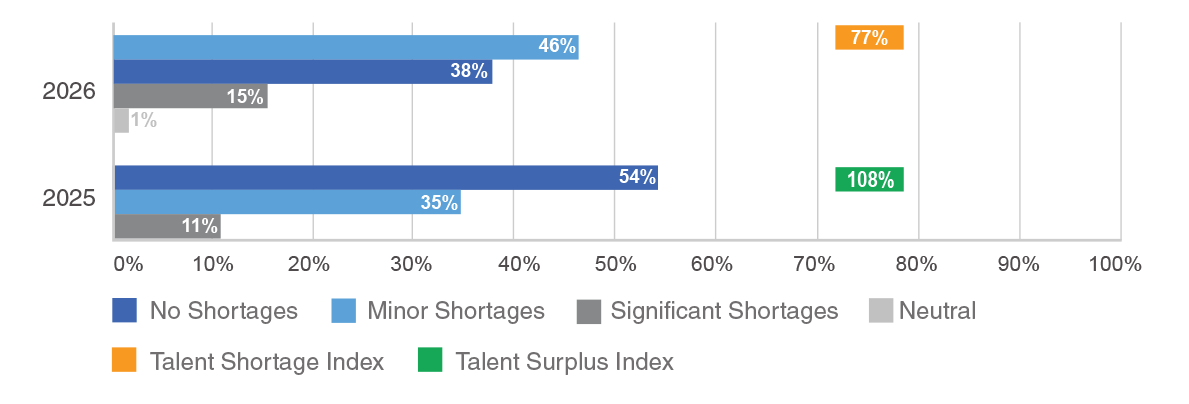
Those numbers describe more than a difficult hiring environment. They point toward a structural shift in the accounting profession.
A Labor Market That Has Changed Direction
Hiring shortages are not unusual during periods of economic expansion. Demand rises, unemployment declines, and employers compete more aggressively for qualified candidates.
The accounting profession appears to be experiencing something different.
Unlike cyclical labor shortages, structural shortages develop when workforce supply changes more slowly than employer demand. Even if economic conditions soften temporarily, organizations continue competing for a relatively limited pool of experienced professionals.
Several long-term forces have been building toward this point.
Universities continue reporting fewer accounting graduates than a decade ago. CPA examination participation has declined in many markets. Large numbers of experienced professionals have reached retirement age, while those remaining often carry broader responsibilities than their predecessors. At the same time, finance organizations have expanded well beyond traditional accounting functions, increasing demand for professionals with expertise in financial reporting, internal controls, technology, analytics, forecasting, tax, and business partnership.
Those trends reinforce one another.
As experienced professionals leave the workforce, organizations increasingly compete for candidates possessing both technical accounting expertise and practical leadership experience.
The Shortage Is No Longer Limited to Public Accounting
Historically, talent shortages were often associated with public accounting firms during busy season or periods of strong economic growth.
Today’s survey results indicate the challenge has spread throughout corporate finance.
Controllers, CFOs, Chief Accounting Officers, and finance executives increasingly report difficulty maintaining fully staffed accounting departments, even outside traditional recruiting cycles. Vacancies frequently remain open longer, qualified applicants become more selective, and organizations often encounter multiple competing offers for experienced candidates.
The shortage therefore affects more than recruiting departments.
Delayed hiring increases workloads across existing teams, lengthens financial close processes, slows system implementations, and limits organizational capacity to pursue strategic initiatives.
When key finance positions remain vacant for extended periods, operational performance can begin to suffer.
Experience Has Become Scarcer Than Credentials
One characteristic of the current labor market deserves particular attention.
Many organizations report that applicants exist, yet relatively few possess the combination of technical expertise, business judgment, communication skills, and leadership capability required for today’s finance roles.
Modern Controllers are expected to oversee financial reporting, strengthen internal controls, support technology initiatives, advise executive leadership, participate in acquisitions, improve processes, and increasingly guide AI adoption.
Those responsibilities extend well beyond preparing financial statements.
As expectations expand, organizations naturally compete for professionals capable of performing at that broader level.
The shortage therefore reflects capability as much as headcount.
Compensation Alone Cannot Close the Gap
One common response to labor shortages is increasing compensation.
Higher salaries certainly improve recruiting competitiveness, and this year’s study separately demonstrates meaningful growth in finance compensation across nearly every organizational level.
Compensation, however, addresses only part of the challenge.
Organizations offering similar salary ranges often experience very different recruiting outcomes.
Candidates increasingly evaluate career advancement opportunities, leadership quality, organizational culture, technology investments, flexibility, learning opportunities, and long-term professional development alongside compensation.
Employers that distinguish themselves across several of those areas frequently maintain stronger retention rates than organizations relying primarily on salary adjustments.
In a constrained labor market, retention becomes as valuable as recruiting.
Workforce Development Is Becoming a Competitive Strategy
The organizations navigating today’s talent shortage most effectively share several characteristics.
Rather than viewing recruiting as the primary solution, they place greater emphasis on developing existing employees.
Succession planning begins earlier.
Leadership development extends beyond senior management.
Technical education continues throughout employees’ careers rather than ending after onboarding.
Cross-training prepares individuals for broader responsibilities before critical positions become vacant.
This approach recognizes an important reality.
Building experienced Controllers, accounting managers, and finance leaders often requires years of organizational investment. Waiting until vacancies occur significantly reduces available options.
Finance leaders increasingly understand that tomorrow’s talent pipeline begins with today’s staff development decisions.
Technology Will Help, But It Will Not Eliminate the Shortage
Artificial intelligence and finance automation continue advancing rapidly, prompting understandable questions about future staffing requirements.
The survey findings suggest technology should be viewed as an operational multiplier rather than a workforce replacement strategy. Elsewhere in the study, a majority of finance organizations report evaluating, piloting, or implementing AI initiatives, indicating widespread interest in improving productivity.
Automation reduces repetitive work.
It accelerates reconciliations, document processing, workflow management, reporting preparation, and data collection.
What it does not replace is professional judgment.
Financial statement interpretation, technical accounting decisions, internal controls, regulatory compliance, forecasting assumptions, board communication, and strategic planning continue requiring experienced finance professionals.
Organizations adopting automation successfully often redeploy existing talent toward higher-value responsibilities instead of reducing overall staffing needs.
Technology therefore changes how finance professionals spend their time, not whether experienced finance professionals remain necessary.
What CFOs and Controllers Should Be Planning Now
The movement from a Talent Surplus Index to a Talent Shortage Index within one year should encourage finance leaders to reconsider long-term workforce planning.
Organizations waiting for labor conditions to normalize may discover that today’s shortages represent a lasting change rather than a temporary disruption.
That makes several priorities increasingly important.
Recruiting pipelines should remain active even when immediate vacancies do not exist.
Employee development should receive sustained investment rather than periodic attention.
Succession planning should identify future leaders well before retirement or turnover creates urgent needs.
Finance technology should eliminate routine work so experienced professionals can focus on analysis, governance, forecasting, and business partnership.
Perhaps most importantly, finance leaders should recognize that retaining experienced employees frequently delivers greater organizational value than replacing them.
What This Means for Finance Leaders
The accounting profession has entered a different labor environment.
The findings from the Corporate Finance & Accounting Talent Study 2026 indicate that workforce shortages have progressed beyond isolated recruiting challenges and are increasingly shaping how finance organizations operate.
Organizations that respond by strengthening recruiting, expanding employee development, modernizing finance technology, and creating clear career pathways will likely be better positioned than those relying solely on compensation or external hiring.
The shortage may prove difficult to eliminate. Preparing for it, however, remains entirely within management’s control.
Download the complete Corporate Finance & Accounting Talent Study 2026 to explore all survey findings, benchmarking data, and analysis covering finance hiring, talent shortages, compensation, AI adoption, workforce models, recruiting, and retention strategies.