Finding qualified finance and accounting professionals has become more difficult, but the challenge extends well beyond the number of available candidates. Organizations must also determine where those candidates can be found.
For many employers, recruiting strategies have evolved very little over the past decade. Job openings are posted online, applications begin arriving, interviews are scheduled, and hiring decisions follow. That process remains important, but today’s labor market has become considerably more competitive. Many experienced finance professionals are not actively searching for new positions, forcing employers to think beyond traditional recruiting methods.
The Corporate Finance & Accounting Talent Study 2026 illustrates this shift. Online job boards remain the most widely used recruiting channel, selected by 72 percent of respondents, followed by company career websites at 60 percent. Employee referrals ranked third at 47 percent, narrowly ahead of recruitment agencies at 46 percent. HR and internal recruiting teams accounted for 42 percent of responses, while social media represented 25 percent and campus recruiting just 11 percent.
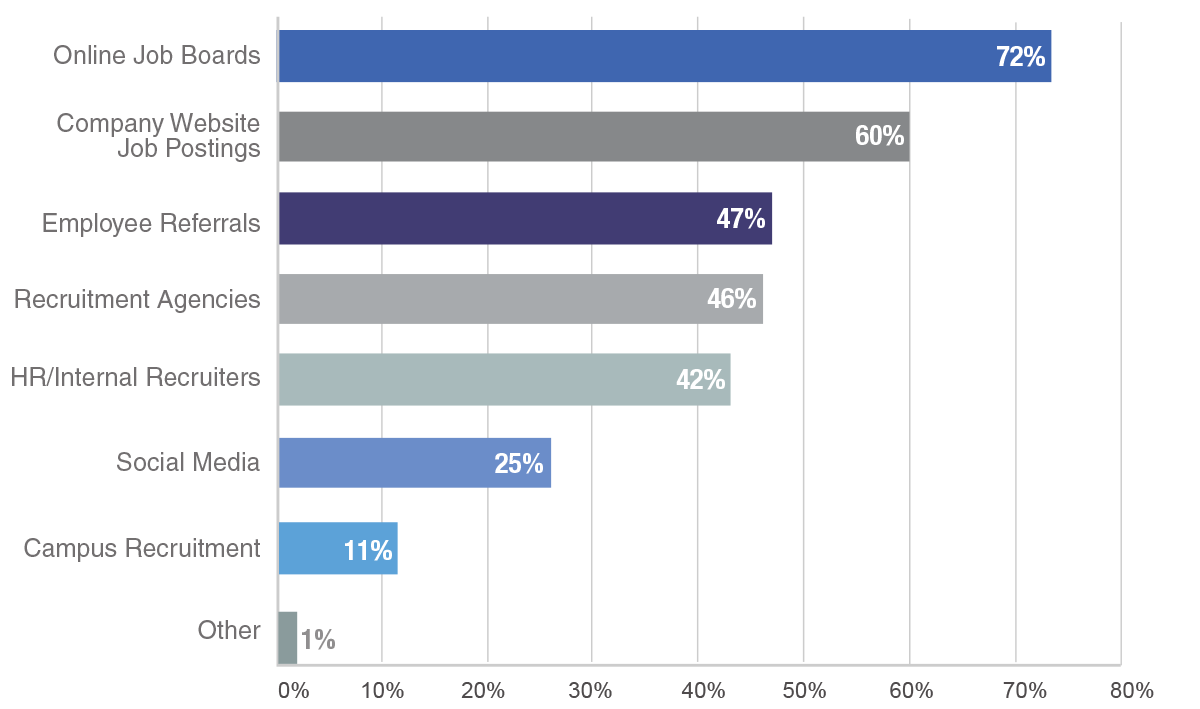
The findings demonstrate that finance organizations are no longer relying on a single recruiting source. Instead, successful employers are building diversified recruiting strategies that combine broad visibility with relationship-based recruiting and long-term talent development.
Online Job Boards Continue to Serve as the Front Door
Despite the emergence of new recruiting technologies and professional networking platforms, online job boards remain the most frequently used hiring channel.
Their continued popularity reflects several practical advantages. Job boards provide immediate visibility, generate large applicant pools, and allow organizations to reach candidates across broad geographic areas with relatively modest recruiting costs. They also remain one of the first places active job seekers begin evaluating new opportunities.
Volume, however, should not be confused with effectiveness.
Finance leaders increasingly recognize that online job postings often generate large numbers of applicants while producing relatively few candidates who possess the technical expertise and leadership experience required for more senior accounting positions. As recruiting becomes more specialized, organizations frequently spend considerable time reviewing applications that ultimately do not match the requirements of the role.
Job boards remain an important component of recruiting, but they are becoming one element of a much broader hiring strategy rather than the strategy itself.
Employee Referrals Continue to Deliver High-Quality Candidates
One of the more interesting findings in this year’s study is the continued strength of employee referrals.
Nearly half of respondents identified referrals as one of their primary recruiting channels, placing them almost equal to external recruiting agencies. That result reflects the growing value employers place on trusted professional networks.
Experienced finance professionals often maintain relationships with former colleagues, auditors, consultants, and business partners throughout their careers. When employees recommend former coworkers, employers gain more than a résumé. They receive practical insight into a candidate’s technical capabilities, work ethic, communication style, and ability to perform within a team.
Referrals also tend to shorten the hiring process. Candidates entering through professional networks often have a clearer understanding of the organization before interviews begin, while hiring managers have greater confidence in the quality of the applicant.
In a labor market where experienced Controllers, accounting managers, FP&A professionals, and tax specialists remain difficult to recruit, employee referrals provide access to candidates who may never respond to a public job posting.
Recruiting Has Become More Proactive Than Reactive
The survey results suggest an important philosophical shift in how organizations approach hiring.
Historically, recruiting often began after an employee resigned or a new position received budget approval. Employers would post the opening, review applications, conduct interviews, and make a hiring decision.
Today’s labor market rarely allows that level of patience.
Experienced finance professionals frequently receive multiple recruiting inquiries even when they have no intention of changing employers. Organizations that wait until a vacancy exists often discover that the strongest candidates have already accepted other opportunities or are unwilling to enter a lengthy interview process.
As a result, many finance leaders are treating recruiting as an ongoing business activity rather than an event triggered by turnover. Professional networking, conference participation, university partnerships, succession planning, and employer branding all contribute to building relationships with future candidates before positions become available.
The strongest recruiting pipeline is often built long before the first interview is scheduled.
Company Reputation Has Become a Recruiting Asset
The fact that 60 percent of respondents rely on company career websites highlights another important reality.
Candidates increasingly research organizations before submitting applications. A company’s website has become more than a location for job postings. It serves as an introduction to organizational culture, leadership philosophy, career opportunities, technology investments, and employee development.
Finance professionals evaluating potential employers frequently examine whether organizations invest in automation, provide advancement opportunities, support continuing education, and maintain a stable leadership team. They also consider whether the company appears financially healthy, strategically focused, and committed to long-term growth.
Recruiting therefore begins well before a conversation with human resources.
Organizations that present a compelling employer brand often attract stronger candidates while reducing dependence on expensive external recruiting efforts.
Recruitment Agencies Continue to Fill Critical Gaps
Although recruitment agencies ranked slightly behind employee referrals, they remain an important component of finance recruiting.
Executive search firms and specialized accounting recruiters often provide access to candidates who are not actively seeking new positions. They also possess detailed knowledge of local compensation trends, candidate availability, and specialized finance skill sets.
This becomes particularly valuable when recruiting for leadership positions.
Controllers, Chief Accounting Officers, technical accounting specialists, and tax leaders frequently require confidential searches, targeted outreach, and careful evaluation of professional backgrounds. External recruiters can often dedicate resources that internal recruiting teams cannot.
Their value, however, tends to increase with the complexity of the position rather than the volume of hiring.
Campus Recruiting Represents a Long-Term Investment
Only 11 percent of respondents identified campus recruiting as a primary hiring channel, making it the least utilized strategy among the major recruiting sources.
That finding should not necessarily be interpreted as a lack of interest in early-career talent.
Many organizations continue investing in internship programs, university partnerships, and graduate recruiting, but those initiatives serve a different purpose than experienced hiring. Campus recruiting develops future accounting professionals rather than addressing immediate shortages of Controllers, FP&A managers, or senior accountants.
Given the broader talent shortages identified throughout the study, organizations may ultimately find greater value in expanding relationships with universities as they build longer-term leadership pipelines.
The benefits of campus recruiting often emerge several years after the initial hiring decision.
Recruiting Success Depends on Integration Rather Than Individual Channels
Perhaps the most important lesson from this year’s findings is that no single recruiting channel consistently produces the strongest finance talent.
Job boards generate visibility.
Career websites strengthen employer branding.
Employee referrals provide trusted recommendations.
Recruitment agencies identify specialized candidates.
Internal recruiting teams coordinate hiring activities.
Campus programs develop future leaders.
Each channel serves a different purpose within the broader recruiting process.
Organizations relying exclusively on one approach may continue finding candidates, but they are unlikely to access the full range of talent available in today’s market.
The most effective finance recruiting strategies combine multiple channels while continuously strengthening the organization’s reputation as an employer of choice.
What This Means for Finance Leaders
The Corporate Finance & Accounting Talent Study 2026 demonstrates that recruiting finance professionals has become both more competitive and more strategic.
While online job boards remain the foundation of most recruiting efforts, organizations increasingly recognize the value of employee referrals, employer branding, specialized recruiters, and long-term relationship building. The strongest hiring outcomes are no longer determined by where organizations advertise positions, but by how effectively they maintain talent pipelines before positions become available.
For CFOs and Controllers, recruiting should be viewed as a continuous business capability rather than an occasional staffing exercise. Organizations that invest consistently in multiple recruiting channels, employee engagement, and professional relationships will likely be better positioned to compete for experienced finance talent in an increasingly constrained labor market.
Download the complete Corporate Finance & Accounting Talent Study 2026 to explore all survey findings, benchmarking data, and analysis covering hiring strategies, recruiting channels, talent shortages, compensation, retention, workplace trends, and the future of finance talent.