
After several years of moderate salary growth, compensation for finance and accounting professionals has accelerated sharply.
For employers, rising salaries represent one of the clearest indicators that the labor market has tightened. Organizations rarely increase compensation at this pace unless competition for talent has intensified. The latest findings from the Corporate Finance & Accounting Talent Study 2026 suggest that finance leaders are once again operating in a market where retaining experienced professionals may prove just as important as recruiting new ones.
The study found that average annual salary increases reached 6.7 percent for executives, 6.2 percent for directors, 5.9 percent for managers, and 5.7 percent for clerical and administrative staff during the past twelve months. Compared with the prior year’s survey, when increases generally ranged from 3.3 to 3.8 percent, compensation growth has nearly doubled across every finance leadership level.
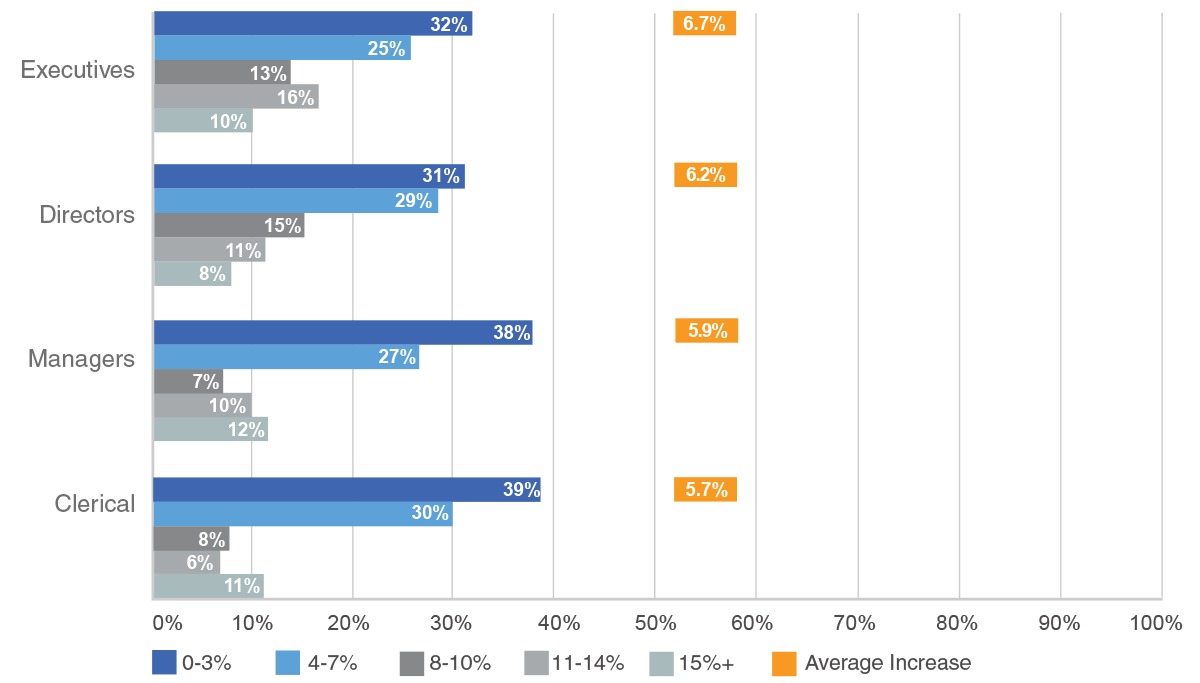
Viewed independently, those figures represent generous salary adjustments. Viewed alongside the study’s findings on hiring demand and talent shortages, they reveal something more significant. Compensation is becoming a direct reflection of the increasingly competitive market for experienced finance professionals.
Compensation Rarely Moves in Isolation
Salary growth does not occur without underlying market forces.
When organizations experience stable staffing levels and a healthy supply of qualified candidates, compensation tends to rise gradually alongside inflation and overall economic conditions. Large increases typically emerge only when employers compete aggressively for a limited number of professionals.
That appears to be exactly what is occurring across finance and accounting.
Elsewhere in the study, 38 percent of organizations report plans to increase hiring while 61 percent indicate they are already experiencing finance and accounting talent shortages. Those two trends naturally place upward pressure on salaries. As employers compete for Controllers, FP&A professionals, tax specialists, technical accountants, and experienced accounting managers, compensation becomes one of the primary tools available to secure and retain talent.
The findings therefore reinforce a simple economic principle. When demand rises more quickly than supply, compensation follows.
Executive Pay Led the Market, but Every Level Benefited
Executives recorded the highest average salary increase at 6.7 percent, followed closely by directors at 6.2 percent. Managers and clerical staff were not far behind, receiving average increases of 5.9 percent and 5.7 percent respectively.
The relatively narrow range between organizational levels is noteworthy.
Rather than concentrating compensation increases exclusively at senior leadership, organizations appear to be investing across the finance organization. That suggests employers recognize the importance of retaining talent throughout the accounting function rather than protecting only executive positions.
The strategy makes sense.
Finance departments depend upon continuity at every level. Losing experienced staff accountants, financial reporting professionals, payroll specialists, or accounting managers frequently creates operational disruption that extends well beyond the individual vacancy. Institutional knowledge, process familiarity, and relationships with auditors, business units, and external stakeholders often take years to replace.
Broad-based salary increases therefore represent an investment in organizational stability as much as employee compensation.
The Market Is Rewarding Experience
One of the more important conclusions from this year’s compensation data is that experience continues to command a meaningful premium.
Organizations are not merely hiring additional people. They are competing for professionals capable of managing increasingly sophisticated finance environments.
Controllers oversee technology implementations, internal controls, compliance, governance, and financial reporting. FP&A professionals support capital allocation and strategic planning. Technical accountants interpret evolving accounting standards, while tax professionals navigate increasingly complex regulatory requirements.
Each of these responsibilities requires judgment developed through years of practical experience.
Because those capabilities remain difficult to replace, employers are demonstrating greater willingness to invest in retaining professionals who already possess them.
The broader finance labor market reflects similar conditions. Recent compensation research indicates employers continue offering premium salaries to candidates with specialized finance, technology, and AI-related skills, even as overall salary growth moderates across other occupations.
Salary Alone Does Not Determine Retention
Although compensation has increased substantially, finance leaders should avoid viewing salary as the sole answer to workforce challenges.
Employees evaluate organizations through a much broader lens.
Career advancement opportunities, leadership quality, workplace flexibility, professional development, organizational culture, and access to modern technology all influence whether employees remain with an employer. In fact, elsewhere in the study, lack of career advancement ranks well ahead of compensation as the leading reason finance professionals leave their organizations.
That finding provides useful perspective.
Competitive salaries may attract candidates and reduce immediate turnover, but they rarely overcome limited career progression or ineffective leadership. Organizations that rely exclusively on annual pay increases may discover that retention challenges persist despite rising payroll costs.
Compensation should therefore be viewed as one component of a broader employee value proposition rather than a complete workforce strategy.
Finance Leaders Face Difficult Budget Decisions
The increase in salary expectations creates a practical challenge for CFOs and Controllers.
Finance organizations are often responsible for managing labor costs throughout the enterprise while simultaneously competing for increasingly expensive talent within their own departments. Balancing those competing priorities requires thoughtful workforce planning rather than across-the-board salary adjustments.
Many organizations are responding by becoming more selective.
Instead of distributing compensation increases evenly, they identify positions that are particularly difficult to replace or employees whose departure would create disproportionate operational risk. Investments in leadership development, succession planning, automation, and employee engagement frequently accompany targeted compensation strategies.
This approach recognizes that retaining one experienced Controller or accounting manager may provide greater long-term value than hiring multiple less experienced employees at lower salaries.
Technology May Change the Work, Not the Market Value
Some executives expected automation and artificial intelligence to reduce salary pressure by lowering demand for finance professionals.
The survey results suggest that outcome has yet to materialize.
Technology certainly improves efficiency by automating reconciliations, reporting workflows, transaction processing, and other repetitive activities. Those productivity gains, however, have largely been redirected toward higher-value work rather than workforce reductions.
Finance leaders continue requiring experienced professionals who can interpret financial information, strengthen governance, oversee controls, evaluate business performance, and advise executive leadership.
As routine work becomes increasingly automated, the market value of those higher-order capabilities may continue rising.
Organizations therefore compete less for transaction processing capacity and more for analytical judgment, leadership, and business insight.
What This Means for Finance Leaders
The compensation findings from the Corporate Finance & Accounting Talent Study 2026 indicate that the finance labor market has entered a more competitive phase.
Nearly every indicator points in the same direction. Hiring plans have strengthened, talent shortages have increased, and salary growth has accelerated across every organizational level. Those trends reinforce one another and suggest that experienced finance professionals will remain in high demand throughout the coming year.
Finance leaders should continue monitoring compensation closely, but they should also recognize that salary represents only one element of long-term workforce strategy. Organizations that combine competitive pay with meaningful career development, strong leadership, modern finance technology, and thoughtful succession planning will likely remain in the strongest position to attract and retain high-performing professionals.
Download the complete Corporate Finance & Accounting Talent Study 2026 to explore all survey findings, benchmarking data, and analysis covering finance hiring, talent shortages, compensation, AI adoption, workplace models, recruiting, and retention strategies.