How much of the controller’s job can actually be automated?
The Controllership 2030: The Future of the Corporate Controller study asked finance leaders to estimate what percentage of today’s controller responsibilities they expect to be automated by 2030.
The results point to significant change, but not the disappearance of the role.
Forty-three percent of respondents expect more than 40% of today’s controller responsibilities to become automated by 2030. At the same time, only 6% believe automation will exceed 80%.
The more likely future is somewhere between minimal change and wholesale replacement. Technology assumes a meaningful portion of the controller’s current workload, while the responsibilities requiring judgment, accountability, interpretation, governance, and leadership become a larger part of the role.
For finance leaders, that makes automation as much a question of job redesign as technology.
Controllers Expect a Significant Share of Their Work to Be Automated
When respondents were asked how much of today’s controller responsibilities they expect to be automated by 2030, they said:
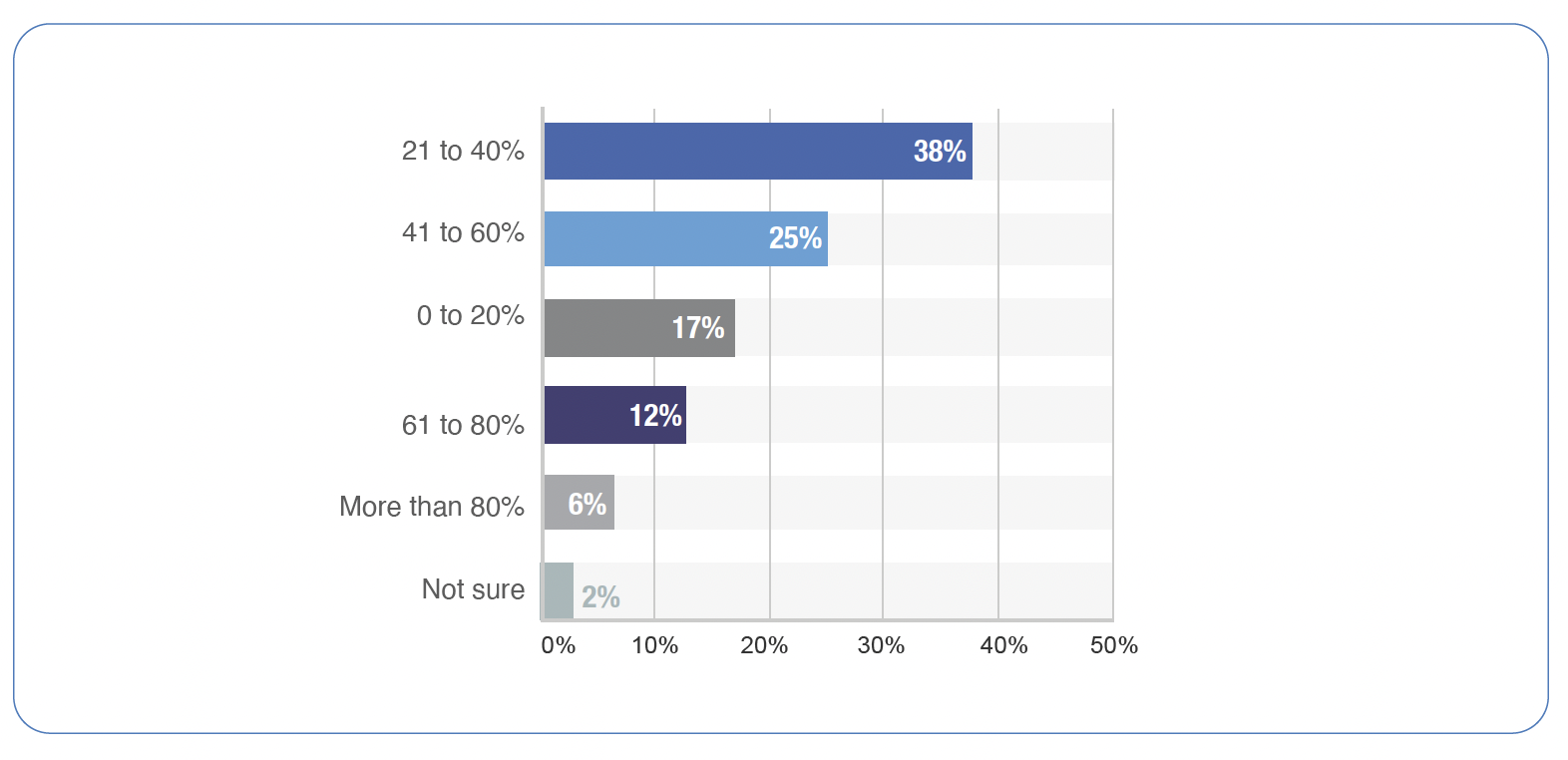
The largest group expects between 21% and 40% of today’s responsibilities to become automated.
But nearly as important is what happens above that threshold.
Combining the respondents who selected 41% to 60%, 61% to 80%, and more than 80% shows that 43% expect automation to assume more than 40% of today’s controller responsibilities within the next several years.
That is enough automation to materially change how a controllership function operates.
It is also far from complete automation.
The Data Does Not Point to the End of the Controller
Predictions about AI and automation frequently move toward extremes. Either the technology will make relatively little difference, or entire professions will be replaced.
Finance leaders appear to expect a more practical outcome.
Only 6% believe more than 80% of controller responsibilities will be automated. Meanwhile, 80% expect automation to fall somewhere between 0% and 60%.
That suggests the controller role is more likely to be reconfigured than eliminated.
This makes sense when considering the range of responsibilities controllers perform.
Some activities are highly suitable for automation. Reconciliations, journal entries, transaction processing, reporting preparation, and portions of the financial close all contain recurring, rules-based work.
Other controller responsibilities are considerably harder to automate.
Interpreting financial results, evaluating unusual transactions, exercising professional judgment, designing controls, communicating with executives, managing teams, assessing risk, supporting strategic decisions, and taking accountability for financial information all depend on capabilities that extend beyond process execution.
Automation can change how those responsibilities are performed. It does not necessarily remove the need for someone to own them.
Automation Will Affect Tasks Before It Replaces Roles
One of the most useful ways to interpret the findings is to distinguish between a job and the individual tasks within that job.
The controller role contains hundreds of activities.
Some require substantial manual effort but relatively little judgment. Others may consume less time while carrying significantly greater organizational importance.
Automation is likely to affect those activities differently.
A controller may no longer need a team to spend the same number of hours preparing reconciliations, assembling reports, processing journal entries, or tracking close activities.
But the controller still needs confidence that reconciliations are accurate, reports are reliable, journal entries are appropriate, and the close is controlled.
The work shifts from performing or supervising every step toward managing the system through which the work is completed.
That distinction helps explain how a large percentage of current responsibilities can be automated without making the controller less important.
In fact, the responsibilities that remain may become more consequential.
The Controller’s Workload Could Shift From Production to Oversight
Historically, a substantial portion of controllership has centered on producing financial information.
Transactions must be processed. Accounts must be reconciled. Entries must be recorded. Reports must be prepared. The books must be closed.
As more of that work becomes automated, controllers may increasingly supervise the processes, systems, and controls responsible for producing the information.
That means asking different questions.
- Is the source data reliable?
- Are automated rules configured correctly?
- Which exceptions require review?
- Who can change the system?
- Are outputs traceable?
- How are unusual transactions handled?
- Where is human approval required?
- Can management rely on the result?
This is still controllership.
But it represents a broader form of financial stewardship in which the controller is responsible for both the integrity of the financial information and the increasingly automated environment that produces it.
Automation Could Create Capacity for a More Strategic Controller
The percentage of controller work automated matters because time is finite.
Every hour devoted to recurring transaction processing, reconciliation management, report preparation, or administrative close activities is an hour that cannot be spent elsewhere.
The study suggests controllers expect that allocation to change.
Financial planning, analysis, and budgeting is expected to become the leading controller responsibility by 2030, selected by 61% of respondents. Strategic planning rises from 42% today to 55% by 2030.
Those responsibilities require capacity.
Automation may help create it.
If technology reduces the amount of effort required to produce financial information, controllers and their teams can potentially devote more attention to interpreting that information.
That could mean deeper analysis of business performance, more frequent forecasting, greater involvement in planning, stronger partnership with operating leaders, and more time devoted to enterprise decisions.
The strategic controller envisioned for 2030 may therefore depend partly on successfully automating portions of the controller’s current workload.
The Value of Automation Depends on How Capacity Is Redeployed
Automating 30%, 40%, or 50% of existing responsibilities does not automatically make finance more strategic.
Organizations still have to decide what happens to the capacity they create.
Some companies may use automation primarily to operate with smaller finance teams.
Others may maintain similar staffing levels while changing the work employees perform.
Some may do both, depending on growth, turnover, transaction volume, and the availability of accounting talent.
The study suggests finance leaders expect multiple models.
When asked how AI will affect finance staffing by 2030, 41% expect teams to remain approximately the same size but require different skills. Another 35% expect smaller teams.
That makes workforce planning an important component of automation planning.
Finance leaders should know whether the objective is cost reduction, additional capacity, scalability, faster reporting, better controls, improved analysis, or some combination of these outcomes.
Without a clear objective, organizations risk automating work without fully capturing its value.
Automation Could Also Change the Finance Career Ladder
There is another implication that extends beyond the controller.
Many activities expected to become automated have traditionally been performed by junior and mid-level accounting professionals.
Reconciliations, journal entries, account analysis, reporting preparation, and close activities are not simply work to be completed. They have also been part of how accountants learn.
Professionals develop judgment partly through repeated exposure to transactions, exceptions, errors, and the mechanics of the financial statements.
If technology performs more of that foundational work, finance organizations may need to reconsider how employees develop the experience required for more senior positions.
The challenge is particularly important for controllership.
Future controllers will still need strong accounting knowledge even if they personally spend less time on transactional accounting.
They will be expected to review exceptions, challenge automated outputs, evaluate controls, and make decisions when technology cannot.
That requires experience.
Finance organizations therefore need to think beyond which tasks can be removed from employees. They also need to consider how the next generation of controllers will develop judgment in a more automated environment.
More Automation Could Increase the Importance of Controls
There is a temptation to assume that automated processes require less oversight because they involve fewer manual steps.
In practice, the nature of oversight changes.
A manual error may affect a single transaction.
An incorrectly configured automated process can potentially repeat an error across thousands of transactions before it is detected.
That makes controls over systems, data, access, rules, and exceptions increasingly important.
As controller responsibilities become automated, finance organizations may need to shift some of their control activity upstream.
Instead of checking every output after processing, controllers may place greater emphasis on validating configurations, monitoring exceptions, testing automated rules, controlling changes, and ensuring that the underlying data is reliable.
The more work technology performs, the more important it becomes to understand how that work is being performed.
The Central Question Is What Humans Should Continue to Own
The Controllership 2030 results suggest that a meaningful amount of controller work will become automated.
The next question is more difficult:
Which responsibilities should remain fundamentally human?
Professional judgment is an obvious area.
So is accountability.
Technology can identify an anomaly, but someone must decide what it means.
A system can generate a forecast, but someone must determine whether its assumptions are reasonable.
An automated process can produce a report, but someone remains responsible for whether management should rely on it.
AI can recommend an action, but the organization still needs decision rights governing when a person must intervene.
This is where controllers may become particularly important in an automated finance environment.
Their role may increasingly involve defining the boundary between technology execution and human responsibility.
What This Means for Controllers and CFOs
The finding that 43% of finance leaders expect more than 40% of controller responsibilities to become automated should prompt a broader discussion than which technology to purchase.
Controllers and CFOs should be asking which parts of today’s workload are likely to disappear, which will change, and which will become more important.
They should also consider what they want the controllership function to do with the capacity automation creates.
If recurring work declines, should finance increase its analytical capabilities? Strengthen forecasting? Spend more time with operating leaders? Improve controls? Expand data governance? Assume greater technology oversight?
Those decisions will help determine whether automation simply makes the current finance function less labor-intensive or creates a fundamentally more capable one.
The Controller Role Is Being Redesigned
By 2030, few finance leaders expect the controller’s current workload to remain untouched.
The largest group expects between 21% and 40% of today’s responsibilities to become automated, while 43% expect automation to exceed 40%.
Yet the study does not point toward a controller-less finance organization.
Instead, it points toward a different allocation of work.
Technology performs more recurring processing. Finance professionals manage more exceptions. Controllers oversee increasingly automated financial processes while devoting more attention to analysis, governance, strategy, and decision support.
That is a substantial change.
And for finance leaders, the most important automation decision may ultimately have little to do with how much work technology can perform.
It will be how to use the human capacity that remains.
Explore the Full Controllership 2030 Study
Controllership 2030: The Future of the Corporate Controller examines how automation could reshape the controller role through 2030, including the finance activities most likely to become automated, changes to staffing and organizational structures, emerging governance responsibilities, future skills, and the evolving relationship between Controllers and CFOs.
Download the full Controllership 2030: The Future of the Corporate Controller study
About the Study Sponsor

Built on insightsoftware’s decades of finance software expertise, Lineos brings finance into focus. It gives teams a single line of sight across the full financial workflow, from budgeting, planning, and reporting through close, consolidation, reconciliation, tax, disclosure, and lease. At every stage, Lineos pulls diverse data from across the business into one place, with powerful AI surfacing the insights that drive action. By freeing finance from spreadsheet forensics and chasing numbers, Lineos enables them to move from reporting the past to shaping what’s next, equipped with the tools they need to drive better decisions and unlock breakthrough insight.