

Recruiting has always been one of the more difficult responsibilities facing finance leaders. The challenge, however, is no longer simply finding qualified accountants. Organizations are increasingly competing for professionals who combine technical accounting expertise with leadership ability, business judgment, technology fluency, and the communication skills required to influence executive decision-making.
The Corporate Finance & Accounting Talent Study 2026 highlights just how concentrated that challenge has become. Rather than experiencing shortages evenly across every finance position, employers are struggling most with roles that require deep institutional knowledge and the ability to connect accounting operations with broader business strategy.
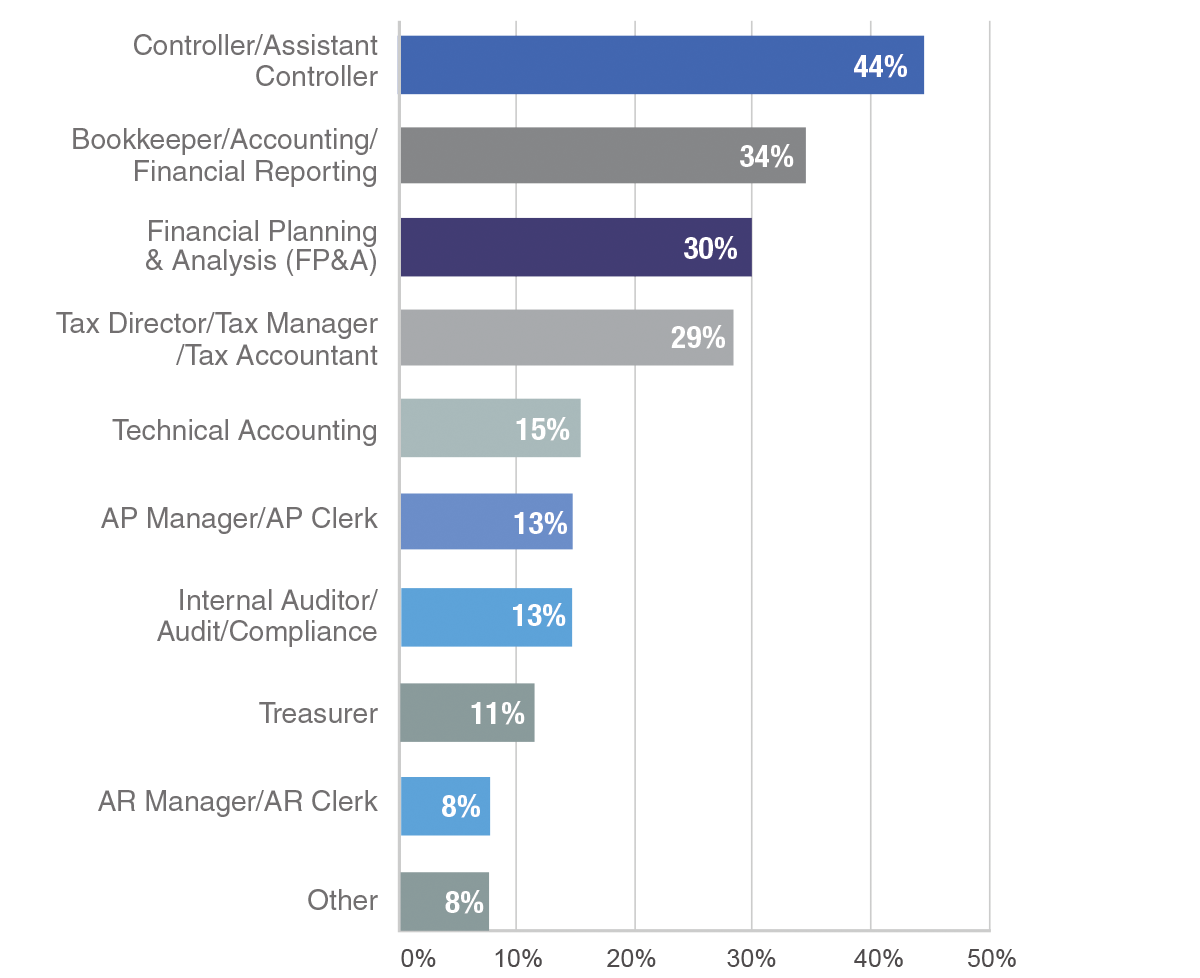
According to this year’s study, Controllers and Assistant Controllers remain the most difficult finance positions to recruit, cited by 44 percent of respondents. Bookkeepers, accountants, and financial reporting professionals ranked second at 34 percent, followed by Financial Planning and Analysis professionals at 30 percent and tax professionals at 29 percent. Technical accounting specialists, internal auditors, treasury professionals, and accounts payable and receivable roles followed at considerably lower levels. Perhaps most notable, Controllers have held the top position in this ranking for four consecutive years.
The Controller Role Has Changed More Than Any Other Finance Position
The modern Controller bears little resemblance to the position many organizations staffed fifteen or twenty years ago.
Traditionally, Controllers focused on financial reporting, compliance, internal controls, and overseeing the monthly close. While those responsibilities remain fundamental, today’s Controllers are increasingly expected to lead finance transformation initiatives, oversee ERP modernization, improve data governance, support acquisitions, participate in strategic planning, and evaluate emerging technologies such as artificial intelligence.
In many organizations, the Controller has become the operational leader of the finance function, translating financial information into business decisions while ensuring accuracy, governance, and regulatory compliance. That broader scope naturally narrows the available talent pool. Candidates must possess strong technical accounting credentials while also demonstrating leadership, communication skills, project management experience, and business acumen.
Finding professionals who excel across each of those disciplines has become considerably more difficult than recruiting for narrowly defined accounting positions.
Leadership Experience Has Become the Scarce Resource
One misconception surrounding today’s accounting labor market is that organizations simply need more accountants.
The survey findings suggest a different conclusion.
Many employers can identify candidates with accounting knowledge. Far fewer candidates possess the experience necessary to lead accounting departments, manage complex reporting environments, supervise staff, interact with executive leadership, and guide organizational change.
Leadership capability develops over years of progressively broader responsibility. It cannot be accelerated simply because market demand increases.
This helps explain why Controller positions continue to top the list of recruiting challenges year after year. Organizations are competing for professionals whose expertise has been built gradually through financial reporting, audit, internal controls, operational finance, and management experience. Supply simply has not kept pace with demand.
The Demand for Specialized Finance Skills Continues to Expand
While Controllers occupy the top position, the remainder of the rankings also tells an important story.
Financial Planning and Analysis professionals rank among the most difficult positions to fill because organizations increasingly rely on forecasting, scenario planning, profitability analysis, and executive decision support. As businesses face greater economic uncertainty, FP&A teams have become central participants in strategic planning rather than providers of periodic reports.
Tax professionals continue experiencing strong demand as regulations grow more complex across domestic and international jurisdictions. Likewise, technical accounting specialists remain difficult to recruit because evolving accounting standards, transaction complexity, and regulatory scrutiny require highly specialized expertise.
Even positions traditionally viewed as operational accounting functions increasingly require familiarity with automation platforms, ERP systems, data analytics, and integrated reporting processes.
The finance profession continues moving toward specialization rather than generalization.
Recruiting Alone Will Not Produce More Controllers
Organizations frequently respond to recruiting challenges by expanding search efforts, increasing compensation, or engaging outside recruiters.
Those approaches remain important, but they address only immediate vacancies.
The more sustainable response begins much earlier.
Organizations that consistently develop future Controllers often establish formal career pathways through accounting, financial reporting, FP&A, internal audit, and operational finance. Employees receive increasing leadership responsibilities throughout their careers rather than only after promotion into management.
Mentoring programs, rotational assignments, exposure to executive leadership, and opportunities to lead technology implementations all contribute to developing the broader capabilities expected of today’s finance leaders.
The Controller shortage therefore reflects succession planning as much as recruiting effectiveness.
Technology Raises the Value of Finance Expertise
Another noteworthy implication of the study is that automation has not reduced demand for experienced finance professionals.
Routine accounting processes continue becoming more efficient through workflow automation, ERP systems, AI-assisted reporting, and integrated financial platforms. Rather than diminishing the importance of Controllers, however, these technologies often increase their strategic value.
As systems assume responsibility for repetitive processing, Controllers spend more time evaluating financial results, strengthening governance, improving controls, supporting acquisitions, and advising executive leadership.
Technology reduces manual effort.
It does not replace professional judgment.
Organizations therefore continue seeking finance leaders capable of combining accounting expertise with technology leadership and business insight.
What This Means for Finance Leaders
The continued dominance of Controllers as the most difficult role to recruit should not be viewed as an isolated staffing issue. It reflects broader changes occurring throughout the finance profession.
Organizations increasingly require finance leaders who understand accounting, technology, analytics, governance, operations, and strategy simultaneously. Developing professionals with that breadth of experience takes years, making succession planning one of the most important long-term investments finance leaders can make.
Companies that begin building future Controllers from within their existing organizations will likely be better positioned than those competing exclusively in an increasingly constrained external labor market.
Download the complete Corporate Finance & Accounting Talent Study 2026 to explore all survey findings, benchmarking data, and analysis covering finance hiring, talent shortages, compensation, AI adoption, workforce models, recruiting, and retention strategies.