
Will AI make finance teams smaller?
It is one of the most common questions surrounding automation, particularly as technology becomes capable of performing work that has traditionally required significant accounting resources.
The findings from Controllership 2030: The Future of the Corporate Controller suggest the answer is more complicated than simple headcount reduction.
When finance leaders were asked how they expect AI to affect finance staffing by 2030, the most common response was not smaller teams.
Forty-one percent expect finance teams to remain approximately the same size, but with different skills. Another 35% expect smaller teams, while 19% actually anticipate larger teams.
The results point toward a significant workforce transition. AI may reduce the amount of human effort required for many finance activities, but organizations will still need people to analyze information, oversee technology, manage data, exercise judgment, maintain controls, and support business decisions.
The finance team of 2030 may therefore look different before it looks dramatically smaller.
Different Skills Is the Most Common Expectation
Respondents were asked how they expect AI to affect finance staffing by 2030:
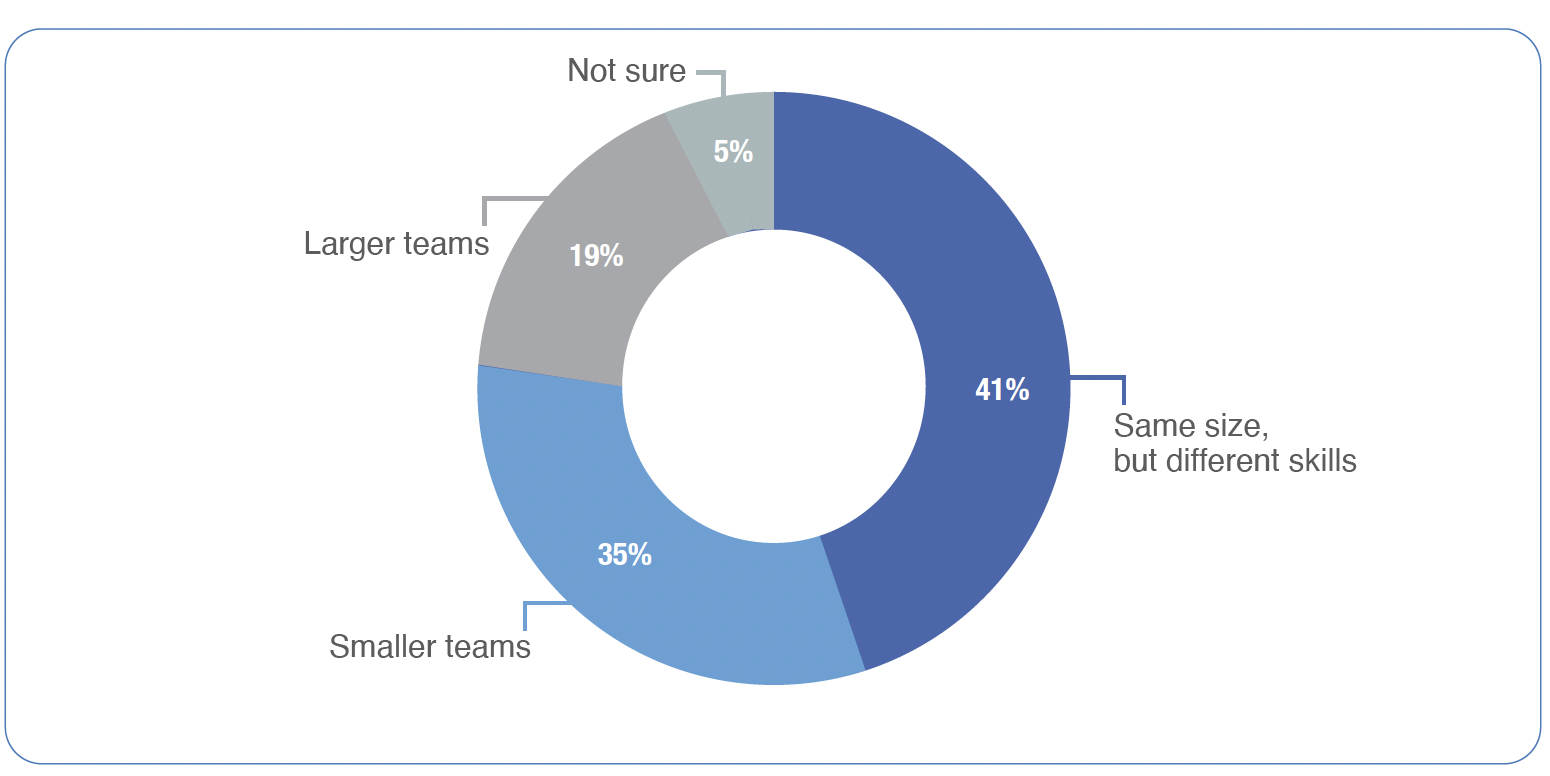
The 41% expecting similar team sizes with different capabilities is particularly important.
It suggests many finance leaders do not view AI primarily as a labor-reduction strategy. Instead, they expect technology to change the type of work employees perform.
This aligns with the broader findings throughout the study.
Controllers expect more automation of reconciliations, journal entries, the close, accounts payable, reporting, and other recurring activities. At the same time, they expect greater emphasis on financial planning, strategy, AI oversight, data governance, and enterprise decision support.
If those shifts occur together, finance organizations will need a different mix of capabilities even when the number of employees remains relatively stable.
Automation Changes the Work That Requires People
The effect of AI on staffing depends heavily on which work is being automated.
Consider a finance team that currently dedicates substantial employee capacity to preparing reconciliations, entering journal entries, updating reports, processing invoices, and investigating routine variances.
Automation may reduce the hours required for those activities.
But that does not mean every hour saved translates directly into a headcount reduction.
Finance organizations also have work they struggle to complete today because employees lack capacity.
Forecasting could become more frequent.
Analysis could become deeper.
Finance could spend more time supporting operating leaders.
Data governance could improve.
Controls over automated processes could require additional attention.
Technology could create new responsibilities around validation, exceptions, configuration, and oversight.
The staffing impact therefore depends partly on what an organization chooses to do with the capacity automation creates.
For some companies, the objective will be to operate with fewer people. For others, it will be to increase the value produced by roughly the same number of people.
Smaller Finance Teams Are Still a Significant Possibility
Although skill transformation ranks first, the 35% expecting smaller finance teams should not be understated.
More than one-third of respondents anticipate AI contributing to headcount reduction by 2030.
That expectation is understandable given the processes finance leaders believe will become highly automated.
Sixty-seven percent expect account reconciliations to become highly automated. Sixty-five percent say the same about manual journal entries, 58% about the month-end close, and 53% about accounts payable processing.
These are labor-intensive activities.
If organizations can automate significant portions of them, fewer employees may be required to support the same transaction volume.
The impact could become particularly visible as organizations grow.
A company that previously needed to add accounting staff every time transaction volume, entity count, or reporting complexity increased may be able to scale without adding employees at the same rate.
In that environment, a finance team can become smaller relative to the business even without significant layoffs.
Attrition, retirement, restructuring, and slower hiring can gradually change the staffing model.
Some Finance Teams Could Actually Grow
Nearly one in five respondents, 19%, expect larger finance teams by 2030.
That result may initially seem counterintuitive.
If AI automates finance work, why would some organizations need more people?
One explanation is that automation and business complexity can increase simultaneously.
Organizations may grow, acquire businesses, expand internationally, face additional regulatory requirements, generate more data, or require more sophisticated planning and analysis.
AI can improve productivity without completely offsetting those demands.
New responsibilities may also emerge.
The study finds that 47% expect new roles for AI, data, and technology oversight. AI governance, data governance, and cybersecurity oversight are also expected to become increasingly important controller responsibilities.
Those activities require people.
Finance organizations may therefore reduce staffing in some transactional areas while adding resources in analytics, systems, governance, data, controls, or business partnership.
The total team can grow even as individual processes become more automated.
The Mix of Finance Roles Could Change Significantly
The staffing question becomes more useful when viewed as a question about workforce composition.
A traditional finance organization may include a relatively large number of employees responsible for transaction processing, account maintenance, reconciliations, reporting preparation, and other recurring work.
A more automated organization may require fewer people performing those activities.
At the same time, demand could increase for professionals capable of working across accounting and technology.
That may include finance professionals who can interpret data, manage automated workflows, oversee AI-enabled processes, evaluate exceptions, administer finance systems, design controls, and communicate financial insights to business leaders.
The shift is important because these are not necessarily interchangeable skill sets.
An organization cannot assume that reducing demand for one type of work automatically creates employees prepared to perform another.
That transition requires deliberate workforce planning.
Reskilling Will Be as Important as Automation
If 41% of finance leaders are correct and the most common outcome is similar-sized teams with different skills, training becomes central to the AI strategy.
Organizations need to determine whether existing employees can develop the capabilities the future finance function requires.
That may involve practical AI proficiency, data analysis, finance technology, process design, systems thinking, and stronger business-partnering skills.
Traditional accounting expertise remains essential.
The future finance professional still needs to understand financial statements, accounting principles, controls, materiality, and the economic substance of transactions.
But that knowledge may increasingly be applied in a different environment.
Instead of manually performing every step, accountants may need to evaluate work produced by automated systems.
Instead of building every report, they may need to determine whether automatically generated analysis is reliable.
Instead of processing every exception, they may focus on the exceptions technology cannot resolve.
The professional judgment remains. The workflow surrounding it changes.
AI Could Increase the Value of Judgment
There is a paradox at the center of finance automation.
As technology becomes capable of performing more work, the remaining human work may become more dependent on judgment.
Routine transactions are often the easiest to automate.
Exceptions are harder.
Standard entries can follow established rules.
Unusual transactions require interpretation.
Recurring reports can be generated automatically.
Determining what the results mean for the business requires context.
This means finance professionals may spend a greater percentage of their time on situations where there is no obvious answer.
For controllers, that changes the talent profile they need to develop.
Technical accounting competence remains important, but so do analytical ability, curiosity, communication, business understanding, and the ability to challenge technology-generated outputs.
A finance team with fewer manual tasks does not necessarily become easier to manage. The work that remains may require stronger professionals.
Entry-Level Finance Roles May Need to Be Reconsidered
Automation also raises a longer-term talent issue.
Many of the activities most likely to become automated have traditionally provided early-career accountants with practical experience.
Preparing reconciliations teaches how accounts behave.
Posting and reviewing journal entries develops an understanding of the general ledger.
Supporting the close helps employees understand how transactions ultimately affect financial statements.
Investigating variances builds analytical judgment.
If technology performs more of this work, the traditional learning path may narrow.
Finance leaders will need to ensure that employees still develop foundational accounting knowledge even when they are not manually performing every underlying task.
That could require more structured training, rotational assignments, review responsibilities, simulations, or earlier exposure to exceptions and analytical work.
The issue extends beyond entry-level employees.
Today’s junior accountants are part of the future pipeline for managers, controllers, and CFOs.
Automation strategies that focus exclusively on eliminating lower-level work could create unintended succession challenges later.
Finance Workforce Planning Needs to Start Before Roles Disappear
Waiting until automation has already changed staffing requirements can make workforce transformation more difficult.
Controllers and CFOs can begin by mapping the work their teams perform today.
- Which activities consume the most employee time?
- Which are likely to become automated?
- Which skills will become less important?
- Which capabilities will become more valuable?
- Can current employees make that transition?
- Where will external hiring be necessary?
- Which roles may no longer need to be replaced when employees leave?
- Where should the organization invest in training now?
These questions connect technology planning directly to workforce planning.
They also help organizations avoid two opposite risks: retaining a finance structure designed around work that no longer exists, or reducing staff so aggressively that the function lacks the skills required for its new responsibilities.
Productivity and Headcount Are Not the Same Thing
One of the most important distinctions for finance leaders is between increasing productivity and reducing headcount.
AI can increase the amount of work each finance professional can support without necessarily reducing the total number of employees.
That productivity can be used in several ways.
An organization can reduce costs.
It can absorb business growth without adding staff.
It can redirect employees toward higher-value work.
It can improve service levels.
It can perform analysis that previously went undone.
It can strengthen controls and governance.
It can also combine several of these outcomes.
For many organizations, the most valuable result may be avoiding future hiring rather than reducing today’s team.
That is why the 41% expecting similar-sized teams with different skills may prove especially important.
AI’s largest workforce effect could be changing the relationship between finance headcount and the amount, complexity, and value of work the function can support.
What This Means for Controllers and CFOs
Finance leaders should be cautious about framing AI strategy primarily around how many positions technology could eliminate.
A more useful question is what finance needs people to do once technology performs more of the recurring work.
Controllers and CFOs should consider:
- Which roles are most exposed to automation?
- Which capabilities will become more important as those tasks decline?
- Can existing employees be reskilled for the future finance model?
- Where will new AI, data, technology, and governance roles be needed?
- How can junior employees develop accounting judgment if foundational work becomes automated?
- Should productivity gains reduce headcount, support growth, expand finance capabilities, or some combination?
- What should the finance workforce look like three to five years from now?
These are strategic workforce decisions, not simply technology decisions.
Finance’s Talent Mix May Change Before Its Size Does
The Controllership 2030 findings do not support a single prediction for finance staffing.
Some organizations will become smaller.
Some will grow.
But the largest group expects something more fundamental: a finance team of approximately the same size doing different work.
That may be the most useful way to think about AI’s workforce impact.
Technology can reduce the need for manual execution while increasing the importance of analysis, judgment, data, systems, governance, and business partnership.
For finance leaders, the challenge is to make sure the workforce evolves at the same pace as the technology.
By 2030, the defining difference between finance teams may not be how many people they employ.
It may be what those people are capable of doing.
Explore the Full Controllership 2030 Study
Controllership 2030: The Future of the Corporate Controller examines how AI and automation could reshape finance staffing, organizational structures, controller responsibilities, governance, skills, and the relationship between Controllers and CFOs through 2030.
Download the full Controllership 2030: The Future of the Corporate Controller study
About the Study Sponsor

Built on insightsoftware’s decades of finance software expertise, Lineos brings finance into focus. It gives teams a single line of sight across the full financial workflow, from budgeting, planning, and reporting through close, consolidation, reconciliation, tax, disclosure, and lease. At every stage, Lineos pulls diverse data from across the business into one place, with powerful AI surfacing the insights that drive action. By freeing finance from spreadsheet forensics and chasing numbers, Lineos enables them to move from reporting the past to shaping what’s next, equipped with the tools they need to drive better decisions and unlock breakthrough insight.