The impact of AI and automation on finance will extend beyond individual tasks.
As reconciliations, journal entries, reporting, transaction processing, and other recurring activities become increasingly automated, finance leaders will also need to reconsider how their organizations are structured.
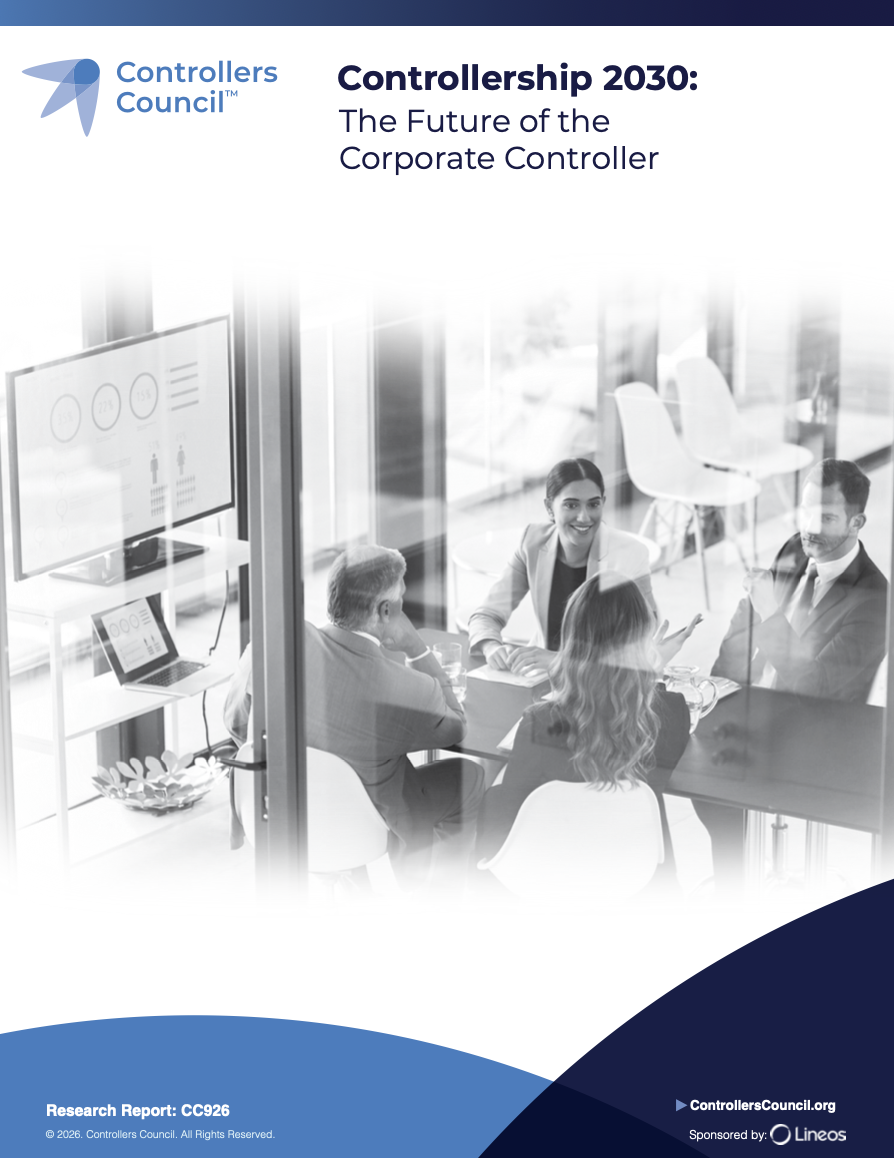
The Controllership 2030: The Future of the Corporate Controller study suggests that many expect substantial organizational change.
Fifty-five percent of respondents expect greater centralization or use of shared services by 2030. Forty-seven percent anticipate new roles dedicated to AI, data, and technology oversight, while 42% expect flatter finance organizations with fewer management layers.
Only 12% expect little or no structural change.
The findings suggest that the future finance organization may not simply perform today’s work more efficiently. It may be organized differently because the work itself has changed.
Centralization and Shared Services Lead Expected Changes
When respondents were asked how they expect their finance organization’s structure to change by 2030, they selected:

The most common expectation, greater centralization and shared services, is closely connected to automation.
Historically, decentralized finance teams have often been necessary because financial work occurred close to individual business units, locations, subsidiaries, or operating companies.
Technology can weaken that requirement.
When processes are standardized, systems are connected, workflows are automated, and information is accessible centrally, organizations may be able to consolidate more finance activity without sacrificing visibility into the business.
That can create economies of scale while also making processes easier to govern.
Automation Makes Centralization More Practical
Centralization is not a new finance strategy. Shared-service models have existed for decades.
What changes with automation is the range of work that can potentially be centralized and the efficiency with which a centralized organization can operate.
Consider account reconciliations.
If every business unit performs reconciliations differently, using different systems, spreadsheets, schedules, and approval processes, consolidating that work can be difficult.
If reconciliation is standardized and substantially automated, the location of the employee performing each manual step becomes less important.
The same principle can apply to accounts payable, accounts receivable, journal entries, reporting, and other recurring processes.
Standardization enables automation, and automation can make centralization more effective.
This creates a potentially reinforcing cycle: organizations standardize processes to automate them, then discover that standardized automated processes can be managed across a broader portion of the enterprise.
For controllers, the result could be a shift away from finance teams organized primarily around entities or locations and toward teams organized around processes, expertise, and decision support.
New Technology Roles Could Become Part of Finance
Nearly half of respondents, 47%, expect new roles for AI, data, and technology oversight by 2030.
This may be one of the most consequential findings about the future finance organization.
As technology becomes more deeply embedded in financial processes, someone needs to understand and govern the intersection between accounting and technology.
Traditional IT teams may understand infrastructure, systems, cybersecurity, and technical architecture. Finance teams understand accounting requirements, financial controls, materiality, reporting, and business context.
Automated finance increasingly requires both.
That creates room for roles that sit between the two disciplines.
Their responsibilities could include overseeing finance automation, maintaining data quality, managing AI-enabled workflows, monitoring automated controls, supporting finance systems, validating technology outputs, or coordinating between accounting and IT.
The exact job titles will vary.
The organizational need is more important than the title.
Finance departments may increasingly require professionals who can translate accounting requirements into technology processes and understand the financial implications of how those processes operate.
The Finance Team Could Become Flatter
Another 42% of respondents expect finance organizations to have fewer management layers by 2030.
Automation provides one possible explanation.
Traditional organizational hierarchies often reflect the need to coordinate and review large amounts of human activity.
An employee prepares work. A supervisor reviews it. A manager oversees the process. A senior finance leader reviews the consolidated result.
When technology performs more of the underlying processing and automatically routes exceptions to the appropriate person, some coordination and supervisory activities may decline.
That does not mean review disappears.
It may become more targeted.
Instead of managing teams primarily around the volume of transactions they process, managers may oversee automated workflows, exceptions, controls, analytical outputs, and higher-risk decisions.
A flatter structure could therefore place greater responsibility on individual finance professionals.
Employees may need stronger judgment and broader capabilities because fewer organizational layers sit between their work and senior leadership.
Managers may also need to become less focused on supervising tasks and more focused on process ownership, decision-making, coaching, and business partnership.
Outsourcing and Offshoring Remain Part of the Future Model
Nearly one-third of respondents, 31%, expect greater outsourcing or offshoring by 2030.
At first glance, that might appear to compete with automation. If technology can perform more finance work, why outsource it?
In practice, the two strategies can coexist.
Organizations may automate portions of a process while outsourcing the activities that still require human execution. Service providers themselves may use automation to deliver finance work more efficiently.
The result could be a more flexible operating model in which companies combine internal finance professionals, centralized shared services, external providers, and automated systems.
That introduces another responsibility for controllers: maintaining consistent standards across a finance environment in which work may be performed by multiple types of resources.
Whether a process is completed by an internal employee, a shared-service center, an outsourced provider, or an automated system, the organization remains responsible for the quality and reliability of the financial result.
Finance Organizations May Become More Process-Oriented
The survey findings point toward a broader organizational change.
Many finance departments have historically been structured around hierarchy, geography, business units, or legal entities.
Automation may encourage more organizations to structure portions of finance around end-to-end processes.
Instead of separate teams performing overlapping activities in different parts of the business, an organization might establish clearer enterprise ownership for areas such as order-to-cash, procure-to-pay, record-to-report, financial planning, or finance data.
This can make it easier to standardize processes and establish accountability.
It can also clarify who owns automation.
When responsibility for a process is fragmented across multiple departments, entities, and systems, automation initiatives can become difficult to govern.
Clear process ownership allows someone to evaluate the entire workflow rather than optimizing individual steps in isolation.
For controllers, this may mean thinking beyond the traditional accounting department and taking a broader view of how financial information moves through the enterprise.
New Structures Will Require New Decision Rights
Changing the organizational chart is relatively easy.
Determining who is responsible for what can be considerably harder.
A more centralized, automated finance function creates questions that organizations will need to answer explicitly.
- Who owns an automated accounting process?
- Who approves changes to the underlying rules?
- Who owns the financial data used by AI?
- Which responsibilities belong to finance and which belong to IT?
- Who reviews exceptions?
- Who determines when human intervention is required?
- Who is accountable when an automated process produces an incorrect result?
These are questions of decision rights.
They become particularly important when finance work crosses traditional organizational boundaries.
An AI-enabled financial process may involve the controller, IT, data teams, cybersecurity, internal audit, external vendors, and business-unit finance professionals.
Without clearly defined ownership, automation can create ambiguity rather than efficiency.
Organizational Design Should Be Part of the Technology Roadmap
Finance transformation programs often begin with systems.
An organization selects a new ERP, introduces automation, implements a planning platform, or adopts AI tools. Organizational changes may follow later.
The Controllership 2030 findings suggest that finance leaders should consider the two together.
- If automation materially reduces transaction-processing work, what happens to the teams performing that work today?
- If financial processes become more centralized, which responsibilities should remain within business units?
- If new AI and data governance requirements emerge, where should those responsibilities reside?
- If the organization becomes flatter, what happens to management roles and career progression?
- If more work moves to shared services or external providers, what capabilities need to remain internally?
Technology decisions can create organizational consequences whether leaders plan for them or not.
Addressing those consequences early allows finance to design the future operating model rather than simply react to it.
The Controller’s Own Organizational Role May Expand
These structural changes also have implications for the controller.
The controller of 2030 may be responsible for a finance environment that looks very different from the traditional accounting organization.
Some work may be centralized.
Some may be outsourced.
Some may be performed by automated systems or AI agents.
New specialists may oversee data, technology, and AI.
Fewer managers may supervise routine processing.
At the same time, the controller remains accountable for reliable financial information and effective financial processes.
That can make orchestration increasingly important.
The controller may need to coordinate people, technology, data, external providers, controls, and process owners across a more complex operating model.
Leadership in this environment depends less on managing the largest possible accounting team and more on ensuring that the entire finance system works effectively.
Organizational Change Could Also Affect Finance Careers
Flatter organizations and greater automation raise another important issue: career development.
Traditional finance career paths often progress through increasing levels of supervision. An accountant becomes a senior accountant, then a manager, director, assistant controller, and controller.
If finance organizations require fewer management layers, that progression may change.
At the same time, new AI, data, analytics, systems, and process roles could create alternative career paths.
Finance professionals may advance through deeper specialization, process ownership, analytical leadership, technology expertise, or business partnership rather than traditional people-management hierarchies alone.
For CFOs and controllers, this creates a talent-management challenge.
Organizations need to ensure that the future finance structure still provides employees with opportunities to develop, assume greater responsibility, and build the experience necessary for leadership roles.
The finance organization can become flatter without becoming a dead end for career growth.
What This Means for Controllers and CFOs
Finance leaders planning for 2030 should consider organizational design alongside their automation and technology strategies.
Useful questions include:
- Which finance activities should remain decentralized and close to the business?
- Which could move into centralized or shared-service models?
- Where will automation reduce the need for manual supervision?
- Does finance need dedicated AI, data, automation, or technology roles?
- Which processes need clearer enterprise ownership?
- How should responsibilities be divided between finance and IT?
- Where could external providers become part of the operating model?
- How will finance career paths change if the organization becomes flatter?
- Who will remain accountable for work performed by automated systems?
The answers should reflect each organization’s complexity, systems, business model, regulatory environment, and strategy.
But waiting until technology has already changed the work may make organizational redesign considerably harder.
The Future Finance Organization Will Be Designed Around Different Work
Only 12% of respondents expect little or no structural change to their finance organizations by 2030.
Most anticipate something more significant.
Greater centralization. New AI, data, and technology roles. Flatter organizations. More outsourcing and offshoring. Different ways of allocating responsibility across people and systems.
These changes are closely connected to the automation of finance work.
As technology assumes more recurring processing, the organizational structures built to manage that processing will also need to evolve.
For controllers and CFOs, the opportunity is to use automation to rethink the finance operating model rather than simply make the existing one faster.
The finance organization of 2030 may be defined as much by how its work is structured as by how much of that work is automated.
Explore the Full Controllership 2030 Study
Controllership 2030: The Future of the Corporate Controller examines how the finance organization could evolve through 2030, including automation, organizational structure, staffing, AI and data governance, future controller skills, and the changing relationship between Controllers and CFOs.
Download the full Controllership 2030: The Future of the Corporate Controller study
About the Study Sponsor

Built on insightsoftware’s decades of finance software expertise, Lineos brings finance into focus. It gives teams a single line of sight across the full financial workflow, from budgeting, planning, and reporting through close, consolidation, reconciliation, tax, disclosure, and lease. At every stage, Lineos pulls diverse data from across the business into one place, with powerful AI surfacing the insights that drive action. By freeing finance from spreadsheet forensics and chasing numbers, Lineos enables them to move from reporting the past to shaping what’s next, equipped with the tools they need to drive better decisions and unlock breakthrough insight.