

The Controllers Council recently convened finance leaders to preview findings from the 2026 CFO and Controller Outlook and Sentiment Study. Moderated by Lindy Antonelli, Partner at Armanino and Board Chair of the Controllers Council, the webcast brought together perspectives from Joy Mbanugo, CFO at CXAI (NASDAQ: CXAI), alongside Executive Director Neil Brown. The discussion centered on how CFOs and controllers are approaching performance, spending, talent, and technology amid economic uncertainty and geopolitical strain.
At the outset, Brown framed the purpose of the research clearly, noting that the study “seeks to understand how current business and economic environments are shaping corporate finance planning, strategy, priorities, and outlooks, and what controllers and CFOs are doing differently to manage in 2026 and beyond.”
Confidence in Financial Performance Continues to Build
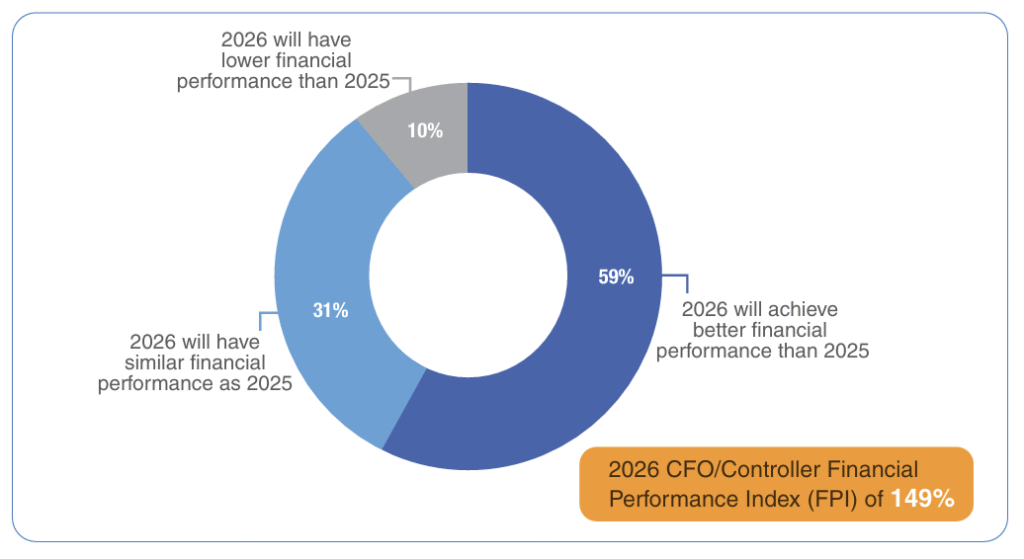
One of the most closely watched indicators in the study is the Financial Performance Index, which reached a record high this year. Survey results showed that 59% of respondents expect better financial performance in 2026 compared with 2025, while only 10 percent anticipate a decline. That spread resulted in a Financial Performance Index of 149%, surpassing prior years.
Antonelli reacted to the trend by emphasizing its consistency. “Look at the increase that we’ve had, the steady increase over four years,” she said. “So super excited about that.”
Mbanugo attributed the optimism to a combination of preparedness and improved decision-making. “We have had kind of a preview of what’s going on from a macroeconomic level,” she said. “We are prepared for almost anything.” She also pointed to advances in financial modeling, noting that “reports and models that used to take weeks, now take minutes,” allowing teams to respond more quickly to risk and opportunity.
Revenue Growth and Cost Control Share the Spotlight
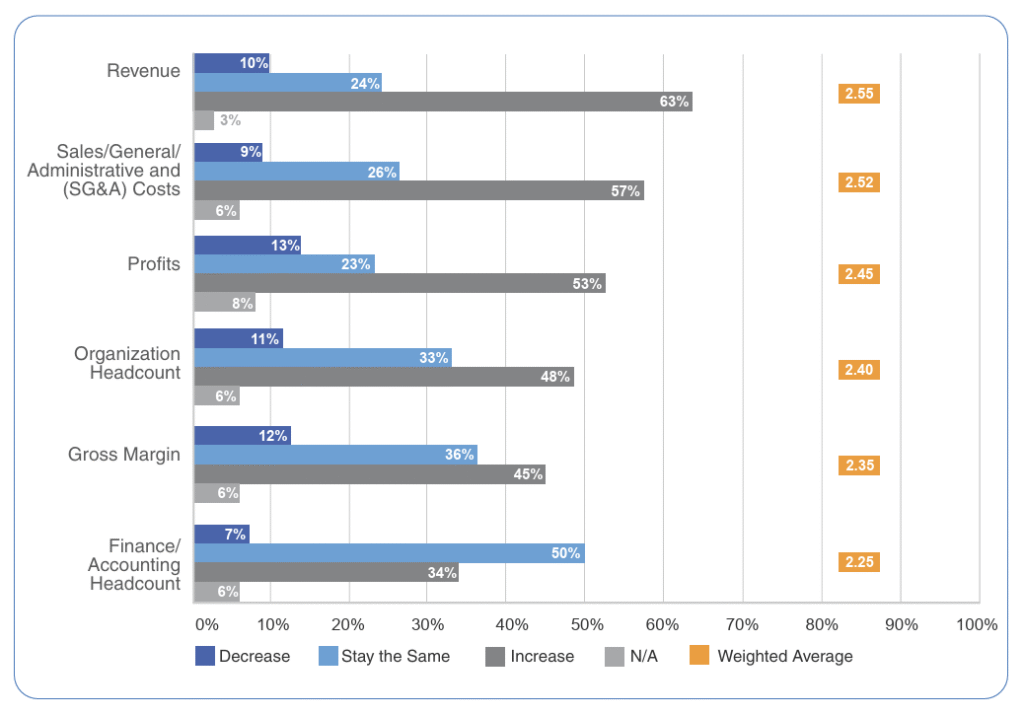
When the conversation turned to financial metrics, revenue once again ranked as the top priority, followed closely by SG&A and profitability. Brown explained that revenue has consistently led the rankings year over year, while cost categories have gained prominence more recently.
Mbanugo was unsurprised by the emphasis on SG&A. “I get pummeled on earnings calls,” she said. “So, seeing those two as the two metrics that are important for 2026, they’re important for me in 2025, so no change there.” She added that while headcount in finance and accounting may remain flat, companies are investing more deliberately in training and skill development. “What we will do from the finance and accounting standpoint is we will be looking more at upskilling and training for finance and accounting and adjacent teams rather than hiring new people.”
Spending Expectations Pull Back After a Strong Year

Despite confidence in performance, the Spending Budget Index declined to 88%, reflecting more cautious expectations for 2026. Nearly four in ten respondents expect spending to decrease, while only 27% anticipate increases.
Mbanugo described the approach as disciplined rather than pessimistic. “You can’t cut your way to growth,” she said. At the same time, she acknowledged increased scrutiny in certain areas. “There are areas that I know I need to cut. It may not be a cut overall, but there will be cuts in certain areas.”
Brown noted that last year’s elevated spending expectations were likely an outlier. “The 2025 SBI of 110% was an anomaly,” he said. “The 2026 SBI of 88% is 22 percentage points lower than last year, but more consistent with 2023 and prior years.”
Hybrid Work Remains the Dominant Model

Work environment planning continues to evolve, but hybrid arrangements remain the prevailing choice. Nearly 60% of survey respondents plan to operate in a hybrid model in 2026, with smaller shares opting for fully onsite or fully remote approaches.
Mbanugo tied these results directly to labor market realities. “Because there are a shortage of talent and an acute need, you have to be flexible,” she said. She described a future in which finance teams operate across locations and time zones, adding, “I wouldn’t be surprised if hybrid remains steady between 60 and 70 percent even going into 2027.”
Antonelli echoed the importance of adaptability, observing that company size and industry often shape work model decisions. Brown added that sector differences remain pronounced, noting that manufacturing and construction require onsite presence, while professional services and technology maintain greater latitude.
Hiring Priorities Shift Toward Technical Roles

Overall hiring expectations remain positive, with increases anticipated across most functions. Research and development, sales, and technology roles lead the list, while finance, accounting, and administrative hiring is more likely to hold steady.
Mbanugo described the reality for many SaaS organizations. “For us, we probably will be investing in R&D,” she said. “Everything else is a lower priority.” She also highlighted the impact of automation, explaining that AI is reshaping entry-level and administrative roles across departments.
Brown reinforced that broader demographic trends continue to influence hiring. “Long-term demographics, we’re going to have worker shortages,” he said, adding that the full effect of AI on employment remains uncertain.
AI and Cybersecurity Drive Technology Investment
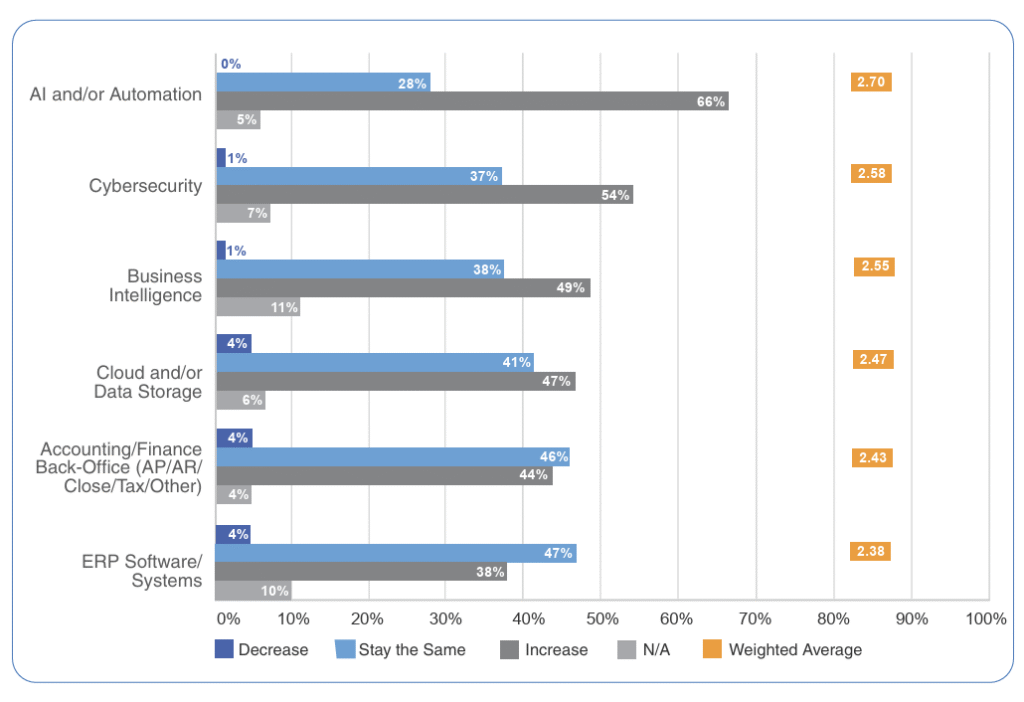
Technology planning results showed overwhelming momentum behind AI and automation, which ranked highest among planned initiatives with 66% planning increases. Cybersecurity followed closely, reflecting growing concern around data protection and system resilience.
For Mbanugo, the emphasis is unavoidable. “We have to spend on AI whether we want to or not,” she said. “We’re constantly iterating on the product.” She also stressed the parallel importance of security. “Leakage of client information or sensitive information can be catastrophic.”
Brown described the broader shift underway in finance organizations. “We’re seeing a rise of the digital CFO and the digital controller,” he said, as AI becomes embedded across financial systems and workflows.
Talent Emerges as the Top Concern
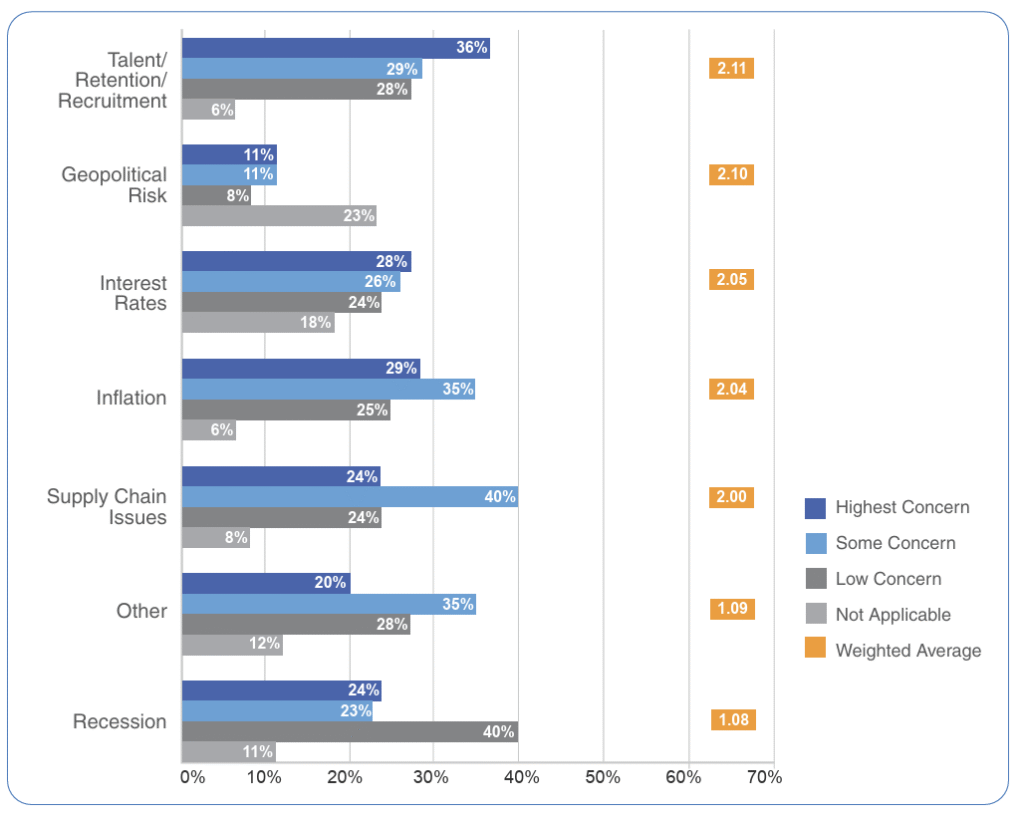
When asked what keeps finance leaders up at night, talent surfaced as the leading concern, surpassing inflation, interest rates, and recession risk. Mbanugo linked the issue to long-term structural challenges. “The number of CPA exam candidates has hit like a 15 to 17 year low,” she said, adding that competition for qualified professionals remains intense.
She also emphasized the need to broaden hiring strategies. “There’s great talent all over the country,” she said. “All of the talent doesn’t just sit in the Bay Area.”
Antonelli agreed, noting that talent discussions are now a daily focus at many firms. Brown added that geopolitical uncertainty continues to weigh heavily on leaders, even as economic indicators remain relatively stable in the United States.
Watch the Full Discussion or Download the Study
The 2026 CFO and Controller Outlook and Sentiment Study highlights a profession balancing confidence with restraint, and ambition with realism. As organizations prepare for another complex year, the perspectives shared during the webcast offer timely guidance for finance leaders navigating change.
Watch the full webinar: https://controllerscouncil.org/events/2026-cfo-controller-outlook-sentiment-study-webcast-panel/
Download the full report: https://controllerscouncil.org/research-studies/2026-cfo-controller-outlook-sentiment-study/